February 26

What was advertised in a colonial American newspaper 250 years ago today?
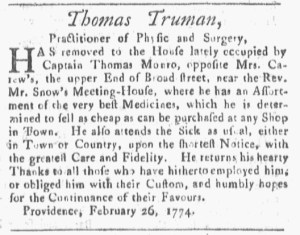
Providence Gazette (February 26, 1774).

“He also attends the Sick as usual, either in Town or Country, upon the shortest Notice, with the greatest Care and Fidelity.”

More than a year after he first positioned himself as the successor to “Doctor SAMUEL CAREW, late of Providence, deceased,” Thomas Truman, “Practitioner of Physic and Surgery,” continued to practice in that town.  As February 1774 came to an end, he once again took to the pages of the Providence Gazette, this time to announce that he “removed” to a new location.  In directing prospective patients to “the House lately occupied by Captain Thomas Munro, opposite Mrs. Carew’s, the upper End of Broad-street, near the Rev. Mr. Snow’s Meeting-House,” he reminded readers of his former affiliation with the deceased doctor.  Mentioning the widow may have jogged the memories of some who had known Truman “during his Apprenticeship with Doctor CAREW.”  When he first sought to establish himself in Providence, Truman faced competition from others who advertised their services as physicians, including Ebenezer Richmond and Daniel Hewes.

Truman’s advertisements may have helped him secure his place.  He expressed “his hearty Thanks to all those who have hitherto employed him … and humbly hopes for the Continuance of their Favours.”  He apparently considered advertising effective enough to justify subsequent investments.  Upon moving to his new location, he advised that he stocked “an Assortment of the very best Medicines, which he is determined to sell as cheap as can be purchased at any Shop in Town.”  Truman realized that for one segment of his business he competed not only with other practitioners but also with apothecaries who compounded medicines and even merchants and shopkeepers who imported patent medicines.  In addition, he “attends the Sick as usual, either in Town or Country, upon the shortest Notice, with the greatest Care and Fidelity.”  Truman wanted readers to remember him when they fell ill.  No matter where they happened to reside, he pledged to provide exemplary care as quickly as possible.  An occasion advertisement in the Providence Gazette enhanced his visibility among prospective patients beyond the reputation he earned through word of mouth.

April 10

What was advertised in a colonial American newspaper 250 years ago today?

Providence Gazette (April 10, 1773).

“An Assortment of choice Medicines.”

Nearly four months had passed since Thomas Truman first placed a notice in the Providence Gazette to request that “all Persons who have Accounts unsettled with Doctor SAMUEL CAREW, late of Providence, deceased,” visit Truman at the “House and Shop lately occupied by Doctor CAREW” to make or receive payment.  He also informed the public that he “proposes to tarry in Providence, and continue the Practice of Physic and Surgery,” reminding “all those Gentlemen and Ladies who have kindly favoured him in the Way of his Business” that he served an apprenticeship under Carew’s supervision.  Truman positioned himself as Carew’s successor, hoping to inherit the physician’s patients.

On April 10, Truman inserted a new notice in which he “once more” directed “those who have hitherto neglected to bring in their Accounts against the Estate of Doctor SAMUEL CAREW” to so do “directly, that they may be settled.”  Similarly, he asked that those “indebted to said Estate … make Payment immediately … that the Books may be closed, and the Debts paid off with Honour.”  In a nota bene, Truman stated that he no longer occupied Carew’s former house and shop.  He had “removed … two Doors further down Street,” where he sold “an Assortment of choice Medicines.”  He offered the lowest prices for the quality of the medicines he peddled.

The timing of Truman’s new advertisement may have been a coincidence, but it happened to appear a week after Ebenezer Richmond placed his own notice that he “proposes to attend to the Practice of Physic and Surgery in this Town” and boasted of his extraordinary record of success caring for patients over several years.  Truman no doubt wished to close the books on Carew’s estate, but he may have also noticed the presence of a rival in the public prints.  Given that advertisements usually ran for three weeks or more, Truman may not have wanted Richmond to enjoy the benefits of being the sole physician to advertise in the city’s only newspaper.  That competition may have played as much of a role in convincing Truman to place a new notice as his desire to bring a conclusion to Carew’s estate.

December 19

What was advertised in a colonial American newspaper 250 years ago today?

Providence Gazette (December 19, 1772).

“He proposes to tarry in Providence, and continue the Practice of Physic and Surgery.”

Thomas Truman was an obvious choice for assisting the executors of the estate of Samuel Carew in December 1772. Truman placed an advertisement in the Providence Gazette “to give Notice to all Persons who have Accounts unsettled with Doctor SAMUEL CAREW … that his Books are put into my Hands, by the Executors.”  Truman had previously served an apprenticeship with Carew, making him familiar with the doctor’s business and, likely, some of the patients and others who had outstanding accounts.  The former apprentice stated that anyone wishing to settle accounts could find him “at the House and Shop lately occupied by Doctor CAREW.”

Truman used this notice in the Providence Gazette for more than assisting the executors in finalizing Carew’s estate.  He also informed readers that he planned to remain in town and “continue the Practice of Physic and Surgery” at the same location where Carew previously saw patients.  That made it all the more important that Truman remind the community of “his Apprenticeship with Doctor CAREW” and that many “Gentlemen and Ladies” were already familiar with him because they “kindly favoured him in the Way of his Business” during that apprenticeship.

Truman adroitly positioned himself as Carew’s successor, hoping to acquire and expand that clientele.  He had learned “the Practice of Physic and Surgery” from Carew, knew many of his patients, and now provided services at the same location, “the well known Shop, lately improved by Dr. CAREW.”  In this endeavor, patients could expect him to “giv[e] the closest Attention” and that “his Bills will be reasonable.”  All of this meant that Carew’s patients did not need to experience any sort of disruption in the services he formerly provided if they opted to treat Truman as the doctor’s successor.  Simultaneously, the advertisement also advised readers who had not been Carew’s patients that a new doctor provided care and sold “an Assortment of genuine Medicines” in Providence.