
What was advertised in a revolutionary American newspaper 250 years ago today?
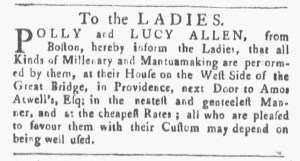
“POLLY and LUCY ALLEN, from Boston.”
On June 3, 1775, Polly Allen and Lucy Allen published an advertisement addressed “To the LADIES” in the Providence Gazette. That notice served as an introduction upon their arrival in the city, informing prospective customers and the community that “all Kinds of Millenary and Mantuamaking are performed by them, at their House on the West Side of the Great Bridge.” Since the Allens were new to town, they gave further directions that stated their location relative to a resident familiar to readers, stating that they could be found “next door to Amos Atwell’s, Esq.” New on the scene, they could not rely on their reputation among an established clientele to generate business. Instead, they assured prospective customers that they made hats and garments “in the neatest and genteelest Manner, and at the cheapest Rates.” In addition to skillful work on fashionable clothing at the lowest prices, the Allens also pledged exemplary customer service, stating that “all who are pleased to favour them with their Custom may depend on being well used.”
As part of their introduction, the Allens described themselves as “from Boston.” That made them refugees, of sorts, who had been displaced during the first weeks of the Revolutionary War. Following the battles at Lexington and Concord on April 19, militias from throughout Massachusetts, joined by companies from other colonies, besieged Boston. The Massachusetts Provincial Congress, meeting in Watertown, negotiated with General Thomas Gage, the governor, to allow Loyalists who wished to enter the city to do so. In return, Patriots and other “Inhabitants of the Town of Boston” could leave. In each case, they could take their effects with them, “excepting their Fire-Arms and Ammunition.” The Allens apparently took advantage of safe passage out of the city, along with between 12.000 and 13,000 other residents. When they introduced themselves in the Providence Gazette as “POLLY and LUCY ALLEN, from Boston,” they did not need to say more for readers to piece together why they chose to relocate at that moment. The Allens may have hoped that their situation would evoke some sympathy among prospective customers or even some curiosity among those who wanted to hear for themselves what conditions had been like since the Boston Port Act closed the harbor a year earlier and, especially, during the siege in recent weeks. Some clients may have headed to the Allens’ shop in hope of stories as well as new hats and dresses.
