What was advertised in a colonial American newspaper 250 years ago today?
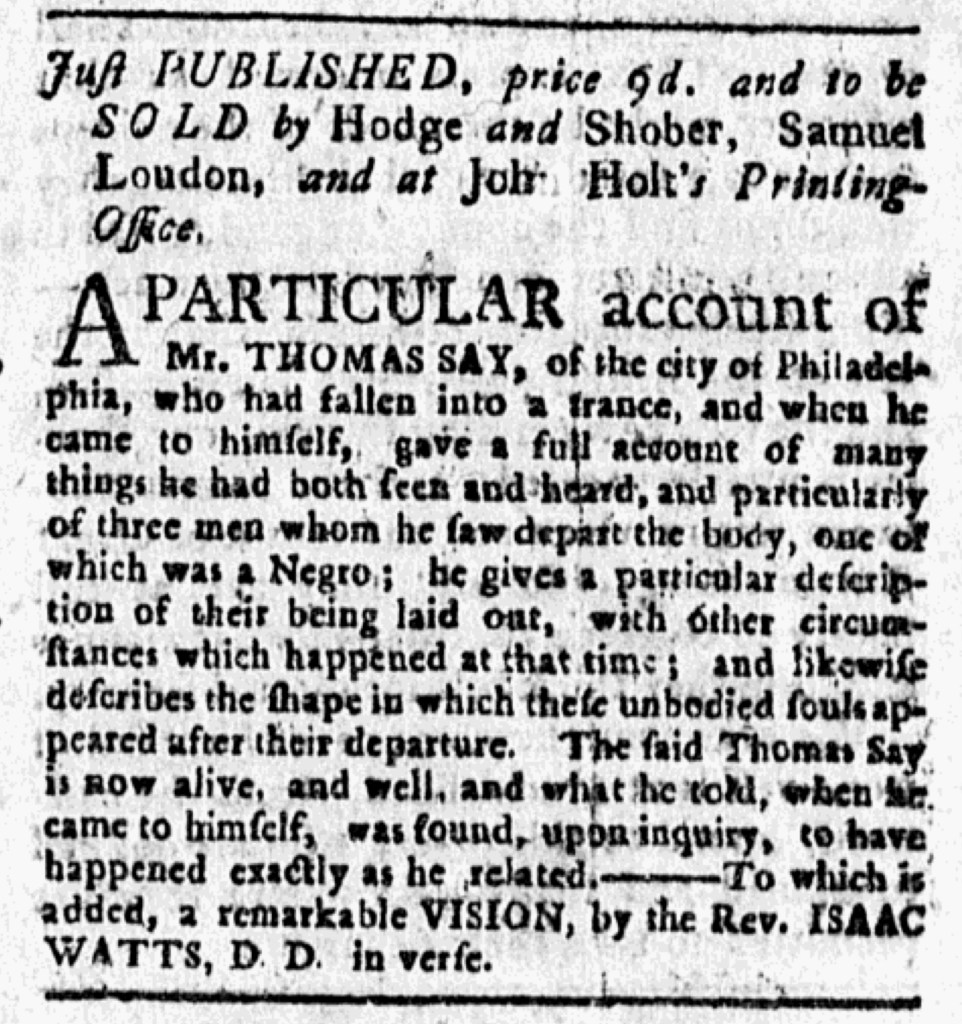
“A PARTICULAR account of Mr. THOMAS SAY … who had fallen into a trance.”
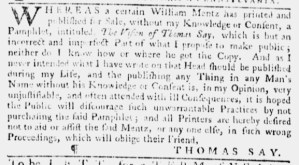
When William Mentz published The Visions of a Certain Thomas Say, of the City of Philadelphia, Which He Saw in a Trance without permission, Say placed an advertisement in the Pennsylvania Gazette to voice his objection. He described the text as an “incorrect and imperfect” rendition of what he wished to reveal to the public, further asserting that “publishing any Thing in any Man’s Name without his Knowledge or Consent is, in my Opinion, very unjustifiable.” He concluded with an appeal to “all Printers … not to aid or assist the said Mentz, or anyone else, in such wrong Proceedings.”
Unfortunately for Say, printers and booksellers in New York either did not see that advertisement or, if they did, chose to disregard it in favor of generating revenue by selling the pamphlet. An advertisement in the June 16, 1774, edition of the New-York Journal described the contents of the work and noted that readers could purchase copies from printers Robert Hodge and Frederick Shober, bookseller Samuel Loudon, and John Holt, printer of the newspaper that carried the advertisement. Mentz apparently shipped copies of The Visions of a Certain Thomas Say to New York, perhaps exchanging them for titles printed there. Local agents felt the pamphlet merited a separate advertisement. Loudon, for instance, simultaneously ran an advertisement for “BOOKS … TO BE SOLD ON THE LOWEST TERMS” that listed dozens of titles but did not mention The Visions of a Certain Thomas Say. That advertisement also did not promote any books by providing summaries, unlike the advertisement about the pamphlet that Say wished to withdraw from circulation.
In his own advertisement, Say stated that he “never intended what I have wrote … should be published during my Life.” More than two decades later, Benjamin Say, his son, published A Short Compilation of the Extraordinary Life and Writings of Thomas Say: In Which Is Faithfully Copied, from the Original Manuscript, the Uncommon Vision, Which He Had When a Young Man. That work, released following Say’s death in 1796, presumably abided by his wishes for disseminating what he recorded of his vision. During his lifetime, however, a public notice in the Pennsylvania Gazettehad not been enough to prevent the marketing of an unauthorized account.