January 31

What was advertised in a colonial American newspaper 250 years ago today?
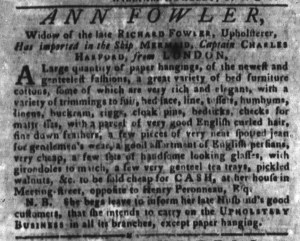
South-Carolina Gazette and Country Journal (January 31, 1775).

“She intends to carry on the UPHOLSTERY BUSINESS in all its branches, except paper hanging.”

Ann Fowler, “Widow of the late RICHARD FOWLER, Upholsterer,” took to the pages of the South-Carolina Gazette and Country Journal to advertise a variety of merchandise that she sold out of her house on Meeting Street in Charleston.  She indicated that she imported her wares “in the Ship MERMAID, Captain CHARLES HARFORD, from LONDON,” a vessel that arrived in port on December 29, 1774, according to the list of “ENTRIES INWARDS” at the custom house published in the January 3, 1775, edition of the South-Carolina Gazette and Country Journal.  Those goods should have fallen under the jurisdiction of the Continental Association.  Nevertheless, Fowler hawked a “Large quantity of paper hangings, of the newest and genteelest fashions, a great variety of bed furniture cottons, some of which are very rich and elegant, with a variety of trimmings to suit, [and] a few sets of handsome looking glasses, with girandoles to match.”  The widow was not the only advertiser who placed notices about imported goods that looked the same as those published before the Continental Association went into effect.

Fowler appended a nota bene to “inform her late Husband’s good customers, that she intends to carry on the UPHOLSTERY BUSINESS in all its branches, except paper hanging.”  Widows often took over the family business in colonial America, sometimes doing the same tasks their husbands had done and sometimes supervising employees.  Even though Ann had not been the public face of the enterprise while Richard still lived, she likely had experience assisting him in his shop and interacting with any assistants that he hired.  She hoped that she and her husband had cultivated relationships that would allow her to maintain their clientele, though they would have to look elsewhere when it came to “paper hanging” or installing wallpaper.  Fowler sold papers hangings “of the newest and genteelest fashions,” but her customers needed to contract with someone else to paste them up.  That may have been because she lacked experience with that aspect of the family business, her role having been primarily in the shop.  On the other hand, perhaps she felt comfortable doing all sorts of upholstery work in the shop, a semi-public space that now belonged to her, but she did not consider it appropriate to enter the private spaces of her customers, especially male clients who lived alone.  As a female entrepreneur, Fowler may have attempted to observe a sense of propriety that the public would find acceptable.  Whether or not Fowler had prior experience installing paper hangings, she constrained herself in discontinuing that service following the death of her husband.
December 11

What was advertised in a colonial American newspaper 250 years ago this week?

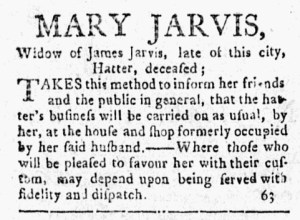
Supplement to the New-York Journal (December 8, 1774).

“The hatter’s business will be carried on as usual, by her.”

Mary Jarvis assumed responsibility for the family business following the death of her husband, James, a hatter.  In an advertisement that ran in the New-York Journal for several weeks in November and December 1774, she “inform[ed] her friends and the public and general, that the hatter’s business will be carried on as usual, by her, at the house and shop formerly occupied by her said husband.”  Like many others who advertised goods and services in colonial newspapers, she promised that “those who will be pleased to favour her with their custom, may depend upon being served with fidelity and dispatch.”  Jarvis may have consulted with John Holt, the printer, on the wording for her notice when she made arrangements for its publication, though that may not have been necessary.  Considering that she knew enough about the enterprise to continue its operations following the death of her husband, she may very well have been familiar enough with the usual contents of newspaper advertisements to compose it herself.  In addition, she could have perused similar notices many times as a consumer and learned for herself what they should contain.

The widow’s role in the business changed following the death of her husband, yet she likely had experience with many of the tasks from assisting him over the years.  When she declared that “the hatter’s business will be carried on as usual, by her,” she suggested that she did the work herself rather than managing employees previously affiliated with the business or hired after her situation changed.  Although James had been the public face of the venture, Mary no doubt made valuable contributions and learned much about the trade.  She sought to leverage that knowledge to support herself through her own industry, joining many other women – milliners and seamstresses – in the garment trades.  Historian Laurel Thatcher Ulrich distinguishes between what was probable for women and what was possible for women in early America.  In this case, Jarvis embodied both.  It was probable that she assisted James in his business as a “deputy husband” (a concept developed by Ulrich) and that made it possible for her to work as a hatter in her own right when circumstances demanded.

June 17

What was advertised in a colonial American newspaper 250 years ago today?

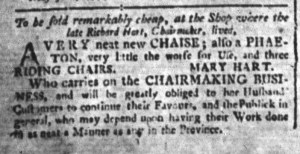
South-Carolina and American General Gazette (June 17, 1774).

“MARY HART … will be greatly obliged to her Husband’s Customers to continue their Favours.”

When she took to the pages of the South-Carolina and American General Gazette in the summer of 1774, Mary Hart advertised several wheeled vehicles for sale “remarkably cheap, at the Shop where the late Richard Hart, Chairmaker, lived” in Charleston.  Her inventory included a “VERY neat new CHAISE,” described by the Oxford English Dictionaryas a “light open carriage for one or two persons, often having a top,” and a “PHAETON, very little the worse for Use,” described as a “light four-wheeled open carriage, usually drawn by a pair of horse, and having one or two seats facing forward.”  Like the modern automobile industry, Hart marketed both new and used vehicles.  She also had three “RIDING CHAIRS,” which public historians at George Washington’s Mount Vernon describe as a “wooden chair on a cart with two wheels … pulled by single horse.”  They explain that riding chairs “could travel country lanes and back roads more easily than bulkier four-wheeled chariots and coaches.”  Hart offered different kinds of wheeled vehicles to suit the needs, tastes, and budgets of her customers.

The widow did not merely seek to sell carriages previously produced by her late husband.  Instead, she announced that she “carries on the CHAIRMAKING BUSINESS.”  Eighteenth-century readers understood that she referred to making wheeled vehicles, not household furniture.  Her husband had cultivated a clientele for the family business, one that Hart wished to maintain and even expand.  She declared that she “will be greatly obliged to her Husband’s Customers to continue their Favours, and the Publick in general, who may depend upon having their Work done in as neat a Manner as any in the Province.”  Did Hart construct carriages herself?  Perhaps, though if that was the case it demonstrated what was possible rather than what was probable.  In a dissertation on “Women Shopkeepers, Tavernkeepers, and Artisans in Colonial Philadelphia,” Frances May Manges demonstrated that female entrepreneurs worked in a variety of trades.[1]  Hart may have worked alongside her husband before his death and then continued.  Rather than building carriages, she may have supervised employees in the workshop, running other aspects of the business both before and after her husband’s passing.  Either way, she confidently asserted that a workshop headed by a woman produced carriages equal in quality to any others made in the colony.  Out of necessity, Hart joined the ranks of widows who continued operating family businesses in colonial America.

**********

[1] Frances May Manges, “Women Shopkeepers, Tavernkeepers, and Artisans in Colonia Philadelphia” (Ph.D. diss., University of Pennsylvania, 1958).

February 28

What was advertised in a colonial American newspaper 250 years ago today?

Boston Evening-Post (February 28, 1774).

“I the Subscriber intend leaving off the Baking Business very soon.”

“The Baking Business will be carried on as usual by the Subscriber.”

Mary Surcomb and William Flagg worked together in placing advertisements in the February 28, 1774, edition of the Boston Evening-Post.  Surcomb took to the pages of that newspaper to advise the public that she “intend[s] leaving off the Baking Business very soon.”  She wished to express her “hearty Thanks to those Gentlemen and Ladies who have favoured me with the Custom since my late Husband’s decease.”  She had not previously advertised her services in any of Boston’s newspapers, though she had placed estate notices in both the Boston-Gazette and the Massachusetts Gazette and Boston Weekly News-Letter following the death of her husband in the fall of 1773.[1]  Those notices indicated that Richard had been a baker as well.  As widows in early America often did, Surcomb continued operating the family business.  In Williamsburg, for instance, Clementina Rind printed the Virginia Gazette after her husband passed away in August 1773, about the same time that Surcomb’s husband died.  For Surcomb, assuming responsibility for the business may have been an extension of her previous responsibilities.  She likely assisted her husband in all kinds of ways, including baking and interacting with customers.

Surcomb appended a nota bene to her advertisement, informing readers that the “Business will be carried on as usual by Mr. William Flagg.  Perhaps Flagg had previously been affiliated with the business as an employee and continued working with the widow.  Whatever his history with the Surcombs, Flagg took over their business and aimed, with Mary’s blessing, to maintain their clientele.  In his own note, he declared that “the Baking Business will be carried on as usual by the Subscriber, who is determined to give universal Satisfaction.”  Rather than the full line that separated other paid notices from each other, a half line demarcated where Surcomb’s portion of the advertisement ended and Flagg’s portion began.  Visually, the format presented a narrative consistent with the copy.  Surcomb and Flagg carefully communicated the transition from one proprietor to the other, including an endorsement from Surcomb for her successor.

**********

[1] See Boston-Gazette (October 25, 1773) and Massachusetts Gazette and Boston Weekly News-Letter (October 7, 1773).

October 29

What was advertised in a colonial American newspaper 250 years ago today?

Boston-Gazette (October 29, 1770).

SARAH DAWSON, the Widow of JOSEPH DAWSON, Gardener.”

Compared to their male counterparts, relatively few female entrepreneurs placed advertisements promoting their commercial activities in Boston’s newspapers in the early 1770s.  With the exception of clusters of advertisements placed by female seed sellers in the spring, commercial notices constituted a primarily male space in the public prints.  Esther Harrison was one of those female shopkeepers who did run advertisements.  Her notice in the October 29, 1770, edition of the Boston-Gazette listed a variety of “Shop Goods cheap for Cash,” similar to advertisements placed by Benjamin Church, Archbald Cunningham, Joshua Gardner, John Gore, Jr., John Head, William Smith, Thomas Walley, and others.

Two other women joined Harrison in advertising the businesses they operated in that edition of the Boston-Gazette.  Most likely by chance rather than by design, their advertisements appeared side by side, one in each column on the final page.  Abigail Davidson and Sarah Dawson both advertised trees, shrubs, and seeds.  Unlike Harrison, Davidson and Dawson connected their businesses to men who had once operated them.  Dawson identified herself as “the Widow of JOSEPH DAWSON, Gardener, lately deceas’d.”  Davidson noted that the trees she sold had been “grafted and innoculated by William Davidson, deceased.”  In both instances, the women likely contributed to the family business before the death of a male relation but did not become the public face for the business until after.  Davidson and Dawson made reference to those male gardeners in much the same way that male advertisers often described their credentials as they sought to convince prospective customers and clients that they were qualified for the job.

Harrison, Davidson, and Dawson all ran businesses.  Their entrepreneurial activities included marketing their wares via newspaper advertisements.  Harrison presented herself as the sole proprietor of her shop, but Davidson and Dawson adopted an approach often taken by women who found themselves responsible for the family business after the death of a husband or other relation.  They identified themselves in connection to the deceased relative, mediating their commercial message through the authority and expertise of men.  Even as female advertisers, their appearance in the public prints contributed to the depiction the marketplace as a predominantly masculine space when it came to producers, sellers, and suppliers.

September 17

What was advertised in a colonial American newspaper 250 years ago today?

Boston-Gazette (September 17, 1770).

“To be sold one third Part cheaper than they can be purchased at any Place in Boston.”

Abigail Davidson was one of several women in Boston who placed newspaper advertisements offering seeds for sale in the late 1760s and early 1770s.  Their advertisements usually ran in multiple newspapers starting late in the winter and continuing through the spring.  Most of these female seed sellers, including Davidson, did not place advertisements for seeds or other goods at any other time during the year.  That made Davidson’s advertisement in the September 17, 1770, edition of the Boston-Gazette all the more notable.

Rather than marketing seeds exclusively, Davidson offered trees, bushes, and “all Sorts of dried Sweet Herbs” as well.  She proclaimed that she had “a large Collection of the best Sorts of young graffed and innoculated English Fruit Trees.”  That work had been done “by William Davidson, deceased.”  Abigail did not comment on her relationship to the deceased William, but expected that prospective customers were familiar with his reputation for horticulture.  She did not previously mention a husband, son, brother, or other male relation in her advertisements, but perhaps a recent death in the family prompted her to assume greater responsibilities that had her placing advertisements in the fall in addition to the spring.  Widows who operated family businesses following the death of their husbands frequently made reference to their departed spouses in their newspaper advertisements as a means of offering reassurance to prospective customers that the quality of their goods and services continued uninterrupted.

Davidson was determined to attract customers and set her prices accordingly.  In a nota bene that concluded her advertisement, she declared that she sold her trees, bushes, and seeds “one third Part cheaper than they can be purchased at any Place in Boston.”  In other words, she offered a deep discount to her customers.  If she feared the family business might lose customers following the death of William, this strategy stood to preserve those relationships as well as entice new customers interested in significant savings.  Davidson combined William’s reputation and bargain prices in her marketing efforts.

February 4

What was advertised in a colonial American newspaper 250 years ago this week?

Feb 4 - 2:1:1770 Maryland Gazette
Maryland Gazette (February 1, 1770).

“The Smith’s Shop is carried on … with the same Care and Dispatch as was in her Husband’s Lifetime.”

When Thomas Williams, a blacksmith in Prince George’s County, Maryland, passed away, his widow, Cave, served as administratrix of his estate, joined by another Thomas Williams, perhaps an adult son, as administrator. They jointly placed an advertisement in the February 1, 1770, edition of the Maryland Gazette, deploying standard language calling on “ALL Persons having any just Claims” against the estate to present them. At the same time they requested that anyone “indebted to the said Estate” settle accounts or else face legal action.

That advertisement featured an addendum that revealed the widow did not serve as administratrix of the estate merely in a ceremonial capacity. She assumed responsibility for her husband’s business and pledged to maintain it after his death. “The Smith’s shop,” she informed readers, “is carried on, by the Subscriber, with the same Care and Dispatch as was in her Husband’s Lifetime.” The widow most likely did not work as a blacksmith herself, though historians have identified some women who did pursue that trade in colonial America. She much more likely managed the business, continuing and expanding on contributions she made to the family business while her husband was still alive. She may have previously served in a role that Laurel Thatcher Ulrich has described as “deputy husband,” taking on tasks most often associated with men but undertaken by their wives when necessary. Those tasks might have included interacting with customers and ordering supplies on behalf of the business, exercising authority presumed to belong to her husband but seamlessly transferred to her as his representative. The widow certainly had a sense of what needed to be done for the “Smith’s Shop” to serve customers and succeed. She vowed that “all Gentlemen and others may depend on their Work being done faithfully.” She also asserted that she kept on hand “a Sufficiency of Coal and Iron, so as not to disappoint any Customer.” Even if Cave Williams did not pump the bellows or pound a hammer herself, she understood the operations of her family’s blacksmith shop. She aimed to convince previous clients of that, asking for “the Continuance of their Favours,” while simultaneously attracting new customers.