October 17

What was advertised in a colonial American newspaper 250 years ago today?
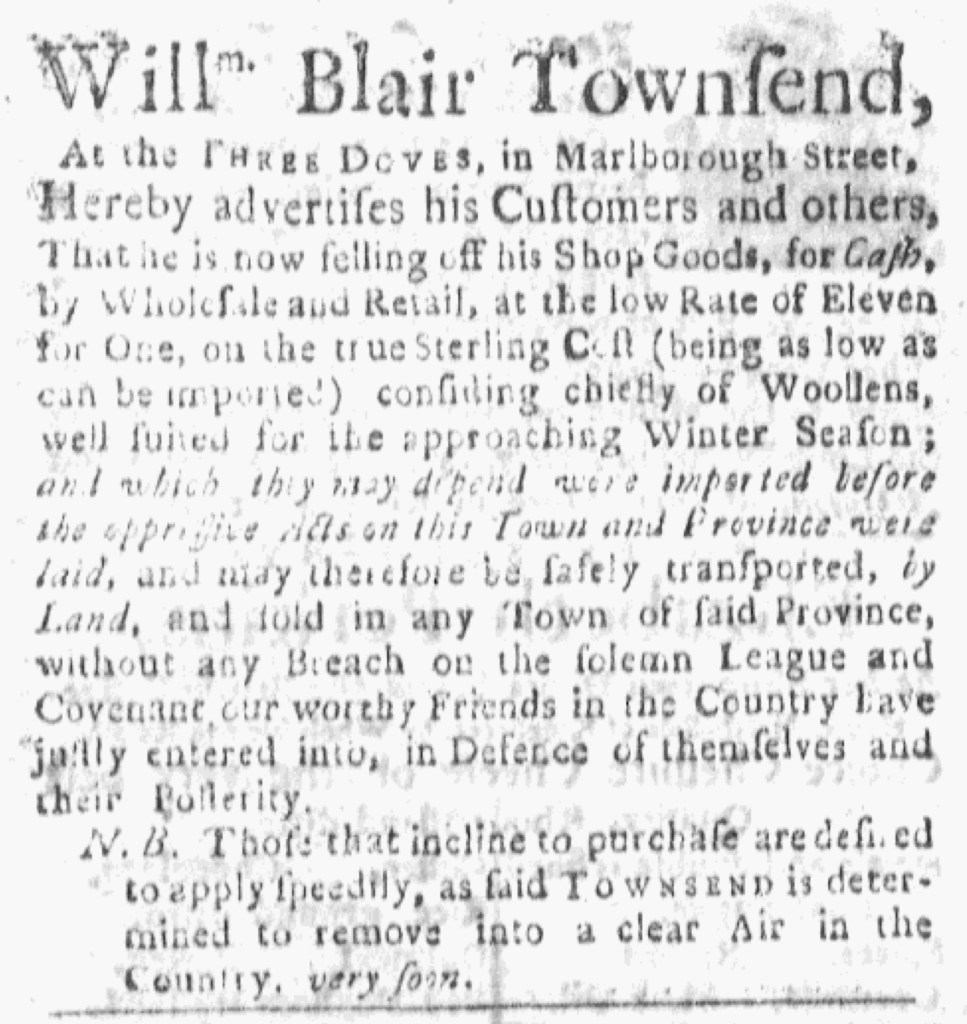
Boston Evening-Post (October 17, 1774).

“May therefore be … sold … without any Breach on the solemn League and Covenant.”

Politics took center stage in William Blair Townsend’s advertisements for “Shop Goods … consisting chiefly of Woollens, well suited for the approaching Season” in the October 17, 1774, edition of the Boston Evening-Post.  He looked to sell his entire inventory “by Wholesale and Retail” and close his shop, a casualty of the blockade of Boston that went into effect with the Boston Port Act that Parliament passed to punish the town for tossing tea into the harbor the previous December.  To that end, he assured prospective customers that “they may depend [the goods] were imported before the oppressive Acts on this Town and Province were laid.”  In addition to the Boston Port Act, Townsend invoked the Massachusetts Government Act and the other Coercive Acts.

Furthermore, he asserted that his wares “may therefore be safely transported, by Land, and sold in any Town of said Province, without any Breach on the solemn League and Covenant our worthy Friends in the Country have justly entered into, in Defence of themselves and their Posterity.”  Townsend referred to a plan outlined in a letter that the Boston Committee of Correspondence circulated on June 8.  After outlining the abuses perpetrated by Parliament, the letter encouraged resistance in the form of “affecting the trade and interest of Great Britain, so deeply as shall induce her to withdraw her oppressive hand.”  The Committee of Correspondence sought to revive nonimportation agreements enacted twice in the past decade, first in response to the Stamp Act and, later, the Townshend duties.  The letter proposed that colonizers “come into a solemn league, not to import goods from Great Britain, and not to buy any goods that shall hereafter be imported from thence, until our grievances shall be redressed.”  Some merchants advocated waiting for more comprehensive measures that enlisted cooperation of other colonies, like the Continental Association that the First Continental Congress was in the process of drawing up in Philadelphia at the time Townsend published his advertisement, yet colonizers in towns throughout Massachusetts supported the Solemn League and Covenant.

Knowing that was the case, Townsend acknowledged the politics of the moment in his advertisement.  He endorsed the pact while also making clear that neither he nor his prospective customers violated it.  They could buy and sell with clear consciences … and without attracting the ire of the public.  Beyond that, Townsend wished to clear out of Boston.  In a nota bene, he encouraged “Those that incline to purchase … to apply speedily” since he “is determined to remove into a clear Air in the Country, very soon.”  The situation had grown so bleak that that he did not intend to remain in Boston much longer.
April 30

What was advertised in a colonial American newspaper 250 years ago today?

Apr 30 - 4:30:1767 Boston News-Letter
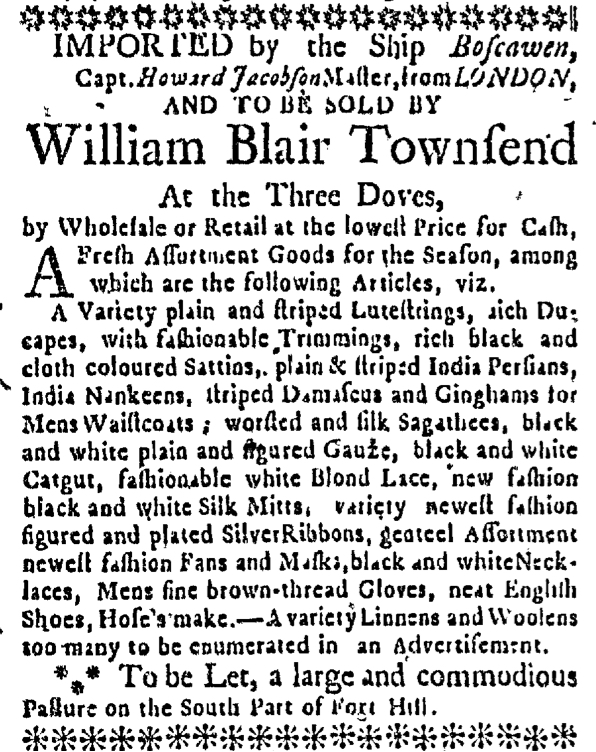
Massachusetts Gazette (April 30, 1767).

“Genteel Assortment newest fashion Fans and Masks.”

At his shop at the sign of the Three Doves in Boston, William Blair Townsend sold “A Fresh Assortment Goods for the Season” recently imported from London. Many of his competitors advised potential customers that they stocked fashionable goods, especially textiles, accessories, and adornments for garments, but most deployed some sort of blanket statement to that effect. Townsend, on the other hand, underscored that he carried dry goods à la mode, inserting the word “fashionable” five times in his list of merchandise. For instance, he carried “Ducapes, with Fashionable Trimmings” and “fashionable white Blond Lace.” For those worried that merchants in England attempted to pawn off inventory already going out of style to colonial shopkeepers to pass along to their customers far removed from the cosmopolitan center of the empire, Townsend asserted that his customers could purchase “new fashion black and white Silk Mitts” as well as a “variety newest fashion figured and plated Silver Ribbons.” Both could have been used to dress up garments that might otherwise have been already passing out of style. Townsend adopted even more expansive language as he continued describing his wares: “genteel Assortment newest fashion Fans and Masks.” Other eighteenth-century advertisers commonly made appeals to fashion, but Townsend made it the centerpiece of his marketing strategy.

Not all colonists were as keen on keeping up with current fashions as the customers Townsend sought to cultivate. The Massachusetts Gazette Extraordinary, a supplement for “other News and New-Advertisements,” included a notice that “In a few Days will be Published, AN ADDRESS TO PERSONS of FASHION.” The author did not look upon the consumer revolution, its rituals of purchasing and display, with fondness. This pamphlet was a warning “worthy the serious Attention of every Christian, especially at a Time when Vice and Immorality seem to have an Ascendancy over Religion.” This advertisement stood in stark contrast to the array of advertisements hawking all sorts of consumer goods that surrounded it. Seemingly separated from Townsend’s advertisement by several pages according to modern archival practices, the Extraordinary may have been inserted in the Massachusetts Gazette as a means of keeping the two publications for April 30 together. If that was the case, the advertisement for the “ADDRESS TO PERSONS of FASHION” appeared on the far left of the page that faced Townsend’s advertisement. Readers would have encountered the critique of fashion almost immediately before perusing the shopkeeper’s efforts to extoll his stylish merchandise.