May 27

What was advertised in a colonial American newspaper 250 years ago today?
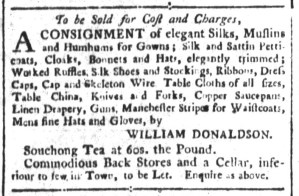
South-Carolina and American General Gazette (May 27, 1774).

“Souchong Tea at 60s. the Pound.”

As summer approached in 1774, William Donaldson advertised a variety of goods in the South-Carolina and American General Gazette.  On May 27, he promoted “elegant Silks, Muslins and Humhums for Gowns; Silk and Sattin Petticoats, Cloaks, Bonnets and Hats, elegantly trimmed; [and] Table China,” among other merchandise.  He had a separate entry for “Souchong Tea at 60s. the Pound.”  As in other towns, decisions about buying, selling, and consuming tea were part of an unfolding showdown between the colonies and Parliament.

Residents of Charleston were well aware of the Boston Tea Party that occurred the previous December.  They also anticipated some sort of response from Parliament, but at the time that Donaldson ran his advertisement, word of the Boston Part Act had not yet arrived in South Carolina.  Indeed, four days after Donaldson’s advertisement appeared in the South-Carolina and American General Gazette, another newspaper, the South-Carolina Gazette and Country Journalcarried updates from London, dated March 15, that included an overview of the proposed act to close Boston Harbor until the town paid for the tea that had been destroyed and “made proper concession for their tumultuous behaviour.”  In addition, the report stated that a “light vessel is said to have been kept ready by some friends to the Bostonians in England, in order to carry accounts of the first determination of a Great Assembly.”  By the end of May, colonizers in New England and New York knew that the Boston Port Act had passed and would go into effect on June 1.  The news was still making its way to South Carolina.

When it arrived, Peter Timothy, the printer of the South-Carolina Gazette, considered it momentous enough to merit an extraordinary, a supplemental issue.  Timothy usually published his newspaper on Mondays, but felt that this news could not wait three more days.  He rushed the South-Carolina Gazette Extraordinary to press on Friday, June 3.  The masthead included thick black borders, traditionally a sign of mourning the death of an influential member of the community but increasingly deployed by American printers to lament the death of liberty.  Confirmation of the Boston Port Act inspired new debates about consuming tea and purchasing other imported goods, eventually leading to a boycott known as the Continental Association, but colonizers did not immediately forego buying, selling, drinking, or advertising tea following the Boston Tea Party.  That happened over time (and loyalists like Peter Oliver claimed that even those who claimed to support the boycott devised ways to cheat).  In the interim, Donaldson continued marketing tea along with other merchandise.

June 4

What was advertised in a colonial American newspaper 250 years ago today?

Pennsylvania Gazette (June 4, 1772).

“At the Sign of the Scythe and Sickle.”

William Dawson advertised “A LARGE Quantity of SCYTHES and SICKLES, prepared for the ensuing Harvest” in a brief notice in the June 4, 1772, edition of the Pennsylvania Gazette.  His advertisement likely attracted less notice than those placed by other cutlers who marketed their goods and services in the same issue.  Dawson’s competitors in Philadelphia used images to enhance their advertisements.

James Hendricks adorned his advertisement with a woodcut depicting a sickle.  Her announced that he had “ONE HUNDRED and Twenty DOZEN” sickles crafted “with the utmost care, and sold at the lowest Rates, and ensured to be good.”  It was not the first time that he incorporated that image into one of his advertisements.  Two years earlier, it ran in an advertisement that stated that the cutler had a workshop “at the Sign of the Sickle” on Market Street.

Benjamin Humphreys advertised both “SAW-MILL SAWS, And a large QUANTITY of SICKLES.”  An image of a saw occupied the upper third of his notice.  The cutler clearly commissioned the woodcut for his exclusive use.  No other advertiser could use it because the name “B. HUMPHREYS” appeared on the saw.  Like Hendricks, Humphreys incorporated his woodcut into a previous advertisement.  The repetition helped to create a visual identity for his business.  In another advertisement, placed in collaboration with Stephen Paschall in 1768, Humphreys used another woodcut.  That one depicted a scythe and sickle, both of them bearing his last name.

By 1772, Humphreys and Paschall advertised separately, perhaps as a result of the Paschall forming a partnership with his son.  The Paschalls determined that they also needed an image to make their advertisements memorable.  Their woodcut depicted several tools, including a scythe, a sickle, and mechanisms for gristmills, that they made and sold “at the sign of the Scythe and Sickle” on Market Street.  They also had the image personalized for their exclusive use, the initials “SP” on one of the tools. Paschall previously noted that he marked his work with “S. PASCHALL.”

Dawson offered the same merchandise as Hendricks, Humphreys, and Paschall and Paschall, but he might have experienced more difficulty attracting customers to his shop.  His competitors made their advertisements easier to spot in the newspaper as well as more memorable.  Did the images matter?  Were they effective?  Several cutlers in Philadelphia considered it worth the expense to commission their own woodcuts and pay for additional space to include them in their newspaper advertisements.

May 7

What was advertised in a colonial American newspaper 250 years ago today?

May 7 - 5:7:1767 Pennsylvania Gazette
Supplement to the Pennsylvania Gazette (May 7, 1767).

“SUPPLEMENT to the PENNSYLVANIA GAZETTE.”

The masthead of the Pennsylvania Gazette declared that it “Contain[ed] the Freshest Advices, Foreign and Domestic.” Readers expected a variety of news updates from Europe, especially England, the Caribbean and other locales in the Atlantic world, and neighboring colonies. The Pennsylvania Gazette also carried some local news, but when it came to local affairs word of mouth often scooped newspapers published only once a week.

Readers also expected to encounter a variety of advertising. The Pennsylvania Gazette, like its counterparts in the largest colonial port cities, attracted so much advertising that the printers frequently issued a half sheet supplement devoted exclusively to paid notices of various sorts. Doing so shifted the relative balance of news items and advertising, though sometimes the supplement resulted from the regular issue including more news than usual.

Such was not the case with the May 7, 1767, edition of the Pennsylvania Gazette and the accompanying Supplement. News items appeared on only two of the four pages of the standard issue. Instead of two pages, a half sheet, Hall and Sellers created a four-page supplement, an entire broadsheet filled entirely with advertising. This doubled the number of pages in the May 7 issue. It also underscored the newspaper’s roles as a delivery mechanism for advertising. Paid notices covered three-quarters – six out of eight – pages.

Even with the supplement, space was at a premium. The paid notices were composed primarily of text with little variation in font size. Hall and Sellers incorporated few woodcuts into the advertisement: none of the houses or fleeing figures that accompanied real estate and runaway slave advertisements, respectively, and only one ship in a brief notice about “Accommodations for Passengers” aboard a ship departing “For KINGSTON, in JAMAICA,” in three weeks. Four advertisers drew attention to their notices by including woodcuts specific to their businesses that they commissioned. William Dawson, cutler, presumably replicated his shop sign, “the Scythe and Sickle,” as did dyers Joseph Allardyce and Company “at the Sign of the Blue Hand.” John Young, Sr., a saddler, and Richard Truman, who made “Dutch FANS and SCREENS,” each included images of the products they constructed.

Rather than examine a single advertisement published 250 years ago today, consider the entire issue of the Pennsylvania Gazette. Doing so underscores the importance of advertising in the dissemination of some of the most successful and widely circulated early American newspapers. It also demonstrates the extensive culture of consumption in port cities, practices of purchasing and display that filtered out to the provinces as merchants and shopkeepers distributed goods from their point of entry to customers throughout the colonies.