December 23

What was advertised in a revolutionary American newspaper 250 years ago today?

Virginia Gazette [Dixon and Hunter] (December 23, 1775).

“A large and exact VIEW of the late BATTLE at CHARLESTOWN.”

Like other printers, John Dixon and William Hunter sold books, pamphlets, almanacs, stationery, and other merchandise to supplement the revenues they generated from newspaper subscriptions, advertisements, and job printing.  They frequently placed advertisements in their newspaper, the Virginia Gazette, to generate demand for those wares.  The December 23, 1775, edition, for instance, included three of their advertisements, one for “SONG BOOKS and SCHOOL BOOKS For SALE at this OFFICE” and another for the “Virginia ALMANACK” for 1776 with calculations “Fitting VIRGINIA, MARYLAND, [and] NORTH CAROLINA” by “the ingenious Mr. DAVID RITTENHOUSE of Philadelphia,” the same mathematician who did the calculations for Father Abraham’s Almanack marketed in Philadelphia and Baltimore.

Their third advertisement promoted memorabilia related to the hostilities that erupted at Lexington and Concord earlier in the year.  “Just come to Hand, and to be SOLD at this PRINTING-OFFICE,” Dixon and Hunter proclaimed, “A large and exact VIEW of the late BATTLE at CHARLESTOWN,” now known as the Battle of Bunker Hill.  The copies they stocked were “Elegantly coloured” and sold for “one Dollar.”  Dixon and Hunter apparently carried a print, “An Exact View,” engraved by Bernard Romans and published by Nicholas Brooks, rather than a striking similar (and perhaps pirated) print, “A Correct View,” that Robert Aitken included in a recent issue of the Pennsylvania Magazine, or American Monthly Museum and sold separately.  Romans and Brooks had advertised widely and designated local agents to accept subscriptions for the print.  Dixon and Hunter also advertised another collaboration between Romans and Brooks, “an accurate MAP of The present SEAT of CIVIL WAR, Taken by an able Draughtsman, who was on the Spot at the late Engagement.”  The map also sold for “one Dollar.”  Previous efforts to market the map included a broadside subscription proposal that listed local agents in various towns, including “Purdie and Dixon, Williamsburgh.”  Romans and Brooks apparently had not consulted with all the printers, booksellers, and other men they named as local agents when they drew up the list or else they would have known that Alexander Purdie and John Dixon had dissolved their partnership in December 1774.  Dixon took on Hunter as his new partner while Purdie set about publishing his own Virginia Gazette.  Those details may have mattered less to Romans and Brooks than their expectation that printers, booksellers, and others with reputations for supporting the American cause would indeed aid them in marketing and selling a map depicting the conflict underway in Massachusetts.  Whether or not Purdie or Dixon and Hunter collected subscriptions, local agents in Williamsburg did eventually sell the print and the map that supplemented newspaper accounts and encouraged feelings of patriotism among the consumers who purchased them.
November 26

What was advertised in a revolutionary American newspaper 250 years ago this week?

Virginia Gazette [Dixon and Hunter] (November 25, 1775).

“FOLIOS … QUARTOS … OCTAVOS … DUODECIMOS.”

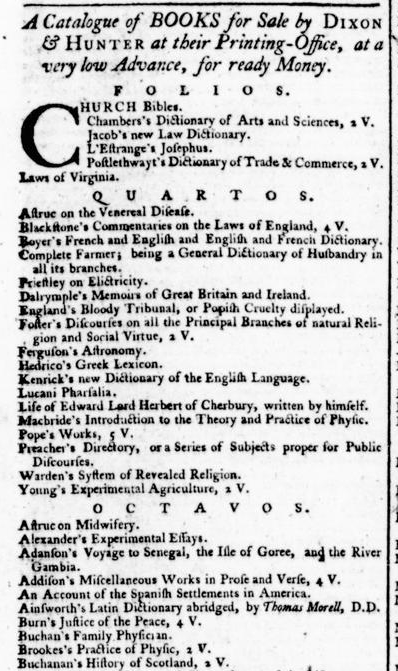
John Dixon and William Hunter, printers of the Virginia Gazette, published a “Catalogue of BOOKS for Saleat their Printing-Office” in the November 25, 1775, edition.  It covered most of the first page, except for the masthead and a short advertisement in which William Hewitt announced his intention to leave the colony and called on associates to settle accounts, and continued onto the second page, where it filled an entire column and overflowed into another.  Overall, Dixon and Hunter’s book catalog accounted for four of the twelve columns of news and advertising in that issue.  The printers could have printed a separate catalog (and very well may have done so), but disseminating the list of books they sold in the newspaper guaranteed that they reached consumers throughout the colony and beyond.

The printers deployed two principles in organizing the contents of their book catalog.  First, they separated the books by size – folios, quartos, octavos, and duodecimos – and then they roughly alphabetized them.  The catalog featured only half a dozen folios, including “CHURCH Bibles,” “Chambers’s Dictionary of Arts and Sciences” in two volumes, and the “Laws of Virginia,” along with nearly a score of quartos.  Dixon and Hunter stocked many more octavos and duodecimos with more than one hundred of each for prospective customers to choose.  In roughly alphabetizing the titles, they first indicated the author and then, if the book did not have an author associated with it, the title.  They clustered titles together by the first letter, but they did not observe strict alphabetical order within those clusters.  For example, the entries for “A” among the duodecimos appeared in this order:

     Addison’s Mescellaneous Works in prose and verse, 4 V.
Adventurer, 4 V.
American Gazetteer, 3 V.
Adventures of a Jesuit, with several remarkable Characters and Scenes in real Life, 2 V.
Agreeable Ugliness, or the Triumph of the Graces.
Apocrypha.
Alleine’s, Alarm to Unconverted Sinners.

A single entry for “Y” – “Yorrick’s Sermons, 7 V.” – appeared at the end of the catalog, immediately above “INTELLIGENCE from the Northern Papers.”

Even with all the “INTELLIGENCE” from London and Philadelphia and proclamation from the royal governor of Virginia, Dixon and Hunter made room in the Virginia Gazette for their book catalog.  They delivered news to their readers, but they also depended on book sales to supplement subscriptions, advertising, and job printing.  Compared to many book catalogs published earlier in the century, they presented a more organized list of titles.  Earlier book catalogs often separated titles by size.  By roughly alphabetizing the entries, Dixon and Hunter attempted to help prospective customers find the titles that interested them.

October 28

What was advertised in a revolutionary American newspaper 250 years ago today?

Virginia Gazette [Dixon and Hunter] (October 28, 1775).

“SKETCHLEY’s New Invented CONVERSATION CARDS.”

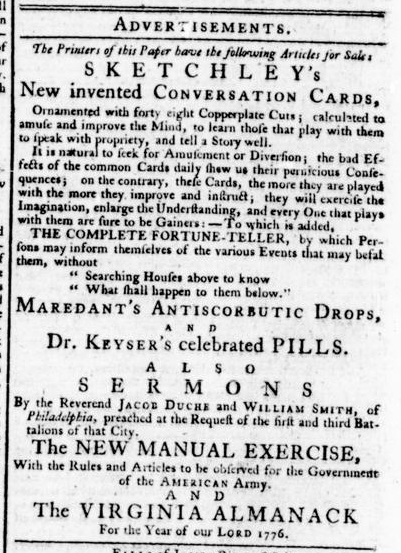
Like other newspaper printers, John Dixon and William Hunter provided a variety of goods and services to supplement the revenues from subscriptions and advertisements.  The masthead of the Virginia Gazette solicited customers for “Printing Work done at this Office in the neatest Manner, with Care and Expedition.”  In addition to job printing, they also published books, pamphlets, and almanacs and, according to their advertisement in the October 28, 1775, edition, they even sold patent medicines.  Many colonial printers kept a stock of similar “MAREDANT’S ANTISCORBUTIC DROPS” and “Dr. KEYSER’S celebrated PILLS” on hand, promoting them in their own newspapers.

Hawking yet another product accounted for nearly half of Dixon and Hunter’s advertisement in that issue of the Virginia Gazette: “SKETCHLEY’s New invented CONVERSATION CARDS, Ornamented with forty eight Copperplate Cuts.”  Today, conversation cards serve a variety of purposes.  They can be used for icebreakers at social gatherings, teambuilding exercises for businesses and organizations, or discussion starters among people seeking to explore topics of common interest and forge stronger personal connections.  While consumers may have used Sketchley’s conversation cards in a variety of ways, the advertisement stated that they were “calculated to amuse and improve the Mind, to learn those that play with them to speak with propriety, and tell a Story well.”  In that regard, these cards differed from playing cards for popular games of “Amusement and Diversion” and the “bad Effects of the common Cards” that “daily show us their pernicious Consequences.”  Card games did not have to devolve to the vices of too much luxury and leisure, too much gossip and idle chatter, and too much drinking and gambling.  Sketchley’s conversation cards, “on the contrary, … the more they are played with the more they improve and instruct; they will exercise the Imagination, enlarge the Understanding, and every One that plays with them are sure to be the Gainers.”  In the company of friends, those who used the cards would become more articulate in their speech, more refined in their comportment, and more enlightened in their understanding of the world.

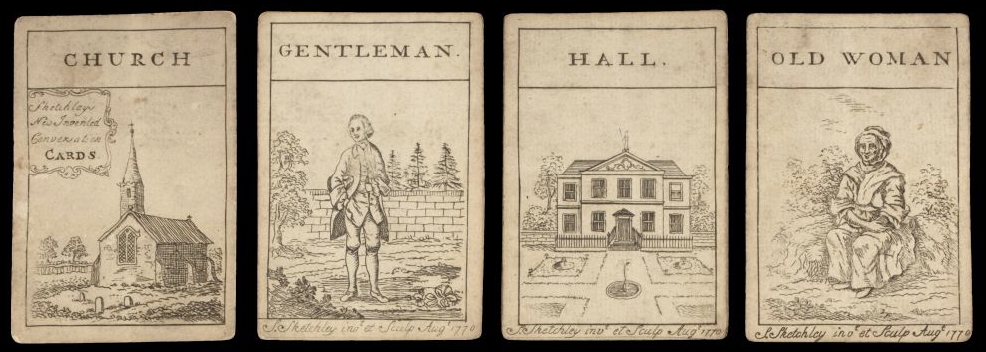
What did consumers acquire when they purchased their own deck of Sketchley’s conversation cards?  Dominic Winter Auctioneers offer this description: “copper engraved playing cards,” measuring 3.75 inches by 2.5 inches, “each with a word [in the] upper margin and [the] associated illustration below.”  The partial set that the auctioneers offered for bids included seventeen cards, such as “Hope,” “Honour,” “Heart,” and “Ruin.”  According to the online auction catalog, those are the only cards from this set known to survive.  “The only other similar, but not identical, set we have been able to trace,” the catalog states, “is that held by the Osborne Collection …, which comprises 52 cards.”  It also features images of sixteen of the cards.  In addition, the catalog notes the advertisement in the Virginia Gazette.  Like most shop signs and many book catalogs, early American newspaper advertisements reveal details that otherwise have been lost because the artifacts do not survive.

By the time that James Sketchley first marketed his “New invented CONVERSATION CARDS” in 1770, he had been producing playing cards for about two decades.  With these cards, he offered an alternative to games of leisure that passed the time with little else to show for it, just as John Ryland had done with a set of “Geographical Cards” that Nichols Brooks advertised in the Pennsylvania Journal in March 1773.  Dixon and Hunter prompted genteel readers and those who aspired to gentility to consider these conversation cards a valuable resource to purchase when their bought they almanac for the coming year or a military manual that included “the Rules and Articles to be observed for the Government of the AMERICAN Army.”

“CHURCH,” “GENTLEMAN,” “HALL,” and “OLD WOMAN,” from Sketchley’s New Invented Conversation Cards (1770).  Courtesy Dominic Winter Auctioneers.

September 23

What was advertised in a revolutionary American newspaper 250 years ago today?

Virginia Gazette [Dixon and Hunter] (September 21, 1775).

“EVERY MAN HIS OWN DOCTOR.”

Like many other printers, John Dixon and William Hunter supplemented revenues from newspaper subscriptions, advertisements, and job printing by hawking patent medicines.  They ran an advertisement for “Dr. KEYS[E]R’s celebrated PILLS” in the September 23, 1775, edition of their newspaper, marketing a familiar remedy for “the Veneral Disorder.”  In addition to curing venereal diseases, the pills reportedly “restored Persons afflicted with dropsical Disorders, the Gravel [or kidney stones], Palsey, Apoplexy, White Swellings, Stiff Joints, and the Asthma.”

Yet, Dr. Keyser’s Pills were especially known for their efficacy in treating venereal disease, so much so that Dixon and Hunter offered a short history intended to assure prospective patients that they could depend on finding relief from their symptoms if they purchased the pills.  “His Majesty ordered the most rigid and nicest Examination, by twenty seven of the principal Physicians and Surgeons,” the printers reported.  They did so “not only immediately upon the Persons having been treated with the Medicine, but even for the Space of two Years afterwards, to see if the cures of all the numerous Patients were durable.”  This trail demonstrated that the pills were indeed effective: “to the eternal Honour of Dr. Keyser, there was not found a single Instance of Failure.”  Such an extraordinary outcome prompted the king to establish a hospital “where these Pills alone are administered.”  In addition, physicians on the continent had also “pronounced the Use of [Dr. Keyser’s Pills] superior in Efficacy, to all the Modes of Practice hitherto discovered.”

Beyond their effectiveness, the pills had another important advantage.  “EVERY MAN HIS OWN DOCTOR,” the headline proclaimed, echoing a similar headline, “Every One their own Physician,” that James Rivington, a printer in New York, previously used in promoting Dr. Keyser’s Pills.  Prospective customers, Dixon and Hunter suggested, could purchase the pills and use them without exposing themselves to the embarrassment of consulting a physician or, even worse, having their symptoms become visible to others.  “The Patient is most effectually cured,” the printers explained, “without any inconvenience to himself, or being exposed to the Shame or Confusion of his Disaster being known to the nicest Observer.”  Referring to “his Disaster” was a telling alternative to “his Disorder,” one intended to stoke anxiety in hopes of convincing readers afflicted with venereal disease to purchase Dr. Keyser’s Pills.  The printers conveniently acquired “a fresh Parcel lately from PARIS,” where the doctor’s widow continued making the pills.

January 7

What was advertised in a colonial American newspaper 250 years ago today?

Virginia Gazette [Dixon and Hunter] (January 7, 1775).

“We now present the Publick with our Paper, as a Sample of what they are to expect from us in Future.”

When John Dixon and William Hunter commenced their partnership as publishers of the Virginia Gazette, they inserted a notice “To the PUBLICK” as the first item in the first column of the first page of the January 7, 1775, edition.  A month earlier, Alexander Purdie and John Dixon announced the end of their partnership, alerting readers that Dixon and Hunter would continue publishing the Virginia Gazette and that Purdie would endeavor to launch his own Virginia Gazette once he attracted enough subscribers.  The numbering for Dixon and Hunter’s newspaper continued uninterrupted, though there were some changes.  They distributed it on Saturdays instead of Thursdays.  For several years, Purdie and Dixon had published their Virginia Gazette on the same day that William Rind, Clementina Rind, and John Pinkney, in succession, took a competing Virginia Gazette to press.  Readers in Williamsburg now had access to newspapers on both Thursdays and Saturdays.  The new partners published their Virginia Gazette “early every Saturday Morning” so it could be “despatched by the several Posts on the same day” for “speedy Conveyance to the Subscribers.”

Dixon and Hunter also updated the combination masthead and colophon beyond merely changing the names of the printers.  The woodcut depicting the arms of the colony that previously adorned the Virginia Gazette now appeared within an ornate baroque border.  The new partners also incorporated a note about the services they provided: “ALL Persons may be supplied with this Paper at 12s6 a Year, and have Advertisements (of a moderate Length) inserted for 3s. the first Week, and 2s. each Week after. – Printing Work done at this Office in the neatest Manner, with Care and Expedition.”  Those lines transformed the masthead and colophon into an advertisement.  In their notice, Dixon and Hunter reported that only a few readers “have withdrawn their Subscriptions,” leaving them feeling confident about the prospects for their newspaper because they received “many Orders … from the Subscribers to this Gazette for continuing them on our List.”  At twelve shillings and six pence for an annual subscription, the price remained the same.  The price for advertising did as well.  Dixon and Hunter charged a shilling for setting type and two shillings for the space the first time an advertisement appeared and then two shillings for each subsequent insertion.

The new partners also signaled their editorial stance in their message “To the PUBLICK.”  They declared that they would published “Whatever may be sent us in Favour of LIBERTY, or for the PUBLICK GOOD … with Cheerfulness.”  In the event of “Scarcity of News,” they planned to fill the pages with “such moral Pieces, from the best Writers, as may contribute to the Improvement of Mankind in general” and, occasionally, “Pieces of Wit and Humour, that tend both to amuse and instruct.”  It went without saying that advertisements would also fill the pages of the Virginia Gazette.  Indeed, paid notices accounted for nearly half the content in Number 1222, the first issue published by Dixon and Hunter.

December 4

What was advertised in a colonial American newspaper 250 years ago this week?

Virginia Gazette [Purdie and Dixon] (December 1, 1774).

“Our Press shall be as free as any in America.”

The first page of the December 1, 1774, edition of the Virginia Gazette featured two notices about the future endeavors of the partners who printed that newspaper.  In the first, Alexander Purdie announced his withdrawal from that partnership and outlined his plans to publish another newspaper on his own as soon as he garnered enough subscribers to make it a viable venture.  In the other, John Dixon expressed his appreciation for customers who had supported the partnership and revealed that he would continue to publish the Virginia Gazette with a new partner, William Hunter.

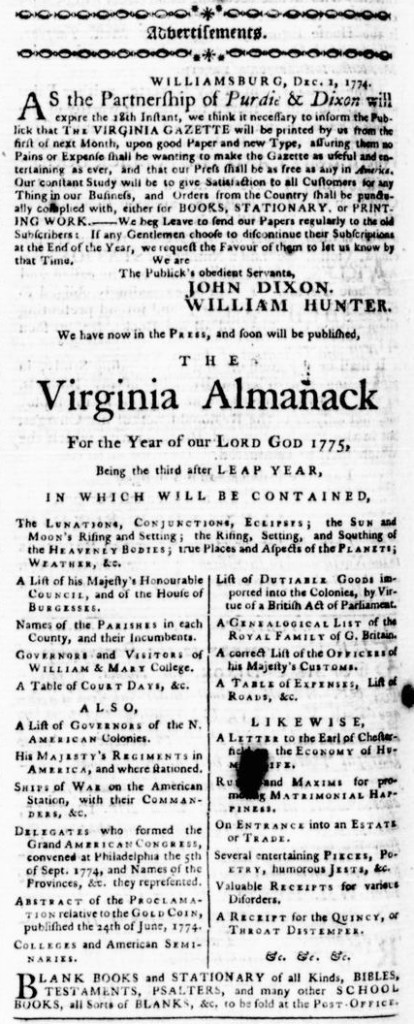
Although those were the only advertisements on the first page, they were not the only advertisements in that issue, nor the end of the notices inserted by the printers.  The remainder of the advertisements appeared after news and essays, commencing in the final column of the second page.  A notice placed by Dixon and Hunter led those advertisements, making clear that the new partnership would actively serve current and prospective customers.  They asserted that their newspaper “will be printed … upon good Paper and new Type.”  Beyond that investment that would benefit readers, Dixon and Hunter pledged that “no Pains or Expense shall be wanting to make this Gazette as useful and entertaining as ever.”  In other words, the newspaper would maintain the same quality that readers expected when the new management went into place.  Furthermore, they proclaimed that “our Press shall be as free as any in America.”  They hoped that would convince customers to continue their patronage, yet did not make assumptions.  “We beg Leave,” they declared, “to send put Papers regularly to the old Subscribers,” but recognized that some might not wish to renew.”  “If any Gentlemen choose to discontinue their Subscriptions at the end of the Year,” they instructed, “we request the Favour of them to let us know by that Time.”  The new partners also promoted other branches of their business, offering “BOOKS, STATIONARY, or PRINTING WORK” to residents of Williamsburg who visited their shop and customers in the country who sent orders.

That, however, did not conclude their advertisement.  Instead, Dixon and Hunter alerted readers that they would soon publish “THE Virginia Almanack For the Year of our LORD GOD 1775.”  The list of contents, intended to entice prospective customers, occupied more space than their announcement about upcoming changes in the partnership.  It contained the usual astronomical data and a selection of informative and “entertaining PIECES” along with several items related to current events.  Those included a list of “DELEGATES who formed the Grand AMERICAN CONGRESS convened at Philadelphia the 5th of Sept, 1774, and Names of the Provinces, &c. they represented,” a “List of DUTIABLE GOODS imported into the Colonies, by Virtue of a British Act of Parliament,” “His MAJESTY’S REGIMENT in AMERICA, and where stationed,” and “SHIPS of WAR on the American Station, with their COMMANDERS.”  The imperial crisis loomed large among the materials selected for inclusion in Dixon and Hunter’s almanac.  Before they began publishing the Virginia Gazette together, they disseminated information about the troubled relationship between the colonies and Britain in an almanac that customers would consult throughout the entire year of 1775.

December 1

What was advertised in a colonial American newspaper 250 years ago today?

Virginia Gazette [Purdie and Dixon] (December 1, 1774).

“I have sent Subscription Papers into all publick Places of the Country.”

Two advertisements that led the front page of the December 1, 1774, edition of Alexander Purdie and John Dixon’s Virginia Gazette provided important updates from the printers.  In the first, Purdie reported that he planned to “resign the Conduct of this Gazette” and wished to express his “sincere and most grateful Acknowledgments to all our Customers, and to the Publick in general,” for years of support.  In addition, he announced that he “shall begin doing Business for myself, and intend to print a GAZETTE as soon as I am furnished with a moderate Number of Customers.”  To entice them, he unveiled the proposed newspaper’s motto: “ALWAYS FOR LIBERTY AND THE PUBLICK GOOD.”  To acquire content, Purdie asked “the Favour of my BROTHER PRINTERS to the Northward to furnish me with their Newspapers, and they shall be sure to have mine, as soon as I begin to print.”  No doubt he and Dixon already participated in such exchanges.

Purdie planned to launch that enterprise “Immediately after Christmas,” but there was no guarantee that he would attract enough subscribers and advertisers to make a go of it.  After all, his newspaper would compete with the Virginia Gazettethat Dixon continued to publish and another Virginia Gazette printed by John Pinkney.  Was Williamsburg and the rest of the colony ready to support three newspapers?  To get a better sense of the market, Purdie “sent Subscription Papers into all publick Places of the Country” and instructed prospective customers that they could also contact him by letter or visit his printing office.  He eventually gained the “moderate Number of Customers” that he needed, though it took a couple of months before he distributed the first issue of his Virginia Gazette on February 3, 1775.  In that time, he also operated a shop where he sold books, sheet music, and stationery, pledging to circulate “a Catalogue of all my Books, &c. as soon as I possibly can.”  Purdie resorted to a variety of marketing media: newspaper advertisements, subscription papers, book catalogs.

In the second advertisement, Dixon revealed William Hunter, “Son of the late Mr. WM. HUNTER of this City, Printer,” would become his new partner in printing the Virginia Gazette and running a book and stationery shop.  He suggested that customers would experience a seamless transition, expressing his “most grateful Thanks for their many Favours” in the past, reminding them that “my Conduct, while in Company with Mr. PURDIE, met with general Approbation,” and pledging that “my future Endeavours to serve the Publick … will render me an Object worthy of their Encouragement.”  Aas Purdie sought subscribers and advertisers for his proposed newspaper, Dixon hoped to maintain the clientele they had cultivated over nearly a decade of working together.

Before perusing news articles or essays in the December 1 edition of Purdie and Dixon’s Virginia Gazette, readers first encountered two advertisements that delivered important news about the future of that newspaper and the possibility that another newspaper might soon be published in Williamsburg.  As was so often the case, printers used advertising space in their own publication to promote their enterprises, framing their work as service to the public.