April 27

What was advertised in a revolutionary American newspaper 250 years ago today?
Providence Gazette (April 27, 1776).

“He is persuaded that none of his Readers will think him unreasonable in adding a Shilling to the Price per Year.”

The first advertisement in the April 27, 1776, edition of the Providence Gazette featured news for subscribers.  John Carter, the printer, informed them of an imminent price increase.  His own expenses had gone up in the year since the war began at Lexington and Concord.  “THE increased Price of Paper (the chief Article of a Printer’s Stock) and of almost every Necessary of Life, has been so great,” he explained, “that it must have naturally fallen within the Notice of every Reader of this Gazette.”  Given the circumstances that Carter believed honest readers acknowledged, he was “thereforecompelled to acquaint his Customers, that the Price thereof in future will be Eight Shillings per Annum.”

He emphasized that the situation “compelled” him to take this action rather than doing so willingly or eagerly.  Carter also noted that other printers had recently done the same, so he was not alone in seeking such a remedy to his financial woes.  “He likewise begs leave to inform [subscribers],” the printer stated, “that for the same Reason the Price of the Cambridge Paper,” the New-England Chronicle, “has been raised to Eight Shillings” and “the Philadelphia Evening-Post to Two Dollars.”  (Carter meant the Pennsylvania Evening Post.)  In addition, John Dunlap had recently advertised a price increase from ten to fifteen shillings for Dunlap’s Maryland Gazette; or, the Baltimore General Advertiser.  In consideration of those recent precedents, Carter was “persuaded that none of his Readers will think him unreasonable in adding a Shilling to the Price per Year, which is not quite a Farthing on each Gazette” or each issue of the newspaper.[1]

The printer pledged to honor the previous price for current subscribers “till the Year, or other Time for which each Subscriber contracted, shall be expired.”  Once their current year (or other amount of time previously agreed between printer and subscriber) came to an end, the new price went into effect.  Those who did not wish to continue their subscriptions “at the Price above mentioned, … are requested to give Notice to the Printer.”  Carter understood that money was also tight for his subscribers, but he hoped that they would accept a small increase in the annual subscription fee in order to continue receiving the news (about the war, politics, and other matters), editorials, advertisements, and other content he published and disseminated each week.

**********

[1] A farthing was worth one-quarter of a penny.  Carter published the Providence Gazette weekly.  An additional farthing for fifty-two issues amounted to thirteen pence … or one shilling and one penny.  Carter raised the price by only one shilling, so indeed “not quite a Farthing” for each issue.

April 16

What was advertised in a revolutionary American newspaper 250 years ago today?

Dunlap’s Maryland Gazette (April 16, 1775).

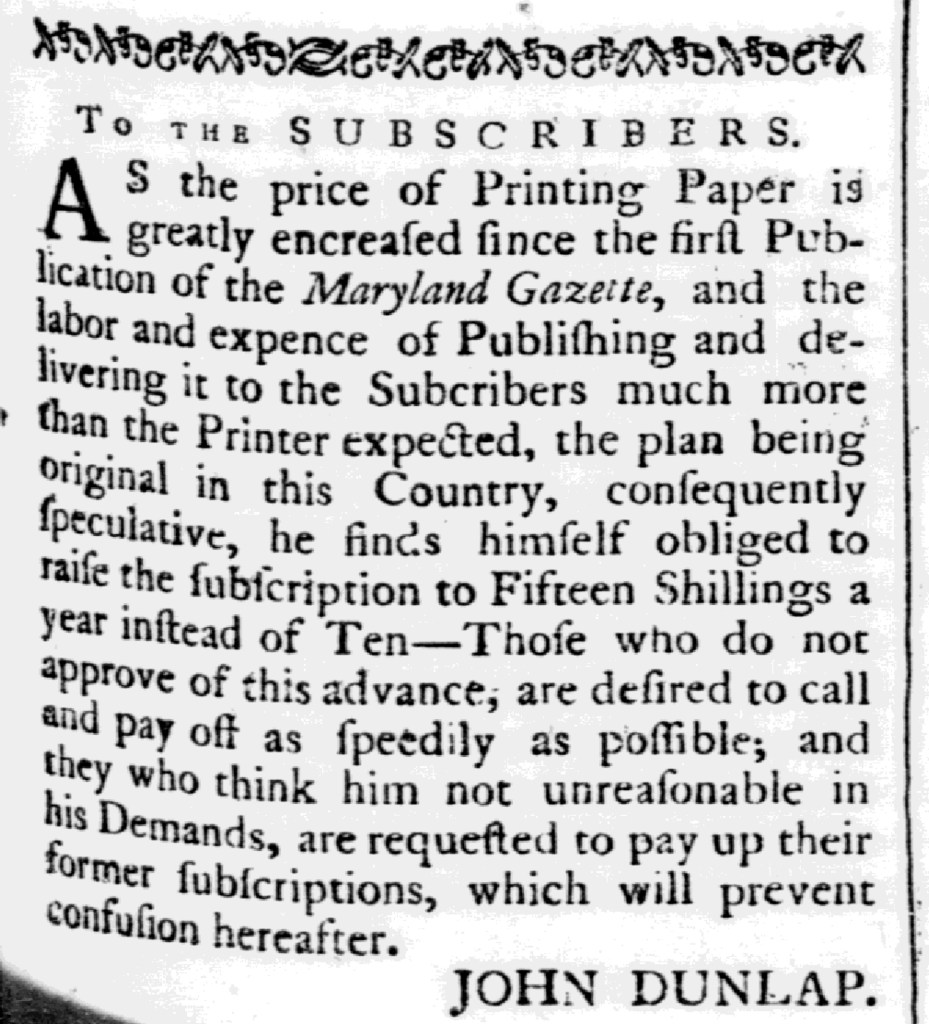
“He finds himself obliged to raise the subscription to Fifteen Shillings a year instead of Ten.”

As Dunlap’s Maryland Gazette; or, the Baltimore General Advertiser neared the end of its first year of publication, John Dunlap, the printer, ran a notice addressed “TO THE SUBSCRIBERS.”  In the April 16, 1776, edition, just a couple of weeks shy of the anniversary of establishing the newspaper, that notice appeared first among the advertisements.  Dunlap exercised his discretion as printer to give his notice a privileged place.

“AS the price of Printing Paper is greatly encreased since the first Publication of the Maryland Gazette, and the labor an expence of Publishing and delivering it to the Subscribers much more than the Printer expected” he explained, “he finds himself obliged to raise the subscription to Fifteen Shillings a year instead of Ten.”  Dunlap happened to commence publication a couple of weeks after the battles at Lexington and Concord.  The Continental Association, a nonimportation agreement devised by the Second Continental Congress in protest of the Intolerable Acts, already disrupted the supply of paper.  The outbreak of war meant even more shortages, causing some printers in New England to make adjustments or to suspend publication.  Printers in other regions also commented on the scarcity of paper and its impact on their newspapers.  To make matters even more complicated, Dunlap continued publishing Dunlap’s Pennsylvania Packet in Philadelphia and entrusted his printing office in Baltimore to James Hayes, Jr.  They experienced other difficulties, including the theft of newspapers intended for delivering in Elk Ridge, Annapolis, and Alexandria in the summer of 1775.

Now Dunlap found it necessary to increase the annual subscription significantly, raising it from ten shilling to fifteen.  “Those who do not approve of this advance,” he advised, “are desired to call and pay off as speedily as possible.”  Those customers presumably dealt with Hayes in the printing office on Market Street in Baltimore rather than directly with Dunlap.  He also called on “they who think him not unreasonable in his Demands … to pay up their former subscriptions, which will prevent confusion hereafter.”  Whatever their decision about whether to continue receiving Dunlap’s Maryland Gazette, the printer wanted subscribers to check in to confirm their decision and, just as importantly, to pay what they owed for the past year.  Printers often allowed generous credit to subscribers and depended on advertising revenue to make their newspapers viable ventures.  Dunlap did brisk business in advertising, but he apparently wished for more security than those paid notices provided.  The issue that carried his notice also featured resolutions passed “In CONGRESS” in Philadelphia and a “Proclamation … by his Excellency General Washington, on his taking possession of the town of Boston.”  If subscribers wished to continue receiving such news, they needed to share the cost with advertisers by paying more for their subscriptions.

January 22

What was advertised in a colonial American newspaper 250 years ago this week?

Massachusetts Spy (January 19, 1775).

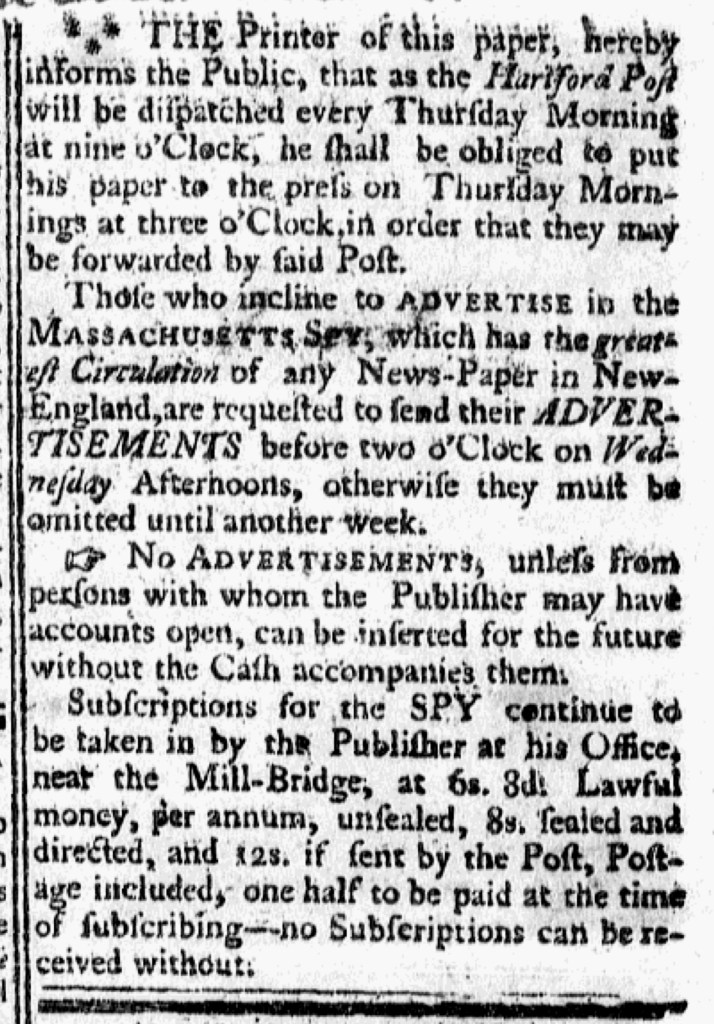
“No ADVERTISEMENTS … can be inserted for the future without the Cash accompanies them.”

In a notice in the January 19, 1775, edition of the Massachusetts Spy, Isaiah Thomas, the printer, provided several important details about the practices he enacted for publishing his newspaper.  He opened by noting that “the Hartford Post will be dispatched every Thursday Morning at nine o’Clock.”  In order that that the Massachusetts Spy “may be forwarded by said Post,” Thomas “shall be obliged to put his paper to the press on Thursday Mornings at three o’Clock.”  Calling attention to such early mornings not only testified to the industriousness of the printer but also alerted the public that he could publish updates that arrived at his printing office merely hours before he distributed the new issue of his weekly newspaper.

Thomas also advised “[t]hose who incline to ADVERTISE in the MASSACHUSETTS SPY … to send their ADVERTISEMENTS before two o”Clock on Wednesday Afternoons, otherwise they must be omitted until another week.”  To convince them to advertise in in his newspaper, he proclaimed that it “has the greatest Circulation of any News-Paper in New-England.”  That meant that advertisers were likely to experience the greatest return on their investment by placing notices in the pages of the Massachusetts Spy.  Although compositors worked quickly, they did need some time to set type for individual advertisements and lay out all the news, editorials, advertisements, and other content for each issue.  While Thomas might welcome “Articles of Intelligence” that arrived very shortly before taking his newspaper to press, he insisted that advertisements required more time to prepare for publication.  Advertisers needed to plan accordingly.

In addition, Thomas declared, “No ADVERTISEMENTS, unless from persons with whom the Publisher may have accounts open, can be inserted for the future without the Cash accompanies them.”  He also asserted that subscriptions for the newspaper required “one half [of the annual fee] to be paid time of subscribing” and “no Subscriptions can be received without.”  Historians of the early American press often make general statements about printers extending generous credit to subscribers, expecting that some would never pay, because they understood that newspaper advertisements were a much more most significant revenue.  According to such accounts, printers supposedly insisted on receiving payment for advertisements in advance of publishing them.  While that may have been the case in some printing offices, several printers published notices indicating that they departed from such practices.  That Thomas put in place such a policy “for the future” suggests that it may have been a new policy or one that he had not previously enforced.  Similarly, Thomas joined other printers who extended credit yet also demanded that subscribers submit half of the annual fee in advance, updating the terms that he published in the colophon that appeared in each issue of the Massachusetts Spy.

January 7

What was advertised in a colonial American newspaper 250 years ago today?

Virginia Gazette [Dixon and Hunter] (January 7, 1775).

“We now present the Publick with our Paper, as a Sample of what they are to expect from us in Future.”

When John Dixon and William Hunter commenced their partnership as publishers of the Virginia Gazette, they inserted a notice “To the PUBLICK” as the first item in the first column of the first page of the January 7, 1775, edition.  A month earlier, Alexander Purdie and John Dixon announced the end of their partnership, alerting readers that Dixon and Hunter would continue publishing the Virginia Gazette and that Purdie would endeavor to launch his own Virginia Gazette once he attracted enough subscribers.  The numbering for Dixon and Hunter’s newspaper continued uninterrupted, though there were some changes.  They distributed it on Saturdays instead of Thursdays.  For several years, Purdie and Dixon had published their Virginia Gazette on the same day that William Rind, Clementina Rind, and John Pinkney, in succession, took a competing Virginia Gazette to press.  Readers in Williamsburg now had access to newspapers on both Thursdays and Saturdays.  The new partners published their Virginia Gazette “early every Saturday Morning” so it could be “despatched by the several Posts on the same day” for “speedy Conveyance to the Subscribers.”

Dixon and Hunter also updated the combination masthead and colophon beyond merely changing the names of the printers.  The woodcut depicting the arms of the colony that previously adorned the Virginia Gazette now appeared within an ornate baroque border.  The new partners also incorporated a note about the services they provided: “ALL Persons may be supplied with this Paper at 12s6 a Year, and have Advertisements (of a moderate Length) inserted for 3s. the first Week, and 2s. each Week after. – Printing Work done at this Office in the neatest Manner, with Care and Expedition.”  Those lines transformed the masthead and colophon into an advertisement.  In their notice, Dixon and Hunter reported that only a few readers “have withdrawn their Subscriptions,” leaving them feeling confident about the prospects for their newspaper because they received “many Orders … from the Subscribers to this Gazette for continuing them on our List.”  At twelve shillings and six pence for an annual subscription, the price remained the same.  The price for advertising did as well.  Dixon and Hunter charged a shilling for setting type and two shillings for the space the first time an advertisement appeared and then two shillings for each subsequent insertion.

The new partners also signaled their editorial stance in their message “To the PUBLICK.”  They declared that they would published “Whatever may be sent us in Favour of LIBERTY, or for the PUBLICK GOOD … with Cheerfulness.”  In the event of “Scarcity of News,” they planned to fill the pages with “such moral Pieces, from the best Writers, as may contribute to the Improvement of Mankind in general” and, occasionally, “Pieces of Wit and Humour, that tend both to amuse and instruct.”  It went without saying that advertisements would also fill the pages of the Virginia Gazette.  Indeed, paid notices accounted for nearly half the content in Number 1222, the first issue published by Dixon and Hunter.

September 13

What was advertised in a colonial American newspaper 250 years ago today?

Essex Gazette (September 13, 1774).

“This GAZETTE may be had for 6s. 8d. per Annum, exclusive of Postage.”

The printers of the Essex Gazette incorporated the colophon into the masthead of that newspaper.  Within that masthead, they declared that the publication “Contain[ed] the freshest Advices, both foreign and domestic” and gave the date and volume and issue numbers.  Next came the publication information that more often appeared at the bottom of the final page in other newspapers: “SALEM: Printed by Samuel and Ebenezer Hall, at their Printing-Office in King-Street.”  That made it easy for prospective subscriber and advertisers as well as others with business for the printers to contact or visit them.

Even with that choice about where to place the colophon, the Halls still recognized the bottom of the final page as valuable space for promoting their newspaper, publishing a perpetual advertisement that ran across all three columns in each issue.  A single line advised, “This GAZETTE may be had for 6s. 8d. per Annum, exclusive of Postage – 3s. 4d. (or 4s. 6d. if sent by the Eastern Post) to be paid at Entrance.”  Throughout the colonies, printers generously extended credit to subscribers, recognizing that if they increased their circulation then they could attract more advertisers.  In turn, printers often published notices calling on subscribers to pay for subscriptions going back months and even years.

For their part, the Halls refused to assume the risk of allowing readers to subscribe completely on credit.  They required payment of three shilling and four pence, half of the annual price of six shillings and eight pence, at the time that subscriptions commenced.  Even if they had difficulty collecting the balance from subscribers, those initial payments covered some of the expenses and limited their losses.  In addition, subscribers who ordered their newspapers delivered by a post rider were expected to pay an additional shilling at the start, though the notice did not indicate if that covered the entire year or, like the entrance fee, was only half of what subscribers were expected to pay.  Either way, the Halls intended that service would further expand their circulation.

No matter what kinds of news or paid notices the printers placed on the final page of the Essex Gazette from week to week, readers always encountered an advertisement for the newspaper as the final item.  Colonial newspapers often passed from hand to hand, reaching readers beyond the original subscribers.  This strategy encouraged those additional readers to consider purchasing their own subscriptions for consistent access to the news rather than rely on the possibility that others would share their newspapers.