Slavery Advertisements Published December 26, 1772

The Slavery Adverts 250 Project chronicles the role of newspaper advertising in perpetuating slavery in the era of the American Revolution. The project seeks to reveal the ubiquity of slavery in eighteenth-century life from New England to Georgia by republishing advertisements about enslaved people – for sale as individuals or in groups, wanted to purchase or for hire for short periods, runaways who liberated themselves, and those who were subsequently captured and confined in jails and workhouses – in daily digests on this site as well as in real time via the @SlaveAdverts250 Twitter feed, utilizing twenty-first-century media to stand in for the print media of the eighteenth century.

The project aims to provide modern audiences with a sense of just how often colonizers encountered these advertisements in their daily lives. Enslaved men, women, and children appeared in print somewhere in the colonies almost every single day. Those advertisements served as a constant backdrop for social, cultural, economic, and political life in colonial and revolutionary America. Colonizers who did not purport to own enslaved people were still confronted with slavery as well as invited to maintain the system by purchasing enslaved men, women, and children or assisting in the capture of so-called “runaways” who sought to free themselves from bondage. The frequency of these newspaper advertisements suggests just how embedded slavery was in colonial and revolutionary American culture in everyday interactions beyond the printed page.

These advertisements also testify to the experiences of enslaved men, women, and children, though readers must consider that those experiences have been remediated through descriptions offered by enslavers rather than enslaved people themselves. Often unnamed in the advertisements, enslaved men, women, and children were not invisible or unimportant in early America.

These advertisements appeared in colonial American newspapers 250 years ago today.

Providence Gazette (December 26, 1772).

December 25

What was advertised in a colonial American newspaper 250 years ago today?

New-Hampshire Gazette (December 25, 1772).

“Those who neglect, & are Indebted, must expect … the Accounts will be lodged with such Gentlemen as will create Trouble.”

As 1772 drew to a close, Daniel Fowle and Robert L. Fowle, printers of the New-Hampshire Gazette, announced their intention to dissolve their partnership.  Robert planned to leave the colony “in a short Time.”  Daniel founded the New-Hampshire Gazette in October 1756.  Nearly eight years later, according to Clarence S. Brigham, “Daniel admitted his nephew … to a share in the management” in September 1764.[1]  The Fowles worked together for more than eight years, distributing their last issue as partners in April 1773.  Daniel then became sole proprietor of the newspaper once again.

As Robert prepared to set out on his own, he inserted a notice in the December 25 edition, the final issue of the year, to alert readers that he “earnestly desires all Persons who have Accounts open, in which he has any Connections,” including accounts with the New-Hampshire Gazette, “to settle the same, as soon as possible.”  As the Fowles often did when they placed notices calling on subscribers and others to pay their bills, Robert threatened legal action against those who ignored this notice.  “Those who neglect, & are Indebted,” he warned, “must expect, that without respect to Persons, the Accounts will be lodged with such Gentlemen as will create Trouble and needless Charges.”  In other words, it did not matter if those who owed the Fowles happened to be the most influential colonial officials and the most affluent merchants; Robert intended to hold them accountable no matter their status.  To that end, he would hire attorneys, those “Gentlemen as will create Trouble and needless Charges.”  He hoped to avoid that “very disagreeable” action if “all Persons who have Accounts open” settled them, but he did not consider it “ungenerous” to sue them “after the repeated Solicitations for a Settlement” published in the newspaper and likely communicated to them in other ways.

As many colonial printers did, the Fowles gave this notice a privileged place in their newspaper.  It appeared at the top of the first column on the first page, immediately below the masthead.  That made it difficult for readers, including those indebted to the Fowles, to overlook the notice.  Perhaps as a means of reminding some of those readers of his other contributions to the community and their mutual obligations to each other, another notice signed by Robert L. Fowle appeared immediately below the one calling on colonizers to settle accounts.  In his capacity as “Pro. Sec.” of the New Hampshire lodge of the “Brethren of the Ancient and Honorable Society of Free and Accepted MASONS,” Robert extended an invitation on behalf of the master of that lodge to gather “to celebrate the Festival of St. JOHN the Evangelist” on December 28.  Robert may have intended for that notice to alleviate some of the sting of the blunt language in the other notice, having the one follow after the other.

**********

[1] Clarence S. Brigham, History and Bibliography of American Newspapers, 1690-1820 (Worcester, Massachusetts:  American Antiquarian Society, 1947), 471.

Slavery Advertisements Published December 25, 1772

The Slavery Adverts 250 Project chronicles the role of newspaper advertising in perpetuating slavery in the era of the American Revolution. The project seeks to reveal the ubiquity of slavery in eighteenth-century life from New England to Georgia by republishing advertisements about enslaved people – for sale as individuals or in groups, wanted to purchase or for hire for short periods, runaways who liberated themselves, and those who were subsequently captured and confined in jails and workhouses – in daily digests on this site as well as in real time via the @SlaveAdverts250 Twitter feed, utilizing twenty-first-century media to stand in for the print media of the eighteenth century.

The project aims to provide modern audiences with a sense of just how often colonizers encountered these advertisements in their daily lives. Enslaved men, women, and children appeared in print somewhere in the colonies almost every single day. Those advertisements served as a constant backdrop for social, cultural, economic, and political life in colonial and revolutionary America. Colonizers who did not purport to own enslaved people were still confronted with slavery as well as invited to maintain the system by purchasing enslaved men, women, and children or assisting in the capture of so-called “runaways” who sought to free themselves from bondage. The frequency of these newspaper advertisements suggests just how embedded slavery was in colonial and revolutionary American culture in everyday interactions beyond the printed page.

These advertisements also testify to the experiences of enslaved men, women, and children, though readers must consider that those experiences have been remediated through descriptions offered by enslavers rather than enslaved people themselves. Often unnamed in the advertisements, enslaved men, women, and children were not invisible or unimportant in early America.

These advertisements appeared in colonial American newspapers 250 years ago today.

New-London Gazette (December 25, 1772).

December 24

What was advertised in a colonial American newspaper 250 years ago today?

Massachusetts Gazette and Boston Weekly News-Letter (December 24, 1772).

There are some Almanacks with Dr. Ames’s Name thereto that are very erroneous.”

In the December 24, 1772, edition of the Massachusetts Gazette and Boston Weekly News-Letter, Richard Draper continued the efforts to inform the public about counterfeit editions of “AMES’s Almanack for 1773” that he, Thomas Fleet and John Fleet, printers of the Boston Evening-Post, and Benjamin Edes and John Gill, printers of the Boston-Gazette, began three days earlier.  According to a note from Nathaniel Ames, the author of the popular almanac, “The only True and Correct Almanacks from my Copy, are those printed by R. Draper, Edes & Gill and T. & J. Fleet.”

Draper expanded on the notice that previously appeared in other newspapers, advising readers and prospective customers that “there are some Almanacks with Dr. Ames’s Name thereto that are very erroneous.”  In particular, those counterfeits contained misinformation about “Roads and Stages,” but in the “true Almanack” those errors had been “corrected, amended and placed in a better Manner than in any Almanack heretofore published.”  Draper offered a justification not only for choosing Ames’s “true Almanack” over counterfeit editions but also for choosing it over any other almanacs advertised and sold in New England.

Isaiah Thomas, printer of the Massachusetts Spy, advertised some of those almanacs on the same day that Draper published the extended version of the advertisement about Ames’s “True and Correct Almanacks.”  Under a headline that simply declared, “ALMANACKS,” Thomas listed “AMES’s, Lowe’s, Gleason’s (or Massachusetts Calender) and Sterne’s ALMANACKS” available at his printing office.  Thomas did not note whether he sold Ames’s almanac printed by Draper, the Fleets, and Edes and Gill, but his newspaper was the only one in Boston that did not carry the notice from those printers that week.

Postscript to the Massachusetts Spy (December 24, 1772).

In addition, the supplement that accompanied that edition of the Massachusetts Spy contained just one advertisement.  It advised prospective customers about “AMES’s Almanack, for 1773, just published and to be sold by Russell & Hicks, in Union street, next the Cornfield.”  Whether or not Thomas sold the counterfeit almanac at his own shop, he did not seem to have any qualms about generating revenue by running advertisements placed by the printers who published the suspect edition.  Given that households from the most grand to the most humble acquired almanacs each year, those pamphlets were big business for printers.  Rivalries in printing, marketing, and selling almanacs became a regular feature of newspaper advertising each fall and into the winter months.

Slavery Advertisements Published December 24, 1772

The Slavery Adverts 250 Project chronicles the role of newspaper advertising in perpetuating slavery in the era of the American Revolution. The project seeks to reveal the ubiquity of slavery in eighteenth-century life from New England to Georgia by republishing advertisements about enslaved people – for sale as individuals or in groups, wanted to purchase or for hire for short periods, runaways who liberated themselves, and those who were subsequently captured and confined in jails and workhouses – in daily digests on this site as well as in real time via the @SlaveAdverts250 Twitter feed, utilizing twenty-first-century media to stand in for the print media of the eighteenth century.

The project aims to provide modern audiences with a sense of just how often colonizers encountered these advertisements in their daily lives. Enslaved men, women, and children appeared in print somewhere in the colonies almost every single day. Those advertisements served as a constant backdrop for social, cultural, economic, and political life in colonial and revolutionary America. Colonizers who did not purport to own enslaved people were still confronted with slavery as well as invited to maintain the system by purchasing enslaved men, women, and children or assisting in the capture of so-called “runaways” who sought to free themselves from bondage. The frequency of these newspaper advertisements suggests just how embedded slavery was in colonial and revolutionary American culture in everyday interactions beyond the printed page.

These advertisements also testify to the experiences of enslaved men, women, and children, though readers must consider that those experiences have been remediated through descriptions offered by enslavers rather than enslaved people themselves. Often unnamed in the advertisements, enslaved men, women, and children were not invisible or unimportant in early America.

These advertisements appeared in colonial American newspapers 250 years ago today.

Maryland Gazette (December 24, 1772).

**********

Massachusetts Gazette and Boston Weekly News-Letter (December 24, 1772).

**********

New-York Journal (December 24, 1772).

**********

South-Carolina Gazette (December 24, 1772).

**********

South-Carolina Gazette (December 24, 1772).

**********

South-Carolina Gazette (December 24, 1772).

**********

South-Carolina Gazette (December 24, 1772).

**********

South-Carolina Gazette (December 24, 1772).

**********

South-Carolina Gazette (December 24, 1772).

**********

South-Carolina Gazette (December 24, 1772).

**********

South-Carolina Gazette (December 24, 1772).

**********

South-Carolina Gazette (December 24, 1772).

**********

South-Carolina Gazette (December 24, 1772).

**********

South-Carolina Gazette (December 24, 1772).

**********

South-Carolina Gazette (December 24, 1772).

**********

South-Carolina Gazette (December 24, 1772).

**********

Virginia Gazette [Purdie and Dixon] (December 24, 1772).

**********

Virginia Gazette [Purdie and Dixon] (December 24, 1772).

**********

Virginia Gazette [Purdie and Dixon] (December 24, 1772).

**********

Virginia Gazette [Purdie and Dixon] (December 24, 1772).

**********

Virginia Gazette [Purdie and Dixon] (December 24, 1772).

**********

Virginia Gazette [Purdie and Dixon] (December 24, 1772).

**********

Virginia Gazette [Purdie and Dixon] (December 24, 1772).

**********

Virginia Gazette [Purdie and Dixon] (December 24, 1772).

**********

Virginia Gazette [Purdie and Dixon] (December 24, 1772).

**********

Virginia Gazette [Purdie and Dixon] (December 24, 1772).

**********

Virginia Gazette [Purdie and Dixon] (December 24, 1772).

**********

Virginia Gazette [Rind] (December 24, 1772).

**********

Virginia Gazette [Rind] (December 24, 1772).

**********

Virginia Gazette [Rind] (December 24, 1772).

**********

Virginia Gazette [Rind] (December 24, 1772).

**********

Virginia Gazette [Rind] (December 24, 1772).

**********

Virginia Gazette [Rind] (December 24, 1772).

**********

Virginia Gazette [Rind] (December 24, 1772).

**********

Virginia Gazette [Rind] (December 24, 1772).

**********

Virginia Gazette [Rind] (December 24, 1772).

December 23

What was advertised in a colonial American newspaper 250 years ago today?

Pennsylvania Journal (December 23, 1772).

“Repeated INSULTS the City has lately received, by damaging, and taking away, the Public Lamps.”

On one of the shortest days of the year, the “WARDENS of the CITY” of Philadelphia offered a significant reward “for discovery of the person or persons, who … TOOK AWAY, one of the PUBLIC LAMPS” on Fourth Street.  To draw attention to this act of vandalism and theft, the wardens placed advertisements in both the Pennsylvania Gazette and the Pennsylvania Journal on December 23, 1772.  The wardens had determined that someone removed and stole the lamp sometime between ten and eleven on Saturday night.  That they could pinpoint the time that precisely suggested that members of the public took enough notice of the light provided by the lamps to notice when that particular lamp was lit for their safety and convenience and when it disappeared.

The wardens considered the removal of the lamp more than an act of vandalism.  They framed it as an assault on the city and its residents.  “The repeated INSULTS the City has lately received, by damaging, and taking away, the Public Lamps,” the wardens proclaimed, “WILL, doubtless, be PROPERLY RESENTED by the INHABITANTS.”  That being the case, the wardens “Request the ASSISTANCE of their FELLOW-CITIZENS, in order to a discovery of the Perpetrators of those infamous practices, that a check may be put, to a growing evil, of the most dangerous tendency.”  Public works, like street lamps, only benefited the public when they remained in place and optional.  The entire community, the wardens argued, shared the responsibility of identifying the vandals, just as the entire community benefitted from the installation of “Public Lamps” to light the streets during the winter months.

The compositors for the Pennsylvania Gazette and the Pennsylvania Journal did their part in alerting the public to this call to action from the wardens of the city.  In the former, the notice ran immediately below the shipping news from the customs house.  As readers finished perusing news items, they encountered the advertisement offering “TWENTY-FIVE POUNDS REWARD” upon the conviction of the vandals.  Even if they did not closely examine other advertisements in the remainder of the issue, readers interested in the news likely saw this notice.  In the Pennsylvania Journal, the compositor placed the notice at the top of the first full column of advertising in the issue.  In the upper right corner of the third page, it appeared next to local news from Philadelphia.  For added measure, the compositor added a manicule to direct readers to the advertisement, the only manicule anywhere in that issue.

Slavery Advertisements Published December 23, 1772

The Slavery Adverts 250 Project chronicles the role of newspaper advertising in perpetuating slavery in the era of the American Revolution. The project seeks to reveal the ubiquity of slavery in eighteenth-century life from New England to Georgia by republishing advertisements about enslaved people – for sale as individuals or in groups, wanted to purchase or for hire for short periods, runaways who liberated themselves, and those who were subsequently captured and confined in jails and workhouses – in daily digests on this site as well as in real time via the @SlaveAdverts250 Twitter feed, utilizing twenty-first-century media to stand in for the print media of the eighteenth century.

The project aims to provide modern audiences with a sense of just how often colonizers encountered these advertisements in their daily lives. Enslaved men, women, and children appeared in print somewhere in the colonies almost every single day. Those advertisements served as a constant backdrop for social, cultural, economic, and political life in colonial and revolutionary America. Colonizers who did not purport to own enslaved people were still confronted with slavery as well as invited to maintain the system by purchasing enslaved men, women, and children or assisting in the capture of so-called “runaways” who sought to free themselves from bondage. The frequency of these newspaper advertisements suggests just how embedded slavery was in colonial and revolutionary American culture in everyday interactions beyond the printed page.

These advertisements also testify to the experiences of enslaved men, women, and children, though readers must consider that those experiences have been remediated through descriptions offered by enslavers rather than enslaved people themselves. Often unnamed in the advertisements, enslaved men, women, and children were not invisible or unimportant in early America.

These advertisements appeared in colonial American newspapers 250 years ago today.

Pennsylvania Journal (December 23, 1772).

**********

Pennsylvania Journal (December 23, 1772).

December 22

What was advertised in a colonial American newspaper 250 years ago today?

Connecticut Courant (December 22, 1772).

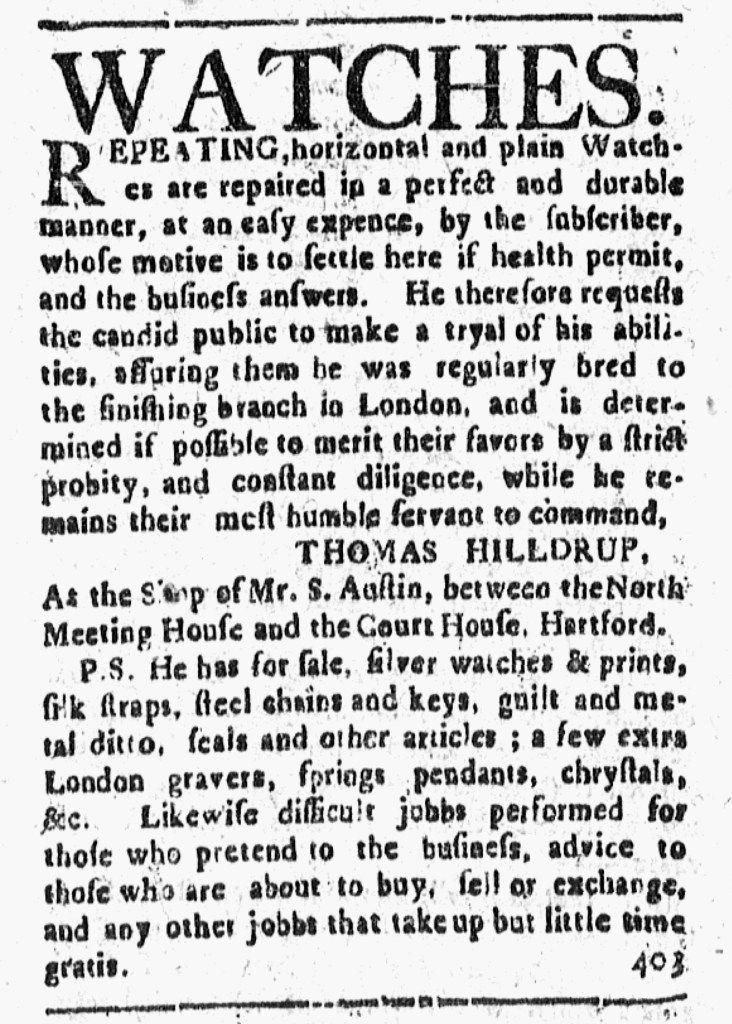
“WATCHES … Advice to those who are about to buy, sell or exchange.”

When Thomas Hilldrup arrived in Hartford in the fall of 1772, he commenced an advertising campaign in hopes to introduce himself to prospective customers who needed their watches repaired.  He first advertised in the September 15 edition of the Connecticut Courant.  That notice ran for three weeks.  On October 13, he published a slightly revised advertisement, one that appeared in every issue, except November 10, throughout the remainder of the year.  Although many advertisers ran notices for only three or four weeks, the standard minimum duration in the fee structures devised by printers, Hilldrup had good reason to repeat his advertisement for months.  He intended to remain in Hartford “if health permit[s], and the business answers.”  If he could not attract enough customers to make a living, then he would move on to another town.

Hoping to remain in Hartford, he asked prospective customers “to make a trial of his abilities” to see for themselves how well he repaired watches.  Satisfied customers would boost his reputation in the local market, but generating word-of-mouth recommendations would take some time.  For the moment, he relied on giving his credentials, a strategy often adopted by artisans, including watchmakers, who migrated from England.  Hilldrup asserted that he “was regularly bred” or trained “to the [watch] finishing branch in London.”  Accordingly, he had the skills “to merit [prospective customers’] favors” or business, aided by his “strict probity, and constant diligence.”  In addition, Hilldrup offered ancillary services in hopes of drawing customers into his shop.  He sold silver watches, steel chains, watch keys, and other merchandise.  He also provided “advice to those who are about to buy, sell or exchange” watches, giving expert guidance based on his professional experience.  Hilldrup concluded his advertisement with an offer that he likely hoped prospective customers would find too good to dismiss.  He stated that he did “any other jobbs that take up but little time gratis.”  Doing small jobs for free allowed the watchmaker to cultivate relationships with customers who might then feel inclined or even obligated to spend more money in his shop.

By running an advertisement with the headline “WATCHES” in a large font larger than the size of the title of the newspaper in the masthead, Hilldrup aimed to make his new enterprise visible to prospective customers in and near Hartford.  He included several standard appeals, such as promising low prices and noting his training in London, while also promoting ancillary services to convince readers to give him a chance.

Slavery Advertisements Published December 22, 1772

The Slavery Adverts 250 Project chronicles the role of newspaper advertising in perpetuating slavery in the era of the American Revolution. The project seeks to reveal the ubiquity of slavery in eighteenth-century life from New England to Georgia by republishing advertisements about enslaved people – for sale as individuals or in groups, wanted to purchase or for hire for short periods, runaways who liberated themselves, and those who were subsequently captured and confined in jails and workhouses – in daily digests on this site as well as in real time via the @SlaveAdverts250 Twitter feed, utilizing twenty-first-century media to stand in for the print media of the eighteenth century.

The project aims to provide modern audiences with a sense of just how often colonizers encountered these advertisements in their daily lives. Enslaved men, women, and children appeared in print somewhere in the colonies almost every single day. Those advertisements served as a constant backdrop for social, cultural, economic, and political life in colonial and revolutionary America. Colonizers who did not purport to own enslaved people were still confronted with slavery as well as invited to maintain the system by purchasing enslaved men, women, and children or assisting in the capture of so-called “runaways” who sought to free themselves from bondage. The frequency of these newspaper advertisements suggests just how embedded slavery was in colonial and revolutionary American culture in everyday interactions beyond the printed page.

These advertisements also testify to the experiences of enslaved men, women, and children, though readers must consider that those experiences have been remediated through descriptions offered by enslavers rather than enslaved people themselves. Often unnamed in the advertisements, enslaved men, women, and children were not invisible or unimportant in early America.

These advertisements appeared in colonial American newspapers 250 years ago today.

South-Carolina Gazette and Country Journal (December 22, 1772).

**********

South-Carolina Gazette and Country Journal (December 22, 1772).

**********

South-Carolina Gazette and Country Journal (December 22, 1772).

**********

South-Carolina Gazette and Country Journal (December 22, 1772).

**********

South-Carolina Gazette and Country Journal (December 22, 1772).

**********

South-Carolina Gazette and Country Journal (December 22, 1772).

December 21

What was advertised in a colonial American newspaper 250 years ago today?

Boston-Gazette (December 21, 1772).

Purchasers, especially by the Quantity, … be particular in enquiring whether they are printed by the above Printers.”

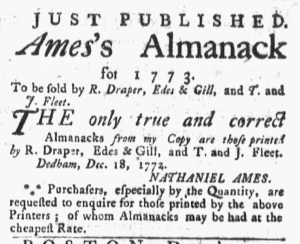
All three newspapers published in Boston on December 21, 1772, carried a notice concerning Nathaniel Ames’s almanac for 1773.  Two of them announced that the almanac was “JUST PUBLISHED” and “sold by R. Draper, Edes & Gill, and T. and J. Fleet.”  All three contained a note from the author to advise consumers that the “only true and correct ALMANACKS from my Copy, are those printed by R. Draper, Edes & Gill, and T. & [J.] Fleet.”  Either Ames or, more likely, the printers added an additional note suggesting that “Purchasers, especially by the Quantity, … be particular in enquiring whether they are printed by the above Printers; of whom ALMANACKS maybe had at the cheapest Rate.”

In addition to the almanacs printed by Draper, Edes and Gill, and the Fleets, Ezekiel Russell and John Hicks produced and sold An Astronomical Diary; or, An Almanack for the Year of Our Lord, 1773 attributed to Ames.  They printed their edition in Boston.  Printers in other towns in New England reprinted Ames’s almanac from Boston editions, including Ebenezer Watson in Hartford, Thomas Green and Samuel Green in New Haven, and Timothy Green in New London.

Massachusetts Gazette and Boston Post-Boy (December 21, 1772).

The printers who printed the “only true and correct” editions of Ames’s popular almanac each inserted the warning about counterfeit editions in their newspapers.  The Fleets ran in the Boston Evening-Post on December 21, the same day that Edes and Gill published it in the Boston-Gazette.  Richard Draper ran a more extensive version in the Massachusetts Gazette and Boston Weekly News-Letter on December 24.  To disseminate the message even more widely, the printers arranged to have the advertisement also appear in the Massachusetts Gazette and Boston Post-Boy on December 21.  Of the five newspapers published in Boston at the time, only Isaiah Thomas’s Massachusetts Spy did not carry the notice.  Instead, it featured an advertisement for the version printed by Russell and Hicks on December 24.

The brief version of the advertisement devised by Draper, Edes and Gill, and the Fleets in the Boston-Gazette, the variation that did not announce the publication of the almanac, appeared immediately below news items and, unlike other advertisements, without a line to separate it from other content.  In making those choices about placement and typography, Edes and Gill implied that information about pirated editions was newsworthy rather than solely a notice directed at consumers.  Blending news and advertising, they sought to serve the best interests of prospective customers while simultaneously protecting their own interests.

It was an interesting turn of events considering that a few years earlier it had been Draper, Edes and Gill, and the Fleets who published a pirated edition of Ames’s almanac.