
What was advertised in a colonial American newspaper 250 years ago today?
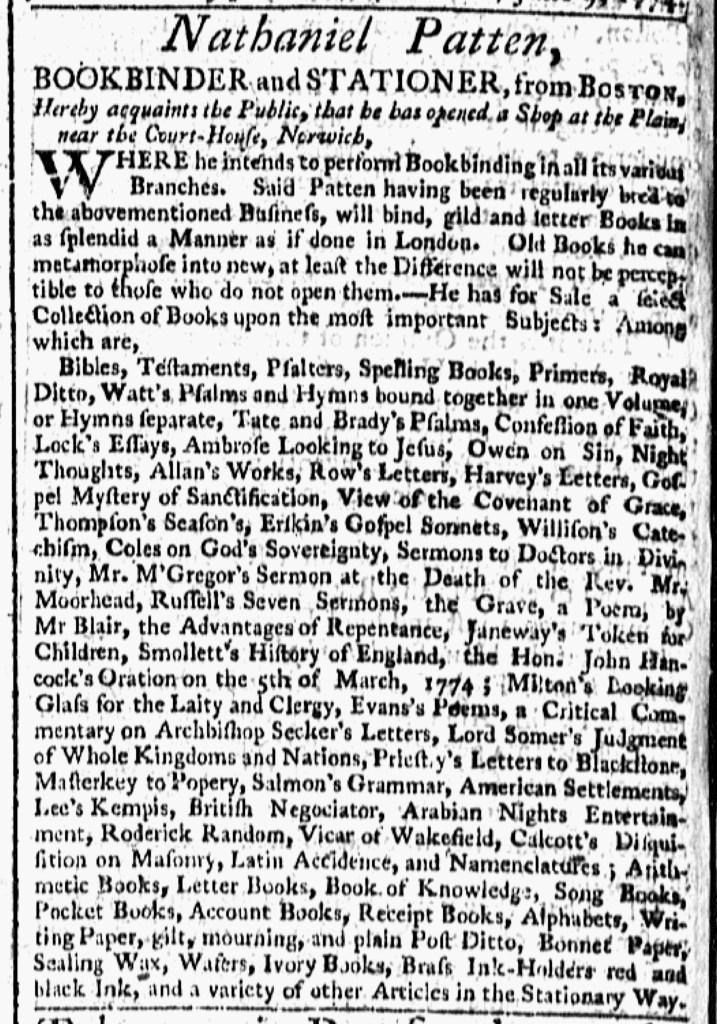
“Old Books he can metamorphose into new.”
When Nathaniel Patten, “BOOKBINDER and STATIONER, from BOSTON,” set up shop in Norwich, he placed an advertisement in the Connecticut Gazette, published in New London, but curiously not in the Norwich Packet. Perhaps he suspected that advertising in the Connecticut Gazette was the better investment since it had been in circulation for more than a decade while the Norwich Packet commenced publication only nine months earlier. Until that time, the Connecticut Gazette had been the local newspaper for Norwich, though the Connecticut Courant (published in Hartford), the Providence Gazette, and newspapers from Boston and other cities in New England made their way to Norwich, some more consistently than others depending on arrangements that subscribers made with post riders. In New England and beyond, newspapers served colonies and regions rather than just the towns where they were published. The full title of the Norwich Packet and Connecticut, Massachusetts, New-Hampshire, and Rhode Island Weekly Advertiser revealed its aspirations to do so as it built up its circulation. For the moment, however, Patten may have believed that advertising in the Connecticut Gazette would yield more customers.
The bookbinder and stationer made several appeals in hopes of drawing readers to his shop or convincing them to send orders. Like many others in his trade, he also sold books, giving over more than half the space in his advertisement to a list of books and pamphlets he stocked. Those “Books upon the most important Subjects” included “the Hon. John Hancock’s Oration on the 5th of March, 1774” in commemoration of the Boston Massacre. He also listed many kinds of paper and writing equipment, such as “Sealing Wax” and “Brass Ink-Holders,” promising a “variety of other Articles in the Stationery Way.” Patten declared that he had been “regularly bred to the [bookbinding] Business.” In other words, he received formal training as a youth, preparing him to “bind, gild and letter Books in as splendid a Manner as if done in London.” The newcomer from Boston did not merely compare his skills to what was available in that city but instead asserted that the quality of his work was equal to that produced in the metropolis at the center of the empire. To that end, Patten boasted that “Old Books he can metamorphose into new,” pledging that “at least the Difference will not be perceptible to those who do not open them.” He could not reverse wear from years of use or repair other damages to the pages themselves, but he could transform the bindings, the most visible part of any books displayed on shelves or elsewhere. That claim challenged prospective customers to put Patten to the test so they could judge for themselves what the bookbinder was capable of accomplishing. Even if they started with just one volume, satisfied customers likely meant more business over time.
[…] When Nathaniel Patten, “BOOKBINDER and STATIONER, from BOSTON,” set up shop in Norwich, he placed an advertisement in the Connecticut Gazette, published in New London, but curiously not in the Norwich Packet. Perhaps he suspected that advertising in the Connecticut Gazette was the better investment since it had been in circulation for more than a decade while the Norwich Packet commenced publication only nine months earlier. Until that time, the Connecticut Gazette had been the local newspaper for Norwich, though the Connecticut Courant (published in Hartford), the Providence Gazette, and newspapers from Boston and other cities in New England made their way to Norwich, some more consistently than others depending on arrangements that subscribers made with post riders. In New England and beyond, newspapers served colonies and regions rather than just the towns where they were published. The full title of the Norwich Packet and Connecticut, Massachusetts, New-Hampshire, and Rhode Island Weekly Advertiser revealed its aspirations to do so as it built up its circulation. For the moment, however, Patten may have believed that advertising in the Connecticut Gazette would yield more customers. The bookbinder and stationer made several appeals in hopes of drawing readers to his shop or convincing them to send orders. Like many others in his trade, he also sold books, giving over more than half the space in his advertisement to a list of books and pamphlets he stocked. Read more… […]
[…] Patten’s advertisement in the January 29, 1776, edition of the Norwich Packet was neither as lengthy nor as visually stimulating as some of his previous advertisements, but that may have been because […]