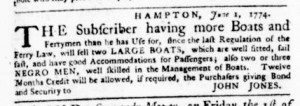
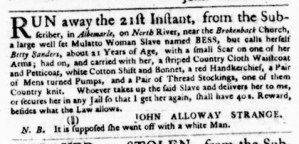
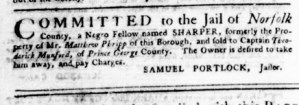
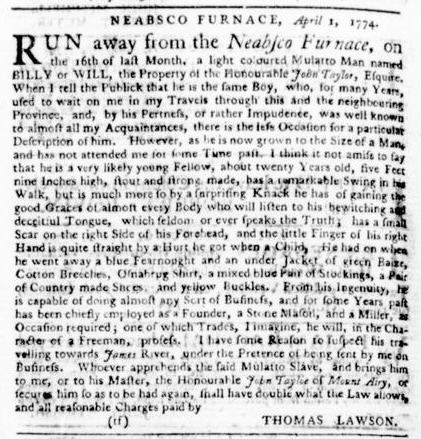
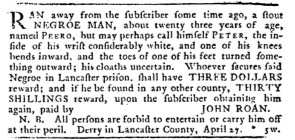
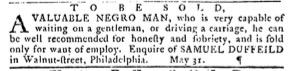
Slavery Advertisements Published June 3, 1774

The Slavery Adverts 250 Project chronicles the role of newspaper advertising in perpetuating slavery in the era of the American Revolution. The project seeks to reveal the ubiquity of slavery in eighteenth-century life from New England to Georgia by republishing advertisements about enslaved people – for sale as individuals or in groups, wanted to purchase or for hire for short periods, runaways who liberated themselves, and those who were subsequently captured and confined in jails and workhouses – in daily digests on this site as well as in real time via the @SlaveAdverts250 Twitter feed, utilizing twenty-first-century media to stand in for the print media of the eighteenth century.

The project aims to provide modern audiences with a sense of just how often colonizers encountered these advertisements in their daily lives. Enslaved men, women, and children appeared in print somewhere in the colonies almost every single day. Those advertisements served as a constant backdrop for social, cultural, economic, and political life in colonial and revolutionary America. Colonizers who did not purport to own enslaved people were still confronted with slavery as well as invited to maintain the system by purchasing enslaved men, women, and children or assisting in the capture of so-called “runaways” who sought to free themselves from bondage. The frequency of these newspaper advertisements suggests just how embedded slavery was in colonial and revolutionary American culture in everyday interactions beyond the printed page.

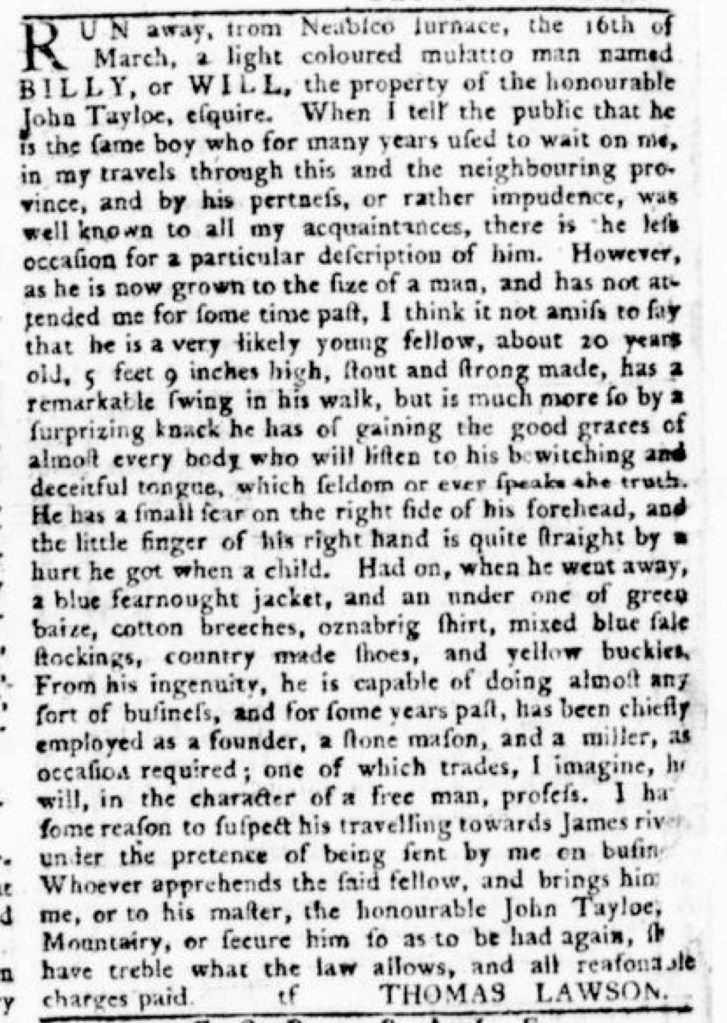
These advertisements also testify to the experiences of enslaved men, women, and children, though readers must consider that those experiences have been remediated through descriptions offered by enslavers rather than enslaved people themselves. Often unnamed in the advertisements, enslaved men, women, and children were not invisible or unimportant in early America.

These advertisements appeared in colonial American newspapers 250 years ago today.
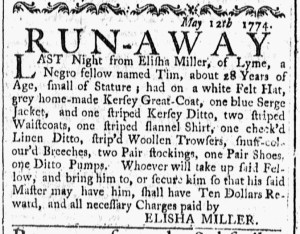
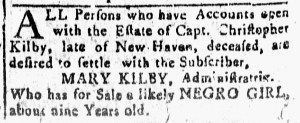
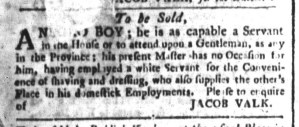
Connecticut Gazette (June 3, 1774).

**********

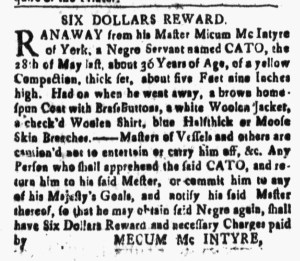
Connecticut Journal (June 3, 1774).

**********

New-Hampshire Gazette (June 3, 1774).

**********

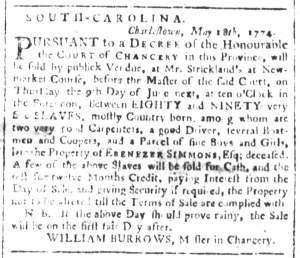
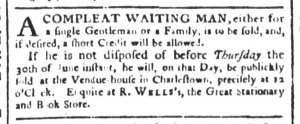
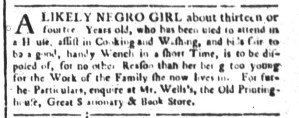
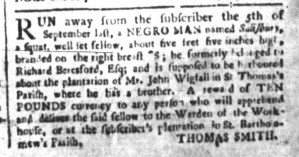
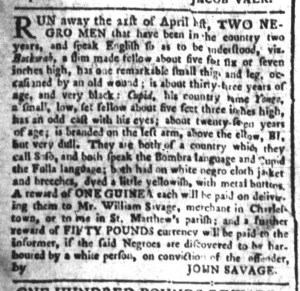
South-Carolina and American General Gazette (June 3, 1774).

**********

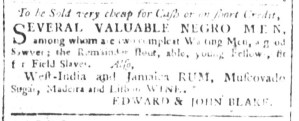
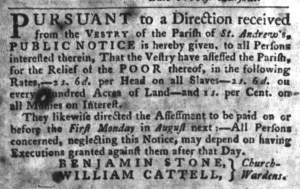
South-Carolina and American General Gazette (June 3, 1774).

**********

South-Carolina and American General Gazette (June 3, 1774).

**********

South-Carolina and American General Gazette (June 3, 1774).

**********

South-Carolina and American General Gazette (June 3, 1774).

**********

South-Carolina and American General Gazette (June 3, 1774).

**********

South-Carolina and American General Gazette (June 3, 1774).

**********

South-Carolina Gazette Extraordinary (June 3, 1774).

June 2

What was advertised in a colonial American newspaper 250 years ago today?

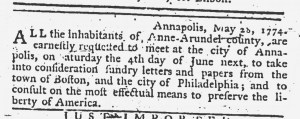
Maryland Gazette (June 2, 1774).

“Meet … to consult on the most effectual means to preserve the liberty of America.”

Advertisements in eighteenth-century newspapers served a variety of purposes.  Sometimes they carried news.  During the imperial crisis, colonizers used advertisements to help them organize.  Consider a notice that ran in the June 2, 1774, edition of the Maryland Gazette.  It advised, “ALL the inhabitants of Anne-Arundel county, are earnestly requested to meet at the city of Annapolis, on Saturday the 4th day of June next, to take into consideration sundry letters and papers from the town of Boston, and the city of Philadelphia.”  The organizers also planned for the participants to “consult on the most effectual means to preserve the liberty of America.”  Those “sundry letters and papers” referred to news of the Boston Port Act.  As punishment for the Boston Tea Party, Parliament closed and blockaded Boston Harbor, starting June 1 and continuing until the residents of that town paid for the tea destroyed the previous December.

More details from some of those “sundry letters and papers” appeared elsewhere in that issue of the Maryland Gazette, including “Extracts of private letters from London, dated April 7 and 8, to private persons in New-York and Philadelphia” on the front page, yet the call to meeting was not among the news items.  It appeared among the advertisements, though it received a privileged place as the first advertisement.  It ran immediately after the list of vessels that entered and cleared the customs house in Annapolis, traditionally the final news item.  The printers, Anne Catherine Green and Son, also ran a note that the “conclusion of the essay on the advantages of a classical education, is postponed for want of room” and “Advertisements omitted will be inserted next week.”  Yet they not only made certain to include the advertisement about the meeting to discuss news related to the Boston Port Act and how to respond but also placed it where readers who might not read the advertisements as closely as the news and editorials would be more likely to see it.  John Holt had done the same with a call to meeting that ran in the May 19 edition of the New-York Journal.  The press played an important role in “preserv[ing] the liberty of America” during the era of the American Revolution, but not solely in the sections of newspapers that carried coverage of current events.  Advertisements also contributed to keeping readers informed and mobilizing colonizers to resist legislation passed by Parliament.

Slavery Advertisements Published June 2, 1774

The Slavery Adverts 250 Project chronicles the role of newspaper advertising in perpetuating slavery in the era of the American Revolution. The project seeks to reveal the ubiquity of slavery in eighteenth-century life from New England to Georgia by republishing advertisements about enslaved people – for sale as individuals or in groups, wanted to purchase or for hire for short periods, runaways who liberated themselves, and those who were subsequently captured and confined in jails and workhouses – in daily digests on this site as well as in real time via the @SlaveAdverts250 Twitter feed, utilizing twenty-first-century media to stand in for the print media of the eighteenth century.

The project aims to provide modern audiences with a sense of just how often colonizers encountered these advertisements in their daily lives. Enslaved men, women, and children appeared in print somewhere in the colonies almost every single day. Those advertisements served as a constant backdrop for social, cultural, economic, and political life in colonial and revolutionary America. Colonizers who did not purport to own enslaved people were still confronted with slavery as well as invited to maintain the system by purchasing enslaved men, women, and children or assisting in the capture of so-called “runaways” who sought to free themselves from bondage. The frequency of these newspaper advertisements suggests just how embedded slavery was in colonial and revolutionary American culture in everyday interactions beyond the printed page.

These advertisements also testify to the experiences of enslaved men, women, and children, though readers must consider that those experiences have been remediated through descriptions offered by enslavers rather than enslaved people themselves. Often unnamed in the advertisements, enslaved men, women, and children were not invisible or unimportant in early America.

These advertisements appeared in colonial American newspapers 250 years ago today.

Massachusetts Spy (June 2, 1774).

**********

New-York Journal (June 2, 1774).

**********

Rivington’s New-York Gazetteer (June 2, 1774).

**********

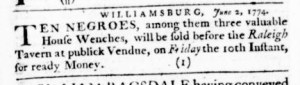
Virginia Gazette [Purdie and Dixon] (June 2, 1774).

**********

Virginia Gazette [Purdie and Dixon] (June 2, 1774).

**********

Virginia Gazette [Purdie and Dixon] (June 2, 1774).

**********

Virginia Gazette [Purdie and Dixon] (June 2, 1774).

**********

Virginia Gazette [Purdie and Dixon] (June 2, 1774).

**********

Virginia Gazette [Purdie and Dixon] (June 2, 1774).

**********

Virginia Gazette [Purdie and Dixon] (June 2, 1774).

**********

Virginia Gazette [Purdie and Dixon] (June 2, 1774).

**********

Virginia Gazette [Purdie and Dixon] (June 2, 1774).

**********

Virginia Gazette [Purdie and Dixon] (June 2, 1774).

**********

Virginia Gazette [Rind] (June 2, 1774).

June 1

What was advertised in a colonial American newspaper 250 years ago today?

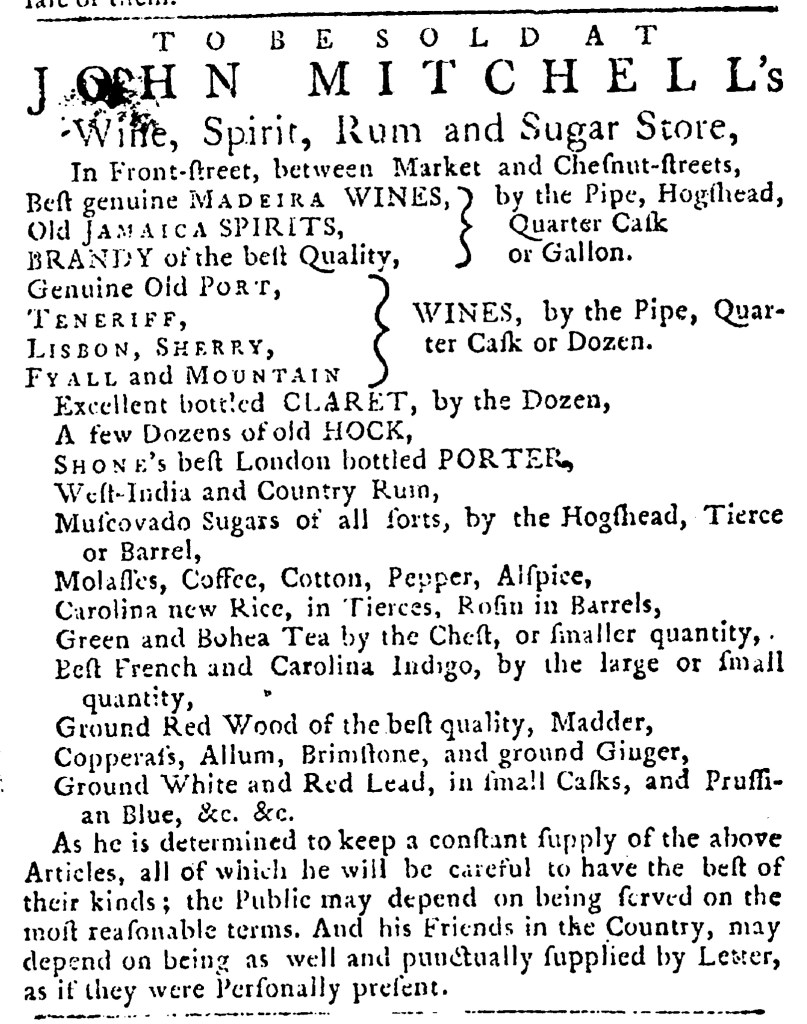
Pennsylvania Journal (June 1, 1774).

“Wine, Spirit, Rum and Sugar Store.”

John Mitchell ran the “Wine, Spirit, Rum and Sugar Store” on Front Street in Philadelphia in the 1770s.  Thomas Batt’s “WINE and SPIRIT STORE” was among his competitors for customers in the bustling urban port and its hinterlands.  To attract the attention of prospective customers, Mitchell provided an extensive list of his inventory in his advertisement in the June 1, 1774, edition of the Pennsylvania Journal.  He sold “Best genuine MADEIRA WINES, Old JAMAICA SPIRITS, [and] BRANDY of the best Quality, by the Pipe, Hogshead, Quarte Cask or Gallon.”  Similarly, his patrons could purchase several kinds of wine, including “Genuine OLD PORT, [and] TENRIFF, LISBON, SHERRY, FYALL and MOUNTAIN” wines, “by the Pipe, Quarter Cask or Dozen.  Like Batt, he offered a choice among quantities.  “Excellent bottled CLARET,” “SHONE’S best London PORTER,” and “West-India and Country Rum” rounded out his selection of alcohol.  Mitchell also stocked groceries, including sugar, molasses, coffee, rice, and the increasingly problematic “Green and Bohea Tea.”

Beyond such a selection, Mitchell also aimed to convince readers that he made shopping at his store convenient.  He advised “Friends in the Country” that they “may depend on being as well and punctually supplied by Letter, as if they were Personally present.”  In other words, Mitchell did not give preference or better treatment to customers who visited his store; instead, he cultivated relationships with customers in towns and villages outside of Philadelphia by providing the same level of service, including filling orders as quickly as possible, so they felt comfortable continuing to buy from him rather than turn to his competitors.  That also meant maintaining “a constant supply” of the merchandise listed in his advertisement so customers did not have to wait on his supply chain after placing their orders.  Mitchell combined these appeals with promises of superior quality and fair prices, declaring that he “will be careful to have the best of their kinds” and that “the Public may depend on being served on the most reasonable terms.”  Although the list of his wares accounted for most of the space in his advertisement, Mitchell deployed a variety of other marketing strategies to entice customers to shop at the “Wine, Spirit, Rum and Sugar Store.”

Slavery Advertisements Published June 1, 1774

The Slavery Adverts 250 Project chronicles the role of newspaper advertising in perpetuating slavery in the era of the American Revolution. The project seeks to reveal the ubiquity of slavery in eighteenth-century life from New England to Georgia by republishing advertisements about enslaved people – for sale as individuals or in groups, wanted to purchase or for hire for short periods, runaways who liberated themselves, and those who were subsequently captured and confined in jails and workhouses – in daily digests on this site as well as in real time via the @SlaveAdverts250 Twitter feed, utilizing twenty-first-century media to stand in for the print media of the eighteenth century.

The project aims to provide modern audiences with a sense of just how often colonizers encountered these advertisements in their daily lives. Enslaved men, women, and children appeared in print somewhere in the colonies almost every single day. Those advertisements served as a constant backdrop for social, cultural, economic, and political life in colonial and revolutionary America. Colonizers who did not purport to own enslaved people were still confronted with slavery as well as invited to maintain the system by purchasing enslaved men, women, and children or assisting in the capture of so-called “runaways” who sought to free themselves from bondage. The frequency of these newspaper advertisements suggests just how embedded slavery was in colonial and revolutionary American culture in everyday interactions beyond the printed page.

These advertisements also testify to the experiences of enslaved men, women, and children, though readers must consider that those experiences have been remediated through descriptions offered by enslavers rather than enslaved people themselves. Often unnamed in the advertisements, enslaved men, women, and children were not invisible or unimportant in early America.

These advertisements appeared in colonial American newspapers 250 years ago today.

Pennsylvania Gazette (June 1, 1774).

**********

Pennsylvania Journal (June 1, 1774).

**********

Pennsylvania Journal (June 1, 1774).

**********

Pennsylvania Journal (June 1, 1774).