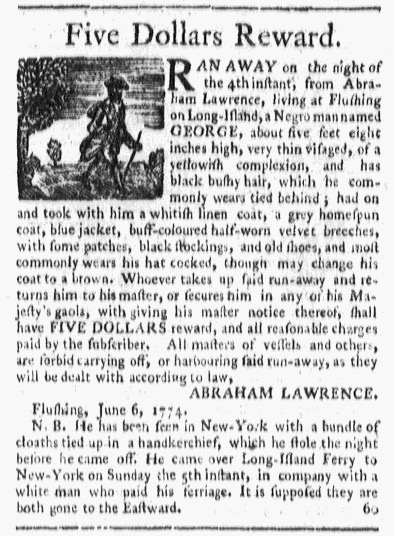
Slavery Advertisements Published June 9, 1774

The Slavery Adverts 250 Project chronicles the role of newspaper advertising in perpetuating slavery in the era of the American Revolution. The project seeks to reveal the ubiquity of slavery in eighteenth-century life from New England to Georgia by republishing advertisements about enslaved people – for sale as individuals or in groups, wanted to purchase or for hire for short periods, runaways who liberated themselves, and those who were subsequently captured and confined in jails and workhouses – in daily digests on this site as well as in real time via the @SlaveAdverts250 Twitter feed, utilizing twenty-first-century media to stand in for the print media of the eighteenth century.

The project aims to provide modern audiences with a sense of just how often colonizers encountered these advertisements in their daily lives. Enslaved men, women, and children appeared in print somewhere in the colonies almost every single day. Those advertisements served as a constant backdrop for social, cultural, economic, and political life in colonial and revolutionary America. Colonizers who did not purport to own enslaved people were still confronted with slavery as well as invited to maintain the system by purchasing enslaved men, women, and children or assisting in the capture of so-called “runaways” who sought to free themselves from bondage. The frequency of these newspaper advertisements suggests just how embedded slavery was in colonial and revolutionary American culture in everyday interactions beyond the printed page.

These advertisements also testify to the experiences of enslaved men, women, and children, though readers must consider that those experiences have been remediated through descriptions offered by enslavers rather than enslaved people themselves. Often unnamed in the advertisements, enslaved men, women, and children were not invisible or unimportant in early America.

These advertisements appeared in colonial American newspapers 250 years ago today.
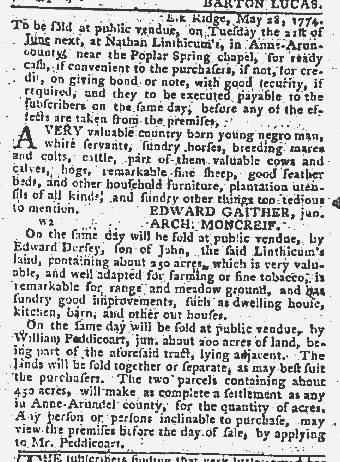
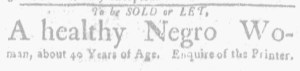
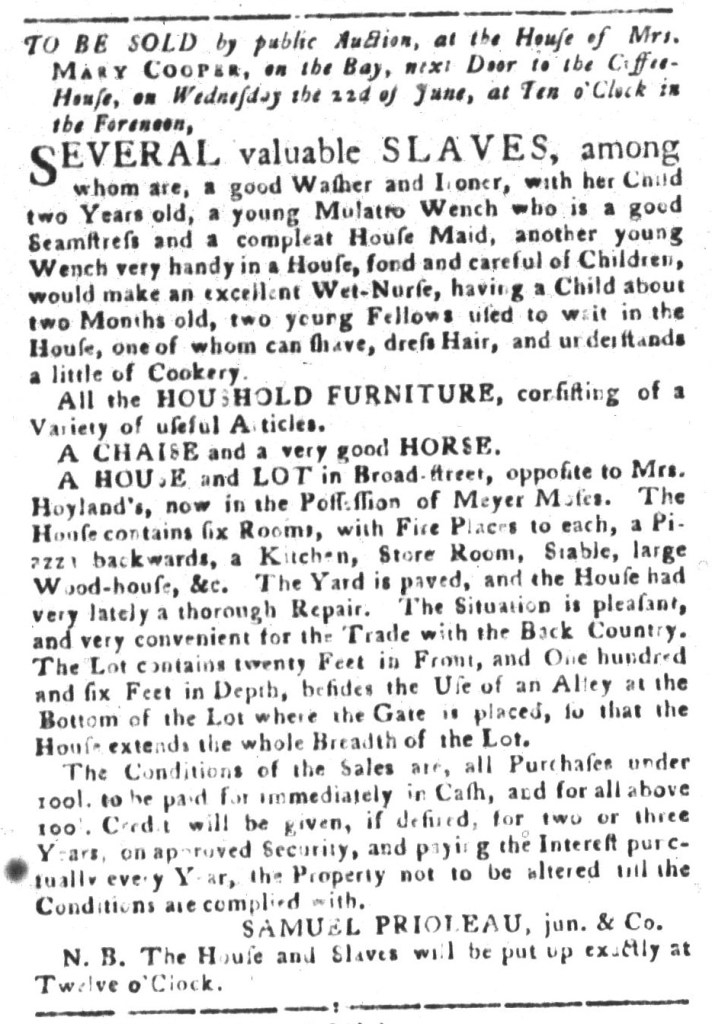
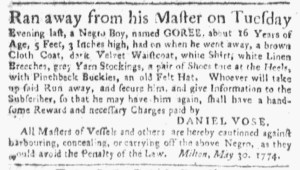
Maryland Gazette (June 9, 1774).

**********
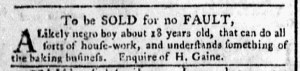
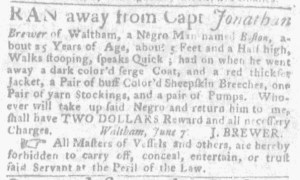
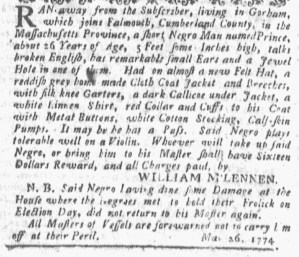
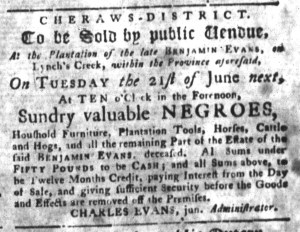
Massachusetts Gazette and Boston Weekly News-Letter (June 9, 1774).

**********
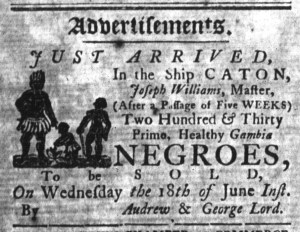
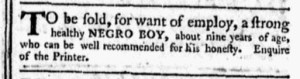
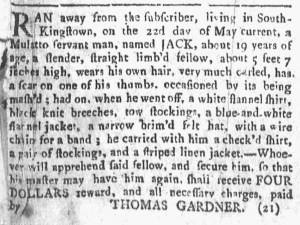
Massachusetts Gazette and Boston Weekly News-Letter (June 9, 1774).

**********
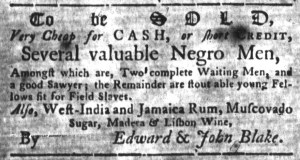
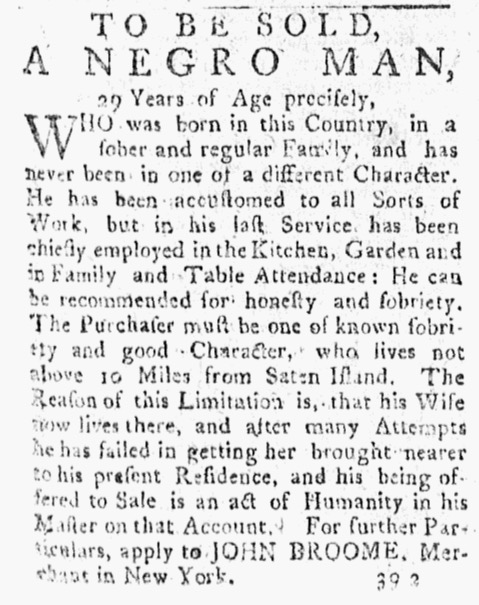
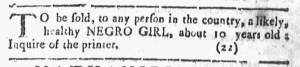
Massachusetts Spy (June 9, 1774).

**********
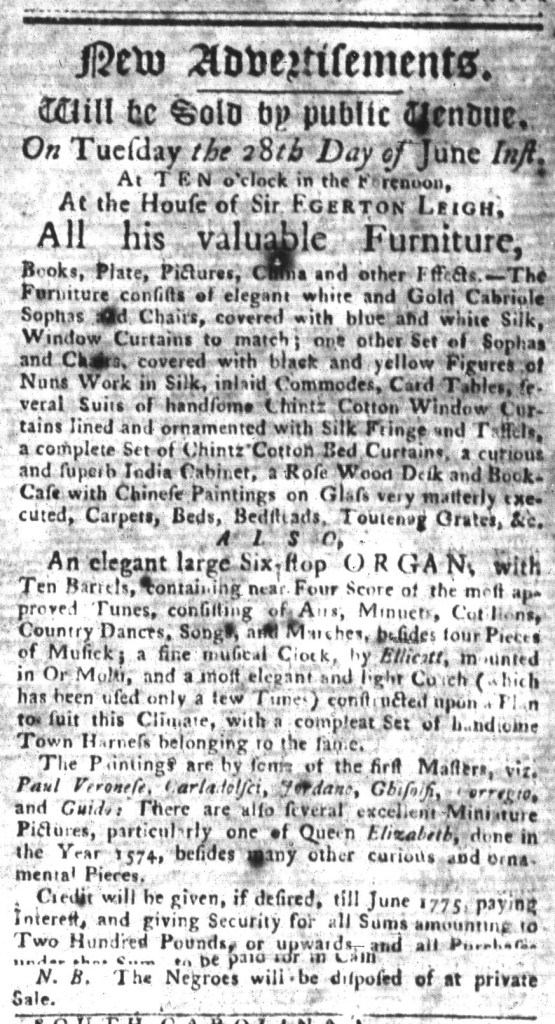
New-York Journal (June 9, 1774).

**********

Rivington’s New-York Gazetteer (June 9, 1774).

**********
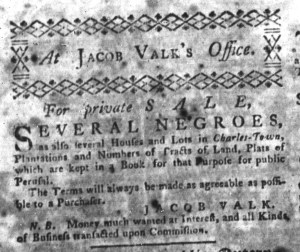
Rivington’s New-York Gazetteer (June 9, 1774).

**********
Virginia Gazette [Purdie and Dixon] (June 9, 1774).

**********
Virginia Gazette [Purdie and Dixon] (June 9, 1774).

**********
Virginia Gazette [Purdie and Dixon] (June 9, 1774).

**********
Virginia Gazette [Purdie and Dixon] (June 9, 1774).

**********
Virginia Gazette [Purdie and Dixon] (June 9, 1774).

**********
Virginia Gazette [Rind] (June 9, 1774).

**********

Virginia Gazette [Rind] (June 9, 1774).

June 8

What was advertised in a colonial American newspaper 250 years ago today?

Pennsylvania Gazette (June 8, 1774).

“There are few or no Inns for the entertainment of travellers, to the southward of Chestnut-street.”

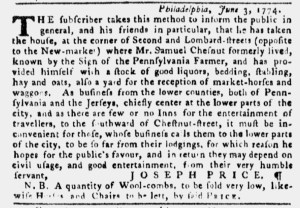
Location!  Location!!  Location!!!  That was the appeal that Joseph Price made when he advertised that he now operated the inn “known by the Sign of the Pennsylvania Farmer” at the corner of Second and Lombard Streets in Philadelphia.  In an advertisement in the June 8, 1774, edition of the Pennsylvania Gazette, he described the location as ideal for colonizers “from the lower counties, both of Pennsylvania and the Jerseys,” heading to market in the bustling city.  Price noted that the business conducted by those visitors “chiefly center[s] at the lower parts of the city,” yet “there are few or no Inns for the entertainment of travellers, to the southward of Chestnut-street.”  The innkeeper insisted that “it must be inconvenient for those, whose business calls them to the lower parts of the city, to be so far from their lodgings.”  Fortunately, they could choose to stay at the Sign of the Pennsylvania Farmer, putting them as close as possible to the market.

Price did not rely on location alone to convince visitors to Philadelphia to lodge there.  He also promoted other amenities that guests could expect, including “a stock of good liquors, bedding, stabling, [and] hay and oats.”  Guests would experience a comfortable stay, whether socializing over drinks or resting in their rooms, while the staff cared for their horses.  In addition to the stables, Price also had a “yard for the reception of market-horses and wagons.”  His guests did not need to go to the trouble of making separate arrangements for their reception at another establishment.  All in all, Price facilitated visits to the city, especially for farmers heading to market from towns to the south.  His marketing strategies anticipated those aimed at modern business travelers, emphasizing the proximity of his inn to the places they conducted business as well as accommodations, such as the yard for parking their wagons, provided specifically to meet their needs.  In addition, a trip to the city did not have to be all business without comforts.  Guests at the Sign of the Pennsylvania Farmer could indulge in the “good liquors” without having to venture elsewhere and then sleep well in the comfortable bedding.  For those who stayed at Price’s inn, a journey undertaken for business also had its pleasures.

Slavery Advertisements Published June 8, 1774

The Slavery Adverts 250 Project chronicles the role of newspaper advertising in perpetuating slavery in the era of the American Revolution. The project seeks to reveal the ubiquity of slavery in eighteenth-century life from New England to Georgia by republishing advertisements about enslaved people – for sale as individuals or in groups, wanted to purchase or for hire for short periods, runaways who liberated themselves, and those who were subsequently captured and confined in jails and workhouses – in daily digests on this site as well as in real time via the @SlaveAdverts250 Twitter feed, utilizing twenty-first-century media to stand in for the print media of the eighteenth century.

The project aims to provide modern audiences with a sense of just how often colonizers encountered these advertisements in their daily lives. Enslaved men, women, and children appeared in print somewhere in the colonies almost every single day. Those advertisements served as a constant backdrop for social, cultural, economic, and political life in colonial and revolutionary America. Colonizers who did not purport to own enslaved people were still confronted with slavery as well as invited to maintain the system by purchasing enslaved men, women, and children or assisting in the capture of so-called “runaways” who sought to free themselves from bondage. The frequency of these newspaper advertisements suggests just how embedded slavery was in colonial and revolutionary American culture in everyday interactions beyond the printed page.

These advertisements also testify to the experiences of enslaved men, women, and children, though readers must consider that those experiences have been remediated through descriptions offered by enslavers rather than enslaved people themselves. Often unnamed in the advertisements, enslaved men, women, and children were not invisible or unimportant in early America.

These advertisements appeared in colonial American newspapers 250 years ago today.

Pennsylvania Gazette (June 8, 1774).

**********

Pennsylvania Journal (June 8, 1774).

**********

Pennsylvania Journal (June 8, 1774).

**********

Pennsylvania Journal (June 8, 1774).

**********

Pennsylvania Journal (June 8, 1774).

June 7

What was advertised in a colonial American newspaper 250 years ago today?

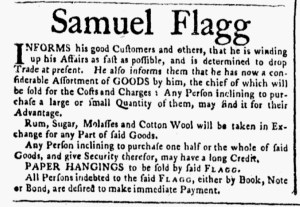
Essex Gazette (June 7, 1774).

“He is winding up his Affairs as fast as possible, and is determined to drop Trade.”

It was a going out of business sale by another name.  As summer approached in 1774, Samuel Flagg took to the pages of the Essex Gazette to inform residents of Salem and nearby towns that “he is winding up his Affairs as fast as possible, and is determined to drop Trade at present.”  That meant that he needed to get rid of his existing inventory, “a considerable Assortment of GOODS.”  For bargain hunters or any consumers looking for good deals, this was quite an opportunity since Flagg pledged to sell his wares “for the Costs and Charges” without significant retail markup.  He attempted to entice customers with promises that they “may find it for their Advantage” to purchase “a large or small Quantity” of his remaining goods.  Flagg also presented his decision to “drop Trade” as favorable to other retailers, suggesting that they might be interested in acquiring “one half or the whole of said Goods.”  Provided that they “give Security,” Flagg was willing to allow “a long Credit” for payment.

Flagg had a history of publishing colorful advertisements in the Essex Gazette, commenting on the marketing strategies deployed by some of his competitors, and it was not the first time that he announced plans to liquidate his merchandise.  A year earlier, he asserted “his present Determination is to go home to London in the Fall; he is therefore determined to sell off the whole of his Goods.”  The entrepreneur made bold claims that he would part with his goods “as low as they can be bought at any Store on the Continent, without any Exception.”  His “Determination” did not result in returning to London in the fall of 1773, but it may have resulted in some good deals for consumers who took advantage of his intentions.  Those who benefited from that sale might have been especially eager to examine Flagg’s goods this time, though others who did not consider the savings all that significant likely would have been wary of renewed promises.  Today, consumers become skeptical of retailers who repeatedly hold going out of business sales yet do not close their doors, realizing that liquidation prices are just their everyday prices.  Flagg risked the same response if he resorted to this marketing strategy too many times.

Slavery Advertisements Published June 7, 1774

The Slavery Adverts 250 Project chronicles the role of newspaper advertising in perpetuating slavery in the era of the American Revolution. The project seeks to reveal the ubiquity of slavery in eighteenth-century life from New England to Georgia by republishing advertisements about enslaved people – for sale as individuals or in groups, wanted to purchase or for hire for short periods, runaways who liberated themselves, and those who were subsequently captured and confined in jails and workhouses – in daily digests on this site as well as in real time via the @SlaveAdverts250 Twitter feed, utilizing twenty-first-century media to stand in for the print media of the eighteenth century.

The project aims to provide modern audiences with a sense of just how often colonizers encountered these advertisements in their daily lives. Enslaved men, women, and children appeared in print somewhere in the colonies almost every single day. Those advertisements served as a constant backdrop for social, cultural, economic, and political life in colonial and revolutionary America. Colonizers who did not purport to own enslaved people were still confronted with slavery as well as invited to maintain the system by purchasing enslaved men, women, and children or assisting in the capture of so-called “runaways” who sought to free themselves from bondage. The frequency of these newspaper advertisements suggests just how embedded slavery was in colonial and revolutionary American culture in everyday interactions beyond the printed page.

These advertisements also testify to the experiences of enslaved men, women, and children, though readers must consider that those experiences have been remediated through descriptions offered by enslavers rather than enslaved people themselves. Often unnamed in the advertisements, enslaved men, women, and children were not invisible or unimportant in early America.

These advertisements appeared in colonial American newspapers 250 years ago today.

Connecticut Courant (June 7, 1774).

**********

Connecticut Courant (June 7, 1774).

**********

Essex Gazette (June 7, 1774).

**********

Essex Gazette (June 7, 1774).

**********

Essex Gazette (June 7, 1774).

**********

South-Carolina Gazette and Country Journal (June 7, 1774).

**********

South-Carolina Gazette and Country Journal (June 7, 1774).

**********

South-Carolina Gazette and Country Journal (June 7, 1774).

**********

South-Carolina Gazette and Country Journal (June 7, 1774).

**********

South-Carolina Gazette and Country Journal (June 7, 1774).

**********

South-Carolina Gazette and Country Journal (June 7, 1774).

**********

South-Carolina Gazette and Country Journal (June 7, 1774).

**********

South-Carolina Gazette and Country Journal (June 7, 1774).

June 6

What was advertised in a colonial American newspaper 250 years ago today?

New-York Gazette and Weekly Mercury (June 6, 1774).

Stove Grate Warehouse, in Beaver-street, (late Parker’s printing-office).”

William Bayley hawked a variety of merchandise to decorate a home according to the latest styles at his “Stove Grate Warehouse” in New York, far more than the name of his shop suggested.  In an advertisement in the June 6, 1774, edition of the New-York Gazette and Weekly Mercury, he listed an array of items recently imported from London, including a “New and general assortment of hard-ware, toys and trinkets; plated, japan’d and brown tea urns and coffee pots of the newest fashions; [and] a large assortment of paper hangings [or wallpaper] of the newest patterns.”  Bayley also stocked a “small assortment of china” and “a number of other articles too tedious to mention.”  He catered to taste while giving consumers choices for outfitting their homes for their own comfort and to impress visitors.

To give prospective customers a glimpse of what they might encounter at his “Warehouse” of decorative arts, Bayley adorned his advertisement with a woodcut depicting an ornate mantel with a stove grate.  Perhaps a similar image appeared on a sign that marked the location of his shop.  The border that enclosed it suggested that might have been the case. Incorporating such an image into his advertisement represented a significant investment for Bayley.  He had to commission the woodcut plus pay for twice as much space in the newspaper, yet he must have considered it worth the expense to increase the chances that customers would come to his new store in the space previously occupied by Samuel F. Parker’s printing office.  Given that the “Stove Grate Warehouse” was a new endeavor, Bayley may have considered even more necessary to make an impression in the public prints, strategically choosing a visual image over the lengthy lists of their inventories that other entrepreneurs, including James Morton and Richard Sause, published in the June 6 edition of the New-York Gazette and Weekly Mercury.  In the early twentieth century advertising executives coined the phrase “a picture is worth a thousand words,” but Bayley and other advertisers already deployed that concept during the era of the American Revolution.

Slavery Advertisements Published June 6, 1774

The Slavery Adverts 250 Project chronicles the role of newspaper advertising in perpetuating slavery in the era of the American Revolution. The project seeks to reveal the ubiquity of slavery in eighteenth-century life from New England to Georgia by republishing advertisements about enslaved people – for sale as individuals or in groups, wanted to purchase or for hire for short periods, runaways who liberated themselves, and those who were subsequently captured and confined in jails and workhouses – in daily digests on this site as well as in real time via the @SlaveAdverts250 Twitter feed, utilizing twenty-first-century media to stand in for the print media of the eighteenth century.

The project aims to provide modern audiences with a sense of just how often colonizers encountered these advertisements in their daily lives. Enslaved men, women, and children appeared in print somewhere in the colonies almost every single day. Those advertisements served as a constant backdrop for social, cultural, economic, and political life in colonial and revolutionary America. Colonizers who did not purport to own enslaved people were still confronted with slavery as well as invited to maintain the system by purchasing enslaved men, women, and children or assisting in the capture of so-called “runaways” who sought to free themselves from bondage. The frequency of these newspaper advertisements suggests just how embedded slavery was in colonial and revolutionary American culture in everyday interactions beyond the printed page.

These advertisements also testify to the experiences of enslaved men, women, and children, though readers must consider that those experiences have been remediated through descriptions offered by enslavers rather than enslaved people themselves. Often unnamed in the advertisements, enslaved men, women, and children were not invisible or unimportant in early America.

These advertisements appeared in colonial American newspapers 250 years ago today.

Boston Evening-Post (June 6, 1774).

**********

Boston Evening-Post (June 6, 1774).

**********

Boston-Gazette (June 6, 1774).

**********

Newport Mercury (June 6, 1774).

**********

Newport Mercury (June 6, 1774).

**********

New-York Gazette and Weekly Mercury (June 6, 1774).

**********

South-Carolina Gazette (June 6, 1774).

**********

South-Carolina Gazette (June 6, 1774).

**********

South-Carolina Gazette (June 6, 1774).

**********

South-Carolina Gazette (June 6, 1774).

**********

South-Carolina Gazette (June 6, 1774).

**********

South-Carolina Gazette (June 6, 1774).

**********

South-Carolina Gazette (June 6, 1774).

**********

South-Carolina Gazette (June 6, 1774).

**********

Supplement to the South-Carolina Gazette (June 6, 1774).

**********

Supplement to the South-Carolina Gazette (June 6, 1774).

**********

Supplement to the South-Carolina Gazette (June 6, 1774).

**********

Supplement to the South-Carolina Gazette (June 6, 1774).

June 5

What was advertised in a colonial American newspaper 250 years ago this week?

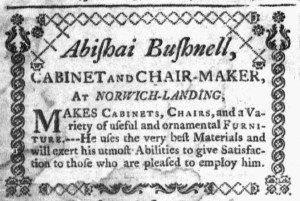
Norwich Packet (June 2, 1774).

“CABINETS, CHAIRS, and a variety of useful and ornamental FURNITURE.”

Alexander Robertson, James Robertson, and John Trumbull had been publishing the Norwich Packet for less than a year when Abishai Bushnell, “CABINET AND CHAIR-MAKER,” ran an advertisement with distinctive graphic design elements.  One of the printers or one of the compositors who worked in the printing office enclosed Bushnell’s copy within a border comprised of decorative ornaments.  That set it apart from other content, both news and advertising, in the Norwich Packet.  Bushnell may have also arranged to have his advertisement printed separated to use as labels for the “CABINETS, CHAIRS, and a variety of useful and ornamental FURNITURE” he made in his shop.

Except for the packet ship carrying letters from one port to another depicted in the masthead, the Norwich Packet did not usually feature visual images, neither to accompany news nor to adorn advertisements.  That included woodcuts of ships, houses, horses, indentured servants, and enslaved people, stock images that many printers made available to advertisers.  Yet the compositors did make liberal use of printing ornaments to indicate where one news item or editorial ended and another began and, especially, to separate advertisements from each other.  An intricate border also enclosed the first letter of the first word in the first article on the first page of each edition of the Norwich Packet, a design that changed every few weeks.  The masthead also made use of decorative type above and below the date of the newspaper, though that was a more recent innovation as the compositor experimented with the appearance of the front page.

Apparently, that was enough to convince Bushnell that Robertson, Robertson, and Trumbull could produce an advertisement that would attract attention with an ornate border that made it unlike anything else that appeared in the pages of the Norwich Packet.  The cabinetmaker almost certainly placed a special order or gave specific instructions about how he wished his advertisement to look.  After all, even though the compositor incorporated a lot of decorative type into each edition of the newspaper, no other advertisements received such treatment.  Bushnell did not opt for a woodcut of a chair or other piece of furniture representing his trade, but he did find a way to make his advertisement more visible and more memorable.

Decorative borders enclosing the first letter of the first word in the first item on the first page of the Norwich Packet (left to right: March 24, 1774; April 21, 1774; April 28, 1774; May 5, 1774; May 12, 1774).

June 4

What was advertised in a colonial American newspaper 250 years ago today?

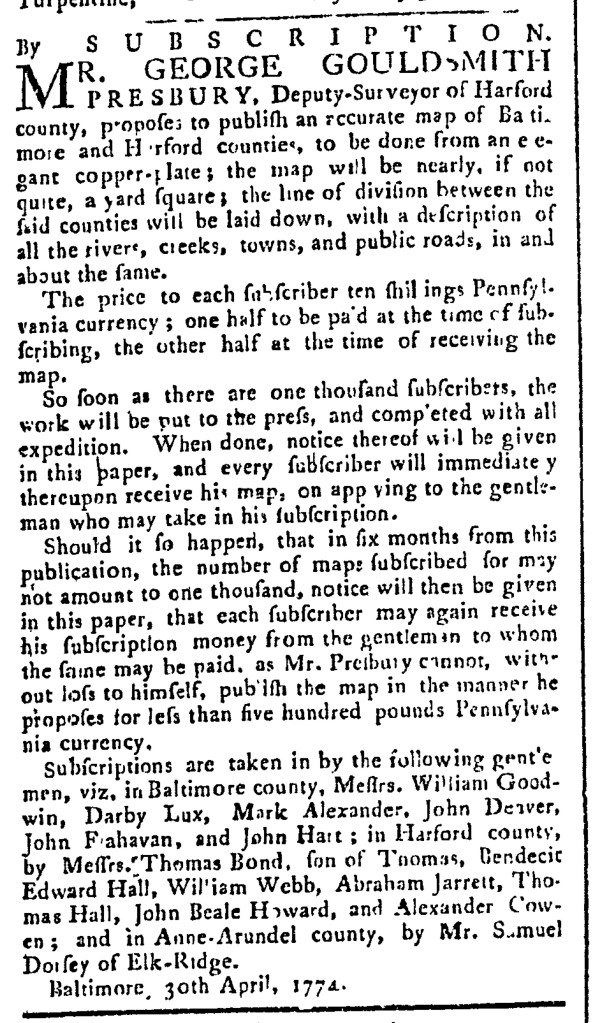
Maryland Journal (June 4, 1774).

“An accurate map of Baltimore and Harford counties.”

Authors, booksellers, and printers often published books and magazines by subscription in the eighteenth century … or at least attempted to do so.  Before taking publications to press, they distributed subscription proposals to encourage interest and assess demand.  Subscribers reserved copies in advance, sometimes paying deposits.  If the publishers determined that the number of subscribers would make books or magazines viable enterprises, they moved forward with the proposed works.  If subscriptions did not generate sufficient revenue, publishers abandoned projects.

Artists and engravers also used subscriptions for publishing prints, as did surveyors for maps.  George Gouldsmith Presbury, “Deputy-Surveyor of Harford county” in Maryland, published subscription proposals for “an accurate map of Baltimore and Harford counties” in the Maryland Journal, Baltimore’s first newspaper, in 1774.  That the surveyor envisioned a market for this map testified to the growing significance of Baltimore on the eve of the American Revolution.  The map “will be nearly, if not quite, a yard square” and feature “a description of all the rivers, creeks, town, and public roads.”  Presbury needed commitments from “one thousand subscribers” before “the work will be put to press.”  To aid in the endeavor, more than a dozen local agents in Baltimore, Harford, and Anne Arundel Counties accepted subscriptions and deposits.  Upon publication, Presbury would advertise in the Maryland Journal once again, calling on subscribers to collect their maps form the local agents who accepted their subscriptions.

Presbury also allowed for the possibility that the market would not yet support this project.  He allowed for six months for subscribers to reserve their copies, advising that he “cannot, without loss to himself, publish the map in the manner he proposes” if he did not raise enough funds.  If necessary, “notice will then be given in this paper” that the proposal had not succeeded and “each subscriber may again receive his subscription money” from the local agent that received it.  Apparently, that was the case, though Presbury did publish A New and Accurate Map of Baltimore-Town six years later. Presbury and other prospective publishers used subscription proposals to take risks in the marketplace for books, magazines, prints, and maps, but only to an extent, while shielding themselves from losses.

June 3

What was advertised in a colonial American newspaper 250 years ago today?

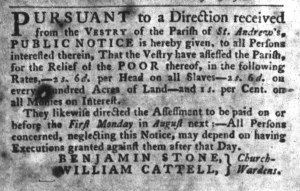
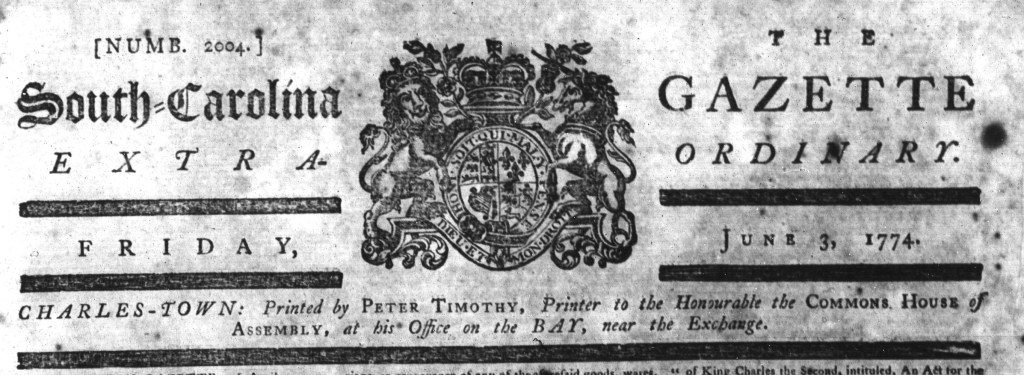
South-Carolina Gazette Extraordinary (June 3, 1774).

“The Vestry have assessed the Parish, for the Relief of the POOR.”

Peter Timothy usually published the South-Carolina Gazette on Mondays in 1774, but upon receiving the text of the Boston Port Act he considered the news momentous enough to merit an extraordinary edition on Friday, June 3.  Word certainly circulated via conversations among colonizers, yet Timothy gave them the opportunity to read the act for themselves and see all the details that might otherwise have been distorted as the news traveled.  The masthead for the extraordinary featured thick black lines, a symbol of mourning that usually signified the death of a prominent official but in this case lamented the death of liberty in the colonies.

The “Act to discontinue … the landing and discharging, lading or shipping of Hoods, Wares, or Merchandize, at the Town, and within the Harbour of Boston” accounted for the entire front page of the extraordinary.  News and editorials originally published in Boston and Philadelphia ran on the second page and most of the third.  Timothy had too much content for a two-page supplement, so he opted for four pages.  That left a page and a half to fill.  The printer opted for advertisements, items with type already set.  He certainly had enough of that kind of content at his printing office.  Advertising comprised three of the twelve columns in the previous standard edition of the South-Carolina Gazette and all four pages of the supplement distributed on the same day.  Yet Timothy may have been selective with which advertisements he chose to deliver with confirmation of the Boston Port Act.  The extraordinary did not include any notices from purveyors of goods and services hawking their wares.  Instead, Timothy chose advertisements that delivered news, including the “PRESENTMENTS of the GRAND-JURORS” for several districts in the colony, an announcement that the Recess Society would hold its quarterly meeting, and a “PUBLIC NOTICE” about taxes “for the Relief of the POOR” in the Parish of St. Andrew’s.  Given the significance of the news that the extraordinary carried, Timothy may have aimed to accompany the Boston Port Act with advertisements that also delivered news rather than attempts to convince consumers to make purchases.  The following Monday, he returned to business as usual with all manner of advertising in the standard issue and supplement published on June 6.

South-Carolina Gazette Extraordinary (June 3, 1774).