
What was advertised in a colonial American newspaper 250 years ago today?
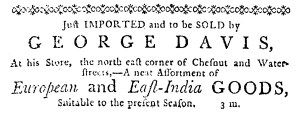
“Just IMPORTED … European and East-India GOODS.”
William Bradford and Thomas Bradford printed and distributed the Pennsylvania Journal on Wednesdays, but in the summer of 1774 they had news of such significance that they opted to issue a Postscript Extraordinary on a Saturday. It bore the same number, 1650, as the weekly edition from July 20, but a different date, July 23, that confirms that the printers issued it a few days later than the weekly edition. They had previously printed a two-page Supplement to the Pennsylvania Journal and a two-page Postscript to the Pennsylvania Journal, both dated July 20, that doubled the amount of content in the standard issue. As the imperial crisis intensified, the Bradfords sought to provide extensive coverage for subscribers and other readers.
At the same time, they scooped the other newspapers printed in English in Philadelphia, Dunlap’s Pennsylvania Packetand the Pennsylvania Gazette. The Postscript Extraordinary featured news from a “PROVINCIAL MEETING of DEPUTIES chosen by the several Counties in Pennsylvania; held at PHILADELPHIA” on July 15 and continuing for several days. Dunlap’s Pennsylvania Packet carried the same news, perhaps reprinted from the Postscript Extraordinary, on Monday, July 25, its usual day of publication, two days after the Bradfords had disseminated it. In turn, the Pennsylvania Gazette provided the same coverage in a Postscript that accompanied the weekly issue on Wednesday, July 27. All three newspapers carried rhetoric that condemned the Boston Port Act and the anticipated passage of the Massachusetts Government Act as well as proposed instructions for Pennsylvania’s delegates who would attend “a Congress of Deputies from the several Colonies,” now known as the First Continental Congress.
Yet coverage of the meeting of delegates from throughout the colony did not fill both sides of the broadsheet. A dozen advertisements completed the Postscript Extraordinary. Disseminating the news provided an occasion provided another opportunity for circulating advertisements placed for various purposes, including notices for “European and East-India GOODS” sold by George Davis and “a large Assortment of DRY GOODS, and CROCKERY” imported by Alexander Bartram. The Postscript Extraordinary gave those advertisements greater visibility, yet news from the meeting framed how colonizers might think about commerce and consumption in the current political environment. Among their various resolutions, the deputies from across Pennsylvania’s counties supported a nonimportation agreement if the First Continental Congress determined that a boycott would aid in achieving their political goals. At the same time, they cautioned that “the venders of Merchandize of every kind within this province, ought not to take advantage of Resolves relating to Non-Importation” by raising prices and gouging customers. The news put all readers on notice about how to behave as consumers while also warning merchants, shopkeepers, and other purveyors of goods about how they should comport themselves.