
What was advertised in a colonial American newspaper 250 years ago today?
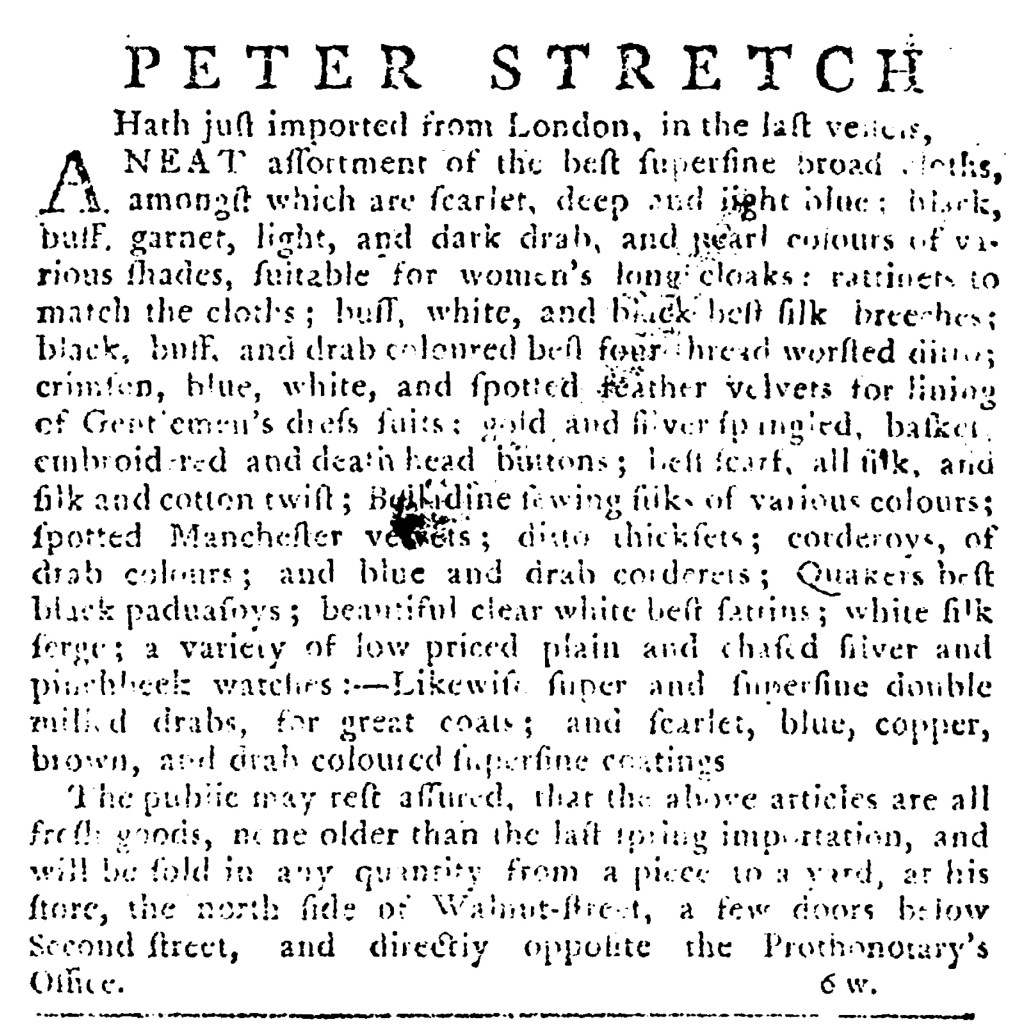
“The above articles are all fresh goods, none older than the last spring importation.”
In the fall of 1774, Peter Stretch advertised a “NEAT assortment” of textiles and accessories that he “Hath just imported from London, in the last vessels.” In an advertisement in the October 12 edition of the Pennsylvania Journal, he listed many of those items, including “the best superfine broad cloths, amongst which are scarlet, deep and light blue, black, buff, garnet, light, and dark drab and pearl colours of various shades, suitable for women’s long cloaks,” “crimson, blue, white, and spotted feather velvets for lining of Gentlemen’s dress suits,” and “gold and silver spangled, basket, embroidered and death head buttons.”
In stating that he had recently imported his wares “in the last vessels,” Stretch deployed language commonly used by merchants and shopkeepers in their marketing efforts. Elsewhere on the same page, for instance, Barclay and Mitchell declared that they stocked merchandise “Imported in the last vessels from England.” Yet Stretch decided to provide further details about when he received his inventory at the end of his advertisement. “The public may rest assured,” he confided, “that the above articles are all fresh goods, none older than the last spring importation.” Stretch was in a bit of an awkward position. He wanted the public to think of his goods as new rather than as leftovers that had been lingering on the shelves or in the storeroom, yet not too new. As the First Continental Congress continued to meet in Philadelphia, just a short distance from Stretch’s store, the colonies prepared to adopt a nonimportation agreement in protest of the Coercive Acts imposed by Parliament following the Boston Tea Party. Stretch seemingly did not want the public to get the impression that he had imported surplus goods with the intention of sidestepping any nonimportation agreement when it went into effect. That would have meant allegations that he technically lived up to the letter of the pact but not the spirit. Rather than hoarding goods in recent months to sell once a nonimportation made imported wares scarce, Stretch “assured” the public that he acquired much of his inventory during “the last spring importation” before the colonies knew about the Boston Port Act, the Massachusetts Government Act, and other legislation passed by Parliament. He hoped that made it acceptable for patriots to make purchases at his store even as they became wary of the goods carried by his competitors.