
What was advertised in a colonial American newspaper 250 years ago today?
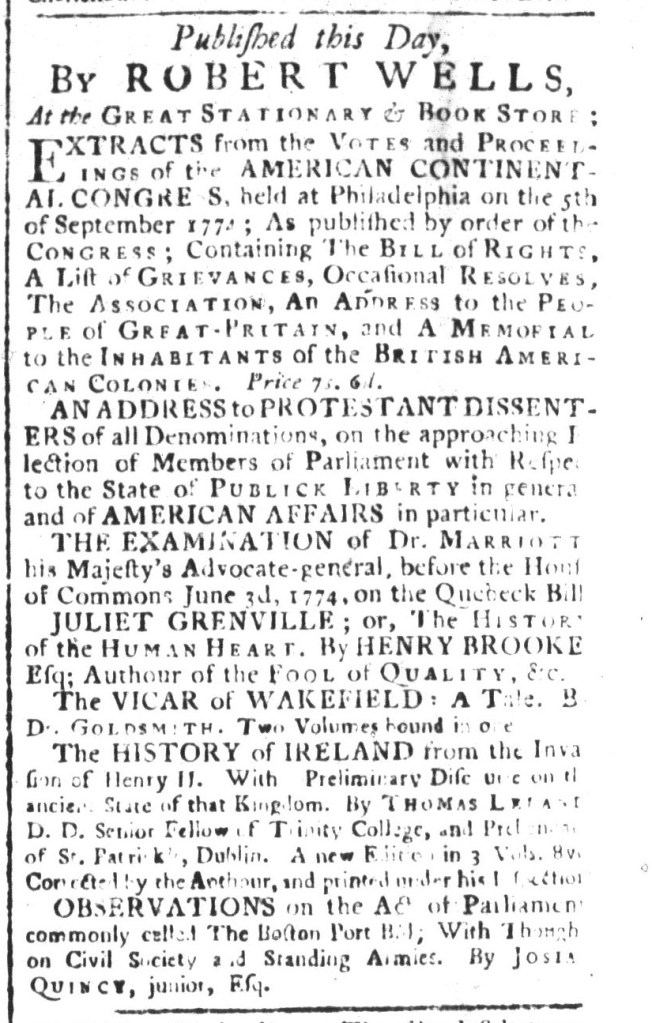
“EXTRACTS from the VOTES and PROCEEDINGS of the AMERICAN CONTINENTAL CONGRESS.”
As soon as the First Continental Congress adjourned near the end of October 1774, printers set about publishing, advertising, and selling “EXTRACTS from the VOTES and PROCEEDINGS of the AMERICAN CONTINENTAL CONGRESS, held at Philadelphia.” William Bradford and Thomas Bradford, printers of the Pennsylvania Journal, were the first to advertise this political pamphlet, but other printers soon advertised that they produced local editions in their own towns, helping to disseminate the news far and wide. Conveniently packaging “The BILL of RIGHTS, A List of GRIEVANCES, Occasional RESOLVES, The ASSOCIATION, An ADDRESS to the PEOPLE of GREAT-BRITAIN, and A MEMORIAL to the INHABITANTS of the BRITISH AMERICAN COLONIES” in one volume, this pamphlet supplemented coverage in newspapers. Its format allowed for easier reference than saving and scouring issue after issue of newspapers that relayed some but not all the contents of the Extracts. The pamphlet met with such demand that some printers quickly printed second editions. In the November 24 edition of the Norwich Packet, for instance, Alexander Robertson, James Robertson, and John Trumbull advertised the “second Norwich EDITION” of the Extracts.
The Adverts 250 Project has examined the publication and dissemination of the Extracts in Pennsylvania, the neighboring colonies of Maryland and New York, and multiple towns in New England. It took a little longer for printers in southern colonies to publish the pamphlet, but within a month of the First Continental Congress finishing its business Robert Wells, the printer of the South-Carolina and American General Gazette, advised readers that they could purchase the Extracts at his “GREAT STATIONARY & BOOK STORE.” Unlike other printers who ran separate advertisements for the pamphlet, Wells included it among a list of half a dozen titles he sold. He gave it a privileged place, first on the list, acknowledging its importance and likely interest among readers. The other items included a couple of novels and a history of Ireland, but Wells concluded the list with “OBSERVATIONS on the Act of Parliament commonly called The Boston Port Bill, With Thoughts on Civil Society and Standing Armies. By JOSIAH QUINCY, junior, Esq.” Among the many volumes available at his bookstore, Wells chose to emphasize two concerning current events as the imperial crisis intensified. Like so many other printers, he marketed items that supplemented the news he published in his newspaper.