
What was advertised in a colonial American newspaper 250 years ago this week?
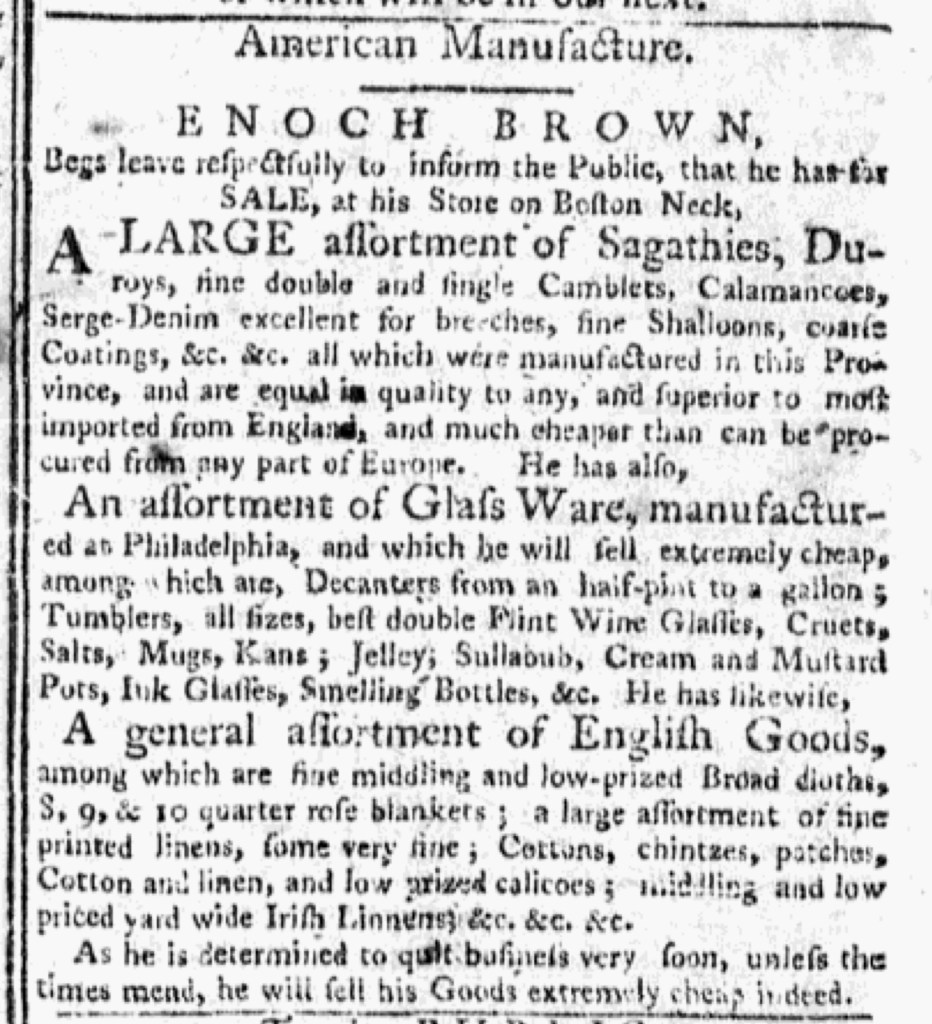
“American Manufacture.”
An advertisement in the January 26, 1775, edition of the Massachusetts Spy informed readers of “SUNDRY Goods, Wares and Merchandize Imported in the Brigantine Venus … from London” that would be “SOLD agreeable to The American Congress Association.” That nonimportation agreement included provisions for selling goods imported between December 1, 1774, and February 1, 1775, yet it also called for encouraging “domestic manufactures” as alternatives to items acquired from Britain.
Enoch Brown emphasized such wares in his own advertisement in that same issue of the Massachusetts Spy. The headline proclaimed, “American Manufacture.” Brown reported that he stocked several kinds of textiles, a “LARGE assortment of Sagathies, Duroys, … Camblets, Calamancoes, Serge-Denim, [and] Shalloons … all which were manufactured in this Province.” Like many other retailers who encouraged consumers to “Buy American” during the imperial crisis, Brown emphasized that his customers would not have to make sacrifices when it came to price or quality for the sake of abiding by their political principles. These textiles, he insisted, “are equal in quality to any, and superior to most imported from England.” In addition, customers could purchase them “much cheaper than can be procured from any part of Europe.”
Yet that was not the extent of Brown’s wares produced in the colonies. He also stocked an “assortment of Glass Ware, manufactured at Philadelphia.” Perhaps he stocked some of the “AMERICAN GLASS” advertised by John Elliott and Company in the Pennsylvania Journal just as the Continental Association went into effect at the beginning of December 1774. Brown listed a variety of items, including decanters, wine glasses, and mustard pots, underscoring that “he will sell extremely cheap.”
Only after detailing products made in the colonies did Brown also mention a “general assortment of English Goods,” naming several textiles, such as “fine printed linens,” not included among those “manufactured in this Province.” He likely attempted to liquidate inventory that had been on his shelves before the nonimportation agreement commenced, intending to “quite business very soon, unless the times mend.” To that end, he vowed to “sell his Goods extremely cheap indeed.” In the process, he gave priority to “American Manufacture” in his advertisement, directing readers to options that would allow them to be responsible consumers who did their part in support of the Continental Association and the American cause.