
What was advertised in a colonial American newspaper 250 years ago today?
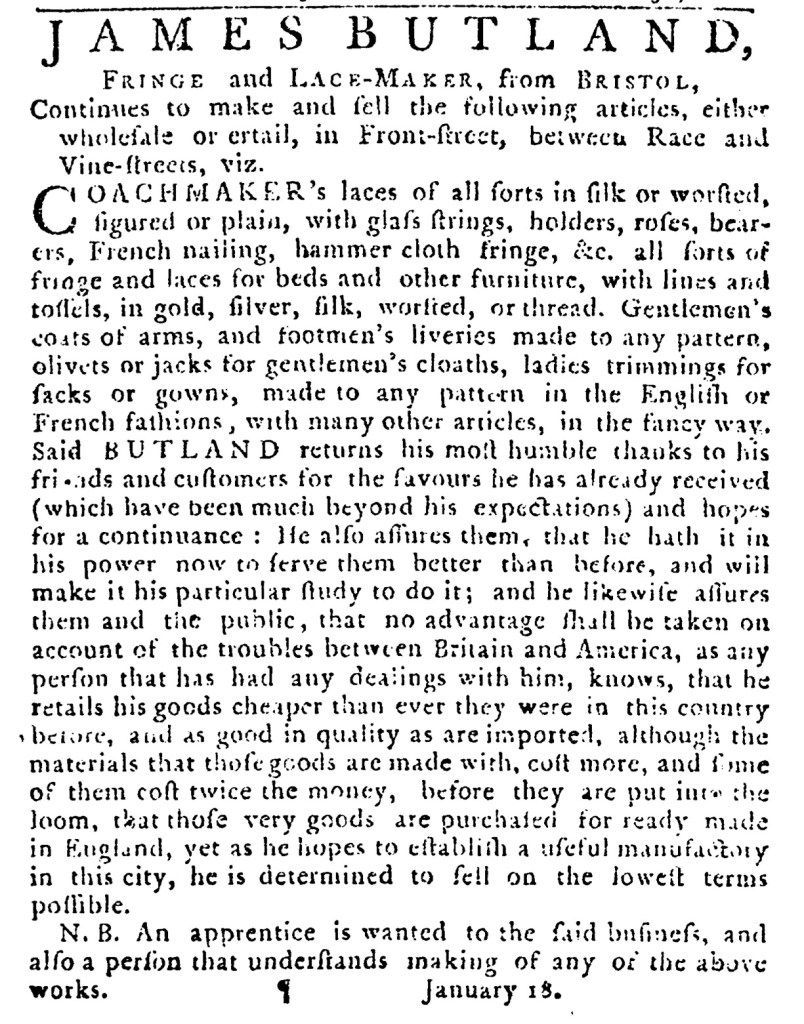
“No advantage shall be taken on account of the troubles between Britain and America.”
James Butland, a “FRINGE and LACE-MAKER, from BRISTOL,” set up shop in Philadelphia in the 1770s. In an advertisement in the February 1, 1775, edition of the Pennsylvania Journal, he informed the public that he made and sold “COACHMAKER’s laces of all sorts in silk or worsted,” “all sorts of fringe and laces for beds and other furniture,” and other trimmings according to “any pattern in the English or French fashions.”
Colonizers observed the Continental Association, a nonimportation agreement enacted by the First Continental Congress in response to the Coercive Acts, at the time that Butland placed his advertisement. Butland certainly had the Continental Association, in particular, and the imperial crisis, more generally, in mind when he made his pitch to prospective customers. He made assurances to “the public, that no advantage shall be taken on account of the troubles between Britain and America.” In other words, he would not raise prices on the fringe and lace he produced locally at a time that patriots refused to purchase imported goods. Butland asserted that he had been in Philadelphia long enough that former customers knew his reputation on the matter: “any person that has had any dealings with him, knows, that he retails his goods cheaper than ever they were in this country before, and as good in quality as are imported.” He did so even though “the materials that those goods are made with, cost more, and some of them twice the money, before they are put into the loom” compared to readymade alternatives from England. That Butland offered such low prices under those circumstances suggested a significant markup on imported fringe and lace.
Butland did his part to satisfy consumers and to serve the American cause as the imperial crisis intensified. Beyond his pledge not to gouge his customers with unreasonable prices during the boycott of imported goods, he sought to increase the inventory of locally produced fringes and laces available to them. He planned “to establish a useful manufactory in this city,” vowing “to sell on the lowest terms possible.” To that end, he sought an apprentice and an employee to assist him and aid in expanding his business. As his advertisement made clear, Butland did his part as a producer to honor the Continental Association. Readers now had a duty as consumers to do their part to support his endeavor.
[…] Front-street” in Philadelphia, placed a new advertisement in some of the city’s newspapers. A few months earlier, he assured “the public, that no advantage shall be taken on account of the troubles between […]
[…] and Lace maker,” placed several newspaper advertisements in 1775. In February, he inserted an advertisement in the Pennsylvania Journal, advising prospective customers that he “Continues to make and […]
[…] other entrepreneurs in urban ports, he inserted notices in multiple local newspapers, including the Pennsylvania Journal in February 1775 and the Pennsylvania Evening Post in July 1775. Yet he did not confine his marketing solely to […]