
What was advertised in a colonial American newspaper 250 years ago today?
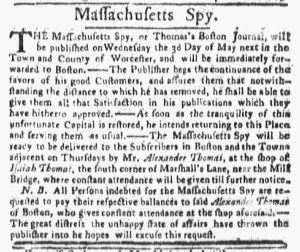
“THE Massachusetts Spy … will be published … in the Town and County of Worcester.”
Isaiah Thomas published the last issue of the Massachusetts Spy in Boston on April 6, 1775. Eleven days later, advertisements in the Boston Evening-Post and the Massachusetts Gazette and Boston Post-Boy informed readers that the “Massachusetts Spy, or Thomas’s Boston Journal, will be published on Wednesday the 3d Day of May next in the Town and County of Worcester, and will be immediately forwarded to Boston.” Why did Thomas suddenly suspend publishing the Massachusetts Spy, founded in 1770, and relocate to Worcester with plans to revive the newspaper there?
In his History of Printing in America, published in 1810, Thomas declared, “It became at length apparent to all reflecting men that hostilities must soon take place between Great Britain and her American colonies.” Through the editorial stance he took in the Massachusetts Spy, the patriot printer “had rendered himself very obnoxious to the friends of the British administration; and, in consequence, the tories, and some of the British soldiery in the town, openly threatened him with the effects of their resentment.” Along with other residents of Boston, Thomas had endured all sorts of “Distresses,” as he called them, following the closure of the harbor in retaliation for the destruction of the tea, but now his own safety was at stake. “For these and other reasons, he was induced to pack up, privately, a press and types, and to send them in the night over the Charles river to Charlestown, whence they were conveyed to Worcester.” Thomas was smart with his timing for getting out of Boston: “This was only a few days before the affair at Lexington.”[1] The printer smuggled a press out of Boston just before the Revolutionary War began with the skirmishes at Lexington and Concord followed by the siege of Boston.
Near the end of February, the Massachusetts Spy carried subscription proposals for a “New Weekly NEWS-PAPER … To be entitled, The WORCESTER GAZETTE.” Thomas had made arrangements with “a number of gentlemen in the county of Worcester, zealously engaged in the cause of the country … to open a printing house, and to publish a newspaper there, in the course of the ensuing spring.” It would be the town’s first printing office and first newspaper. Thomas planned “to send a press, with a suitable person to manage the concerns of it,” having previously gained experience setting up Henry-Walter Tinges as a junior partner who oversaw their printing office in Newburyport and printed the Essex Journal. “The war commencing sooner than expected,” however, Thomas “was obliged to leave Boston, and came himself to Worcester, opened a printing house, and on the 3d of May, 1775, executed the first printing done in the town.”[2]
As he prepared to open that printing office, his advertisement in newspapers still published in Boston advised the public that the “Publisher [of the Massachusetts Spy] begs the continuance of the favors of his good Customers, and assures then that notwithstanding the distance to which he has removed, he shall be able to give them all that Satisfaction in his publications which they have hitherto approved.” Furthermore, he planned to return to Boston “[a]s soon as the tranquility of this unfortunate Capital is restored,” not knowing at the time that he would remain in Worcester after the war ended. For the moment, he designated a local agent, Alexander Thomas, who oversaw his shop in Boston and saw to the delivery of new issues of the Massachusetts Spy on Thursdays, the day after the printer published them in Worcester. He also requested that “All Persons indebted for the Massachusetts Spy … pay their respective balances.” Like other printers, Thomas extended credit to his customers, but the “great distress [of] the unhappy state of affairs” made it necessary to call on them to make payment.” Thomas faced a new chapter, one that the Adverts 250 Projectwill chronicle as it examines advertisements placed in revolutionary American newspapers.
**********
[1] Isaiah Thomas, The History of Printing in America: With a Biography of Printers and an Account of Newspapers (1810; New York: Weathervane Press, 1970), 168.
[2] Thomas, History of Printing, 180-181.
[…] that time, Isaiah Thomas, the printer of the Massachusetts Spy, had already published the final issue of that newspaper in Boston on April 6 and headed to Worcester. He revived it as the Massachusetts Spy: Or, American Oracle […]
[…] coverage of those skirmishes. Then the presses in Boston went quiet. Isaiah Thomas had already removed the Massachusetts Spy to Worcester. The Boston Evening-Post and the Massachusetts Gazette and Boston Post-Boyceased publication […]
[…] took his press and left Boston just before the battles at Lexington and Concord in April 1775. He announced his intention to continue publishing the newspapers at a new printing office he establi…, safely away from the British officials he angered with his advocacy for the patriot cause. […]