
What was advertised in a revolutionary American newspaper 250 years ago this week?
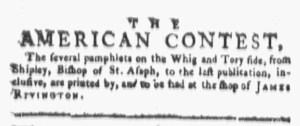
“Several pamphlets on the Whig and Tory side.”
Many Patriots did not care for the editorial stance that James Rivington took in his newspaper. They considered him a Loyalist even though he declared in the masthead that he operated an “OPEN and UNINFLUENCED PRESS” that represented all views. Similarly, he printed, advertised, and sold political pamphlets about “THE AMERICAN CONTEST … on the Whig and Tory side.” Rivington aimed to keep colonizers informed and intended to generate revenue while doing so, believing that controversy could be good for business during the imperial crisis.
Late in 1774 and throughout the first months of 1775, Rivington regularly ran advertisements that listed the variety of political pamphlets available at his printing office. He inserted an abbreviated version in the April 20, 1775, edition. Colonizers in New York had not yet received word of the events at Lexington and Concord the previous morning. Rivington instead published other news, including a recent instance of “some of the lower class of inhabitants, at New-Brunswick” hanging “an effigy, representing the person of Mr. Rivington … merely for acting consistent with his profession as a free printer.” He not only covered that story but also illustrated it with a woodcut depicting the effigy hanging from a tree.
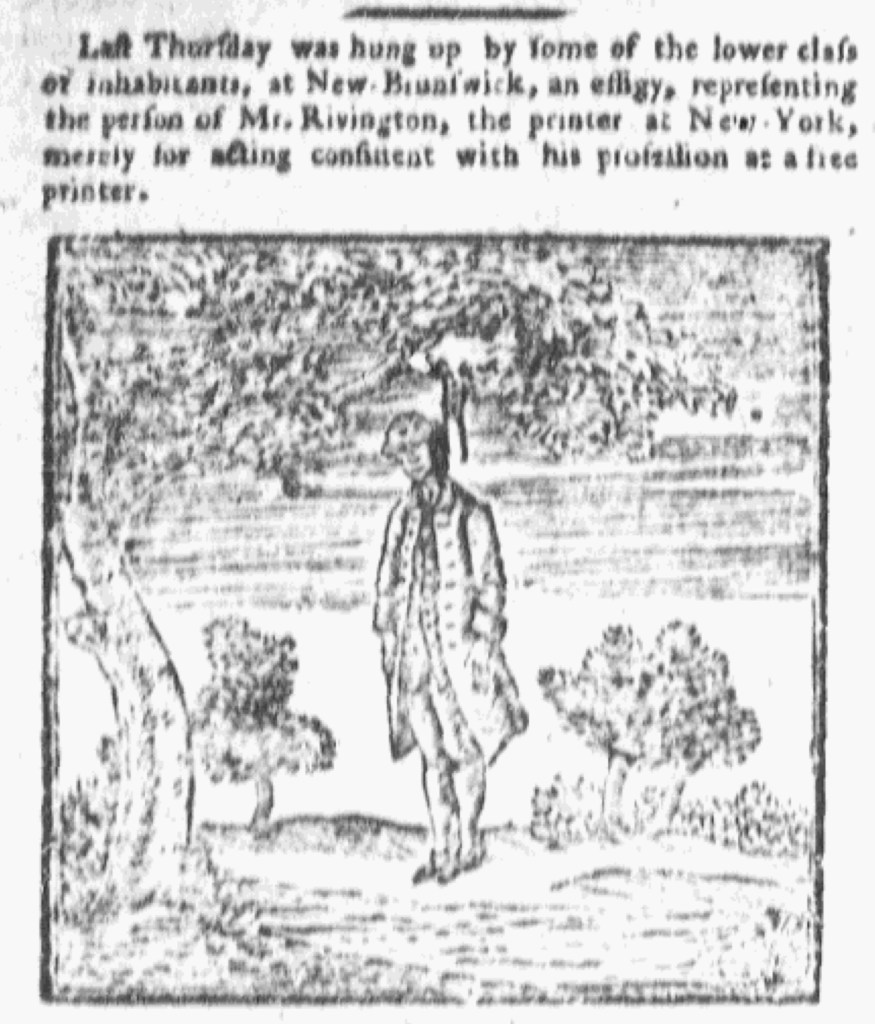
The image almost certainly attracted attention, in part because news items in eighteenth-century newspapers so rarely featured illustrations of any sort. Elsewhere in the same issue, readers encountered only five other images. The masthead contained the coat of arms of Great Britain, as usual, and the drop cap for a letter to the editor appeared within a smaller version of the coat of arms. A stock image of a ship adorned an announcement that the Earl of Dunmore would soon sail for London. Similarly, a stock image of a horse being led by a man helped promote the stud services of Lath, Match ‘Em, Pilgrim, and Bashaw. Abraham Delanoy’s woodcut depicting lobster traps was the only other image created to match the content of an advertisement or a news item.
The scarcity of images made the scene of the effigy even more conspicuous. Rivington wrote a sarcastic description of the event and then affirmed “that his press has been open to publications from ALL PARTIES.” He challenged “his enemies to produce an instance to the contrary,” noting that he treated his role as printer like “a public office” and reasoned that “every man has a right to have recourse” via his press. “But the moment he ventured to publish sentiments which were opposed to the dangerous views and designs of certain demagogues,” Rivington asserted, “he found himself held up as an enemy to his country.” His support for “LIBERTY OF THE PRESS” made him a target for “a most cruel tyranny,” as demonstrated by “very recent transactions” that included the effigy in New Brunswick. His description of how some Patriots comported themselves along with his insistence on continuing to sell political pamphlets “on the Whig and Tory side” did not endear Rivington to “his enemies.” Within in a month, a mob of Sons of Liberty would attack his printing office and destroy his press. Rivington escaped, seeking refuge on a British naval ship in the harbor.
[…] at Lexington and Concord, the printer of Rivington’s New-York Gazetteer once again advertised “several pamphlets on the Whig and Tory side” of “THE AMERICAN CONTEST.” Word of what had occurred in Massachusetts the previous day had […]