
What was advertised in a revolutionary American newspaper 250 years ago today?
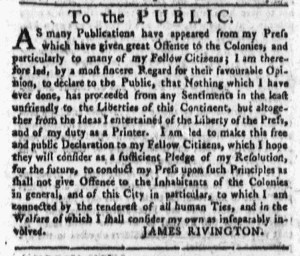
“Many Publications have appeared from my Press which have given great Offence to the Colonies.”
James Rivington seemed to change his tune about what he printed and sold at his printing office on Hanover Square in New York. On April 20, the day after the battles at Lexington and Concord, the printer of Rivington’s New-York Gazetteer once again advertised “several pamphlets on the Whig and Tory side” of “THE AMERICAN CONTEST.” Word of what had occurred in Massachusetts the previous day had not yet arrived in New York, but Rivington had other news concerning the imperial crisis to report. That included residents of New Brunswick, New Jersey, hanging “an effigy, representing the person of Mr. Rivington … merely for acting consistent with his profession as a free printer.” A rare woodcut depicting the scene accompanied the combination article and editorial about his “OPEN and UNINFLUENCED PRESS.”
A week later, Rivington’s New-York Gazetteer carried news of Lexington and Concord. The printer chose not to insert his advertisement hawking pamphlets representing both Whig and Tory perspectives in that issue. In the next issue, two weeks after the battles in Massachusetts, Rivington ran a new advertisement, one that took a different tone than his coverage of the effigy. “AS many Publications have appeared from Press which have given great Offence to the Colonies, and particularly to many of my Fellow Citizens,” the printer declared, “I am therefore led, be a most sincere Regard for their favourable Opinion, to declare to the Public, that Nothing which I have ever done, has proceeded from any Sentiments in the least unfriendly to the Liberties of this Continent, but altogether from the Ideas I entertained of the Liberty of the Press, and of my duty as a Printer.” That being the case, “I am led to make this free and public Declaration to my Fellow Citizens, which I hope they will consider as a sufficient Pledge of my Resolution, for the future, to conduct my Press upon such Principles as shall not give Offence to the Inhabitants of the Colonies in general, and of this City in particular, to which I am connected by the tenderest of all human Ties, and in the Welfare of which I shall consider my own as inseparably involved.” Rivington stopped short of offering an apology or stating that he regretted printing and selling newspapers and pamphlets that advanced Tory views, but he did take a less defiant tone in his effort to explain his editorial decisions. He suggested that he would adopt a new approach, though he did not go into detail about that. Perhaps he hoped that critics would notice that he did not advertise the problematic pamphlets. Even if they did not, Rivington refrained from publishing an advertisement that ran counter to the message he delivered in his notice clarifying his prior actions.
That notice appeared in three consecutive issues of Rivington’s New-York Gazetteer, none of which carried advertisements for political pamphlets. The events unfolding in Massachusetts may have encouraged the printer to take greater caution, though the masthead of his newspaper continued to proclaim that he operated an “OPEN and UNINFLUENCED PRESS.” As far as the Sons of Liberty were concerned, however, the printer could not redeem himself. On May 10, a week after Rivington first published his notice assuring the public that he would “conduct [his] Press upon such Principles as shall not give Offence to the Inhabitants of the Colonies,” the Sons of Liberty attacked his home and printing office. Rivington fled to a British ship in the harbor. Assistants maintained uninterrupted publication of the newspaper, continuing to run Rivington’s notice, while the printer petitioned the Second Continental Congress for pardon. As Todd Andrlik documents, Rivington explained that “however wrong and mistaken he may have been in his opinions, he has always meant honestly and openly to do his duty.” The Continental Congress forwarded the petition to the New York Provincial Congress. Rivington received his pardon, but his reformation was not so complete as to avoid further notice from the Sons of Liberty. In November 1775, Sons of Liberty from New Haven destroyed his press and reportedly melted down his types to make shot, bringing an end to Rivington’s New-York Gazetteer.
[…] time. His home and printing office had been attacked the previous May. For a few weeks, he had sought refuge on a British ship in the harbor. He had been hung in effigy. After all that, the November 23, 1775, edition would […]