
What was advertised in a revolutionary American newspaper 250 years ago today?
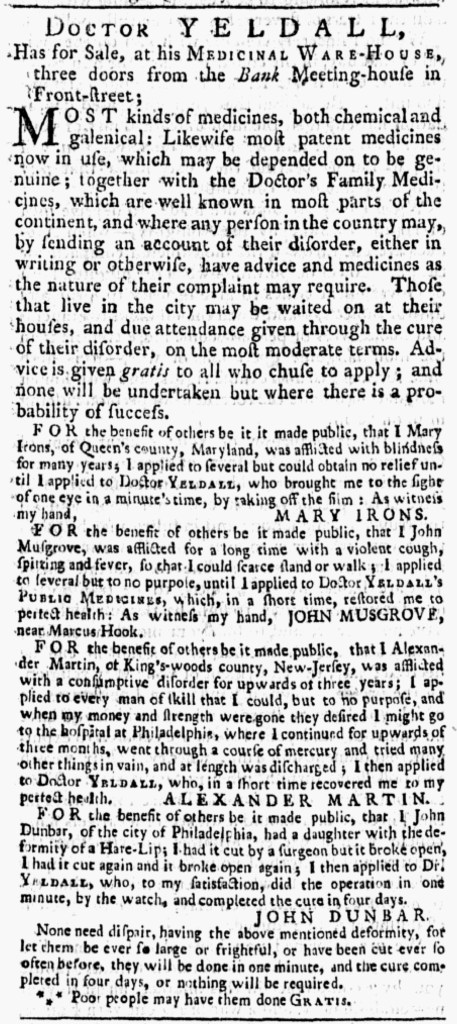
“I applied to Doctor YELDALL’S PUBLIC MEDICINES, which, in a short time, restored me to perfect health.”
An advertisement placed by “DOCTOR YELDALL” in the June 17, 1775, edition of the Pennsylvania Ledger advised the public that he sold “MOST kinds of medicines” at his “MEDICINAL WARE-HOUSE” on Front Street in Philadelphia. He carried “most patent medicines now in use” as well as his own line of “the Doctor’s Family Medicines,” which, he claimed, “are well known in most parts of the continent.” Customers residing in the country could send orders for Yeldall to fill, while those in the city could arrange to “be waited on at their houses, and due attendance given through the cure of their disorder.” The doctor did not charge for consultations, nor did he commence treatment except “where there is a probability of success.” He attempted to build trust with prospective patients in his advertisement.
To that end, he also published a series of testimonials, hoping that former patients would prove even more convincing than his own description of his services. Each started with the same phrase, “FOR the benefit of other be it made public,” suggesting that Yeldall solicited the testimonials and assisted in drafting them (or perhaps even wrote them himself). In one, John Musgrove, who lived near Marcus Hook, Pennsylvania, reported that he “was afflicted for a long time with a violent cough, spitting and fever” to the point that he “could scarce stand or walk.” He sought assistance “but to no purpose, until [he] applied to Doctor YELDALL’S PUBLIC MEDICINES.” They quickly restored him to “perfect health.” Alexander Martin “of Kings-woods county, New-Jersey” similarly declared that he “was afflicted with a consumptive disorder for upwards of three years,” during which time he “applied to every man of skill that [he] could, but to no purpose.” He even entered the “hospital at Philadelphia” and stayed for three months, enduring “a course of mercury” and “tried many other things in vain.” Only after his discharge from the hospital did Martin seek aid from Yeldall, who “in a short time recovered me to my perfect health.” According to Martin and Musgrove, the doctor’s methods were both fast and effective.
In addition to prescribing the right medicines to treat his patients’ maladies, Yeldall also performed medical procedures. In one testimonial, Mary Irons of Queen’s County, Maryland, declared that she “was afflicted with blindness for many years.” She “applied to several, but could obtain no relief until I applied to Doctor YELDALL, who brought me to the sight of one eye in a minute’s time, by taking off the film.” John Dunbar “of the city of Philadelphia” told of a surgeon who unsuccessfully treated his daughter. She had “the deformity of a Hare-Lip” that “broke open” after the surgeon “cut” it. Dunbar then took his daughter to Yeldall, “who, to my satisfaction, did the operation in one minute, by the watch, and completed the cure in four days.” Yeldall added a note that others with “the above mentioned deformity” did not need to “dispair,” no matter how “large or frightful, or hav[ing] been cut so often before,” because his procedure “will be done in one minute, and the cure completed in four days” or else he did not charge for his services. Perhaps the focus on how quickly the doctor performed these operations was meant to reassure prospective patients that they would not experience prolonged discomfort during a procedure.
Yeldall’s promises seemed too good to be true … and they almost certainly were. Yet the “DOCTOR” realized that some prospective patients were likely desperate for any sort of treatment that they could hope for a different outcome. As they searched for hope, he expected that his own promises and, especially, testimonials supposedly composed by his former patients would convince the afflicted to give him a chance to restore them to health.
[…] on Front Street in Philadelphia in Rivington’s New-York Gazetteer at the same time that it appeared in the Pennsylvania Ledger. He did, after all, claim that the “doctors family medicines” that he produced as an […]
[…] Yeldall apparently believed that testimonials worked. In June 1775, he published an advertisement that included several testimonials from his patients. Three months later, he once again promoted his “MEDICINAL WARE-HOUSE’ in Philadelphia with […]