August 4

What was advertised in a revolutionary American newspaper 250 years ago this week?

Pennsylvania Ledger (August 3, 1776).

“For the benefit of others I desire that you may make my case public, that those being imposed upon and labouring under the same complaint may know where to apply for a cure.”

Testimonials worked!  Anthony Yeldall must have thought so because the apothecary repeatedly included testimonials from grateful patients in his newspaper advertisements.  Perhaps some patients mentioned testimonials they read in his advertisements when they consulted him “at his Medicinal ware house” in Philadelphia, prompting him to publish more testimonials.  The testimonials often accounted for much more space than any copy that Yeldall wrote himself.  His advertisement in the August 3, 1776, edition of the Pennsylvania Ledger, for instance, consisted of five paragraphs.  The last four were testimonials that his patients stated that they wanted published “[f]or the benefit of others.”  It was one thing for the apothecary to claim that his “Abilities are well known through most parts of the United Colonies,” but the testimonials demonstrated that was indeed the case.  Joseph Spenser, “Grocer in Second-street,” Benjamin Wilson, “Elizabeth-town, New-Jersey,” Christopher Hughes, “Bedminster-township, Bucks County, Pennsylvania,” and William Bell, “Vincent township, Chester County, Pennsylvania,” each praised the treatment that “DOCTOR YELDALL” provided.

Those testimonials had some common features that suggest Yeldall may have worked with his patients in composing their testimonials or they may have used testimonials that appeared in previous advertisements as models.  Three of the testimonials began with “For the benefit of others” and a request “that my case may be made public” (or some close variation of that phrase).  Hughes expressed similar sentiments but deviated from the formulaic language used by the others: “being desirous that they may reap the same benefit that I have done, I desire that you may make my case public.”  Each testimonial made clear that Yeldall published success stories at the behest of patients he returned to good health.  They did not make their way into print solely due to the self-interest of an apothecary seeking more patients.  Each also told a frustrating story about seeking medical care from physicians and surgeons whose assistance proved ineffective before turning to Yeldall for treatments that returned them to full health.  Spenser, for instance, “applied to several able Physicians in the city, but could find no relief” for a pain that cause him to lose the use of his arm.  He then turned to Yeldall, “who in a short time removed the pain, restored the use of my arm, and I now follow my business.”

Yeldall certainly considered testimonials effective when he decided on his marketing strategy.  He would not have continued to publish them (and invest so much in the space required for each testimonial) if he did believe that they yielded a return on his investment in placing them in the public prints.  He likely appreciated that testimonials helped build trust with patients before they even consulted him for “advice and medicines.”
September 30

What was advertised in a revolutionary American newspaper 250 years ago today?

Pennsylvania Ledger (September 30, 1775).

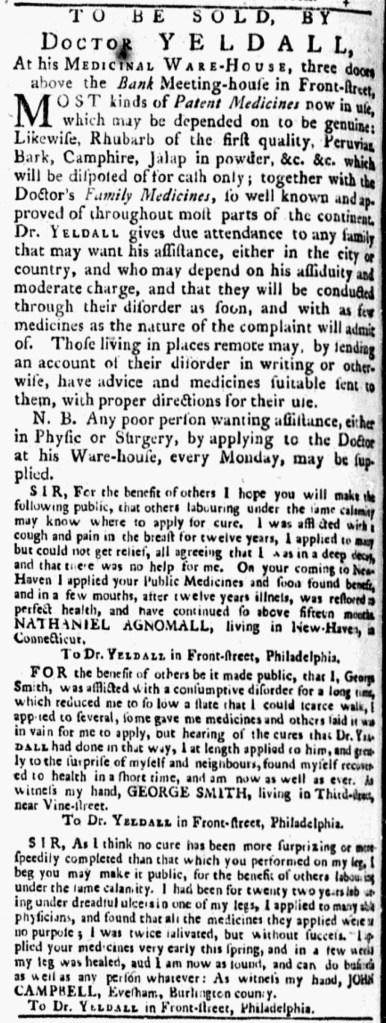
“To the surprise of myself and neighbours, found myself recovered to health.”

Doctor Yeldall apparently believed that testimonials worked.  In June 1775, he published an advertisement that included several testimonials from his patients.  Three months later, he once again promoted his “MEDICINAL WARE-HOUSE’ in Philadelphia with an advertisement that featured three new testimonials.  The notice gave the impression that the doctor had not solicited them, but instead merely published letters addressed “To Dr. YELDALL in Front-Street, Philadelphia” at the request of those who sent them.  “For the benefit of others I hope you will make the following public,” Nathan Agnomall’s testimonial began.  Similarly, John Campbell, who had suffered “dreadful ulcers in one of my leges,” implored the doctor: “I beg you may make it public, for the benefit of others labouring under the same calamity” that Yeldall’s medicines healed leg.

In his preamble to the testimonials, Yeldall described his “Doctor’s Family Medicines” as “so well known and approved of throughout most parts of the continent.”  Two of the testimonials did indeed come from beyond Philadelphia.  Campell listed his address as “Eversham, Burlington county,” in New Jersey, while Agnomall stated that he was “living in New-Haven, in Connecticut.”  The third testimonial, however, came from a resident of Philadelphia, George Smith, “living in Third-street, near Vine-street.”  Skeptics in that city could question the veracity of letters that supposedly arrived from other colonies, but they might know Smith or could seek him out to confirm what they saw printed in the newspaper advertisement.  Smith’s letter even revealed that he had been cured of a “consumptive disorder” and “to the surprise of myself and neighbours, found myself recovered to health.”  Many residents of Philadelphia living in Smith’s neighborhood could also testify to the efficacy of the Yeldall’s medicines, at least that was the inference in Smith’s letter.  Unlikely to attempt to track down Smith or interview any of his neighbors, prospective patients who had not found relief through any other means may have found this testimonial convincing enough to give Yeldall’s medicines a chance.  Even if they had doubts, the details in Smith’s letter gave them hope by encouraging them to believe something that was likely too good to be true.

June 17

What was advertised in a revolutionary American newspaper 250 years ago today?

Pennsylvania Ledger (June 17, 1775).

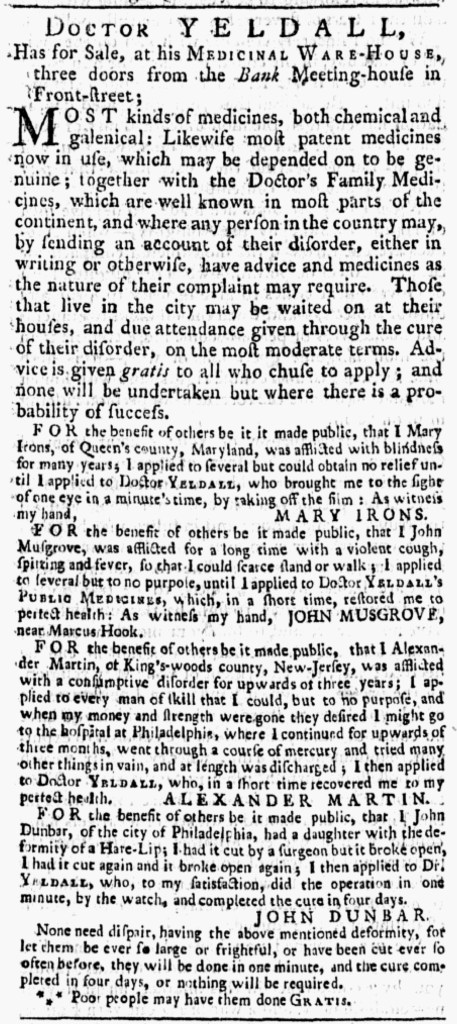
“I applied to Doctor YELDALL’S PUBLIC MEDICINES, which, in a short time, restored me to perfect health.”

An advertisement placed by “DOCTOR YELDALL” in the June 17, 1775, edition of the Pennsylvania Ledger advised the public that he sold “MOST kinds of medicines” at his “MEDICINAL WARE-HOUSE” on Front Street in Philadelphia.  He carried “most patent medicines now in use” as well as his own line of “the Doctor’s Family Medicines,” which, he claimed, “are well known in most parts of the continent.”  Customers residing in the country could send orders for Yeldall to fill, while those in the city could arrange to “be waited on at their houses, and due attendance given through the cure of their disorder.”  The doctor did not charge for consultations, nor did he commence treatment except “where there is a probability of success.”  He attempted to build trust with prospective patients in his advertisement.

To that end, he also published a series of testimonials, hoping that former patients would prove even more convincing than his own description of his services.  Each started with the same phrase, “FOR the benefit of other be it made public,” suggesting that Yeldall solicited the testimonials and assisted in drafting them (or perhaps even wrote them himself).  In one, John Musgrove, who lived near Marcus Hook, Pennsylvania, reported that he “was afflicted for a long time with a violent cough, spitting and fever” to the point that he “could scarce stand or walk.”  He sought assistance “but to no purpose, until [he] applied to Doctor YELDALL’S PUBLIC MEDICINES.”  They quickly restored him to “perfect health.”  Alexander Martin “of Kings-woods county, New-Jersey” similarly declared that he “was afflicted with a consumptive disorder for upwards of three years,” during which time he “applied to every man of skill that [he] could, but to no purpose.”  He even entered the “hospital at Philadelphia” and stayed for three months, enduring “a course of mercury” and “tried many other things in vain.”  Only after his discharge from the hospital did Martin seek aid from Yeldall, who “in a short time recovered me to my perfect health.”  According to Martin and Musgrove, the doctor’s methods were both fast and effective.

In addition to prescribing the right medicines to treat his patients’ maladies, Yeldall also performed medical procedures.  In one testimonial, Mary Irons of Queen’s County, Maryland, declared that she “was afflicted with blindness for many years.”  She “applied to several, but could obtain no relief until I applied to Doctor YELDALL, who brought me to the sight of one eye in a minute’s time, by taking off the film.”  John Dunbar “of the city of Philadelphia” told of a surgeon who unsuccessfully treated his daughter.  She had “the deformity of a Hare-Lip” that “broke open” after the surgeon “cut” it.  Dunbar then took his daughter to Yeldall, “who, to my satisfaction, did the operation in one minute, by the watch, and completed the cure in four days.”  Yeldall added a note that others with “the above mentioned deformity” did not need to “dispair,” no matter how “large or frightful, or hav[ing] been cut so often before,” because his procedure “will be done in one minute, and the cure completed in four days” or else he did not charge for his services.  Perhaps the focus on how quickly the doctor performed these operations was meant to reassure prospective patients that they would not experience prolonged discomfort during a procedure.

Yeldall’s promises seemed too good to be true … and they almost certainly were.  Yet the “DOCTOR” realized that some prospective patients were likely desperate for any sort of treatment that they could hope for a different outcome.  As they searched for hope, he expected that his own promises and, especially, testimonials supposedly composed by his former patients would convince the afflicted to give him a chance to restore them to health.