
What was advertised in a revolutionary American newspaper 250 years ago today?
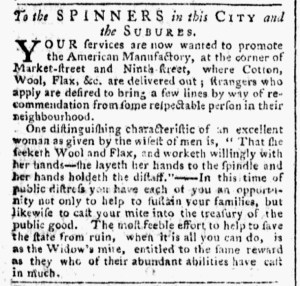
“To the SPINNERS in this CITY and the SUBURBS, YOUR services are now wanted to promote the American Manufactory.”
The proprietors of the American Manufactory in Philadelphia published a recruiting notice that first appeared in Dunlap’s Pennsylvania Packet on August 7, 1775, and then in other newspapers printed in the city for several weeks. They had previously advertised an organizing meeting to gain subscribers (or investors) in the enterprise in March. A month later, the same day as the battles at Lexington and Concord, they ran a notice seeking a “Quantity of WOOL, COTTON, FLAX, and HEMP.” That advertisement also advised that “a number of spinners and flax dressers may meet with employment.” Their latest advertisement devoted significantly more effort to recruiting the “SPINNERS in this CITY and theSUBURBS” to work at the American Manufactory.
“YOUR services are now wanted to promote” the enterprise, the proprietors proclaimed, though they did not plan to hire everyone who presented themselves. Instead, they followed the eighteenth-century version of letters of recommendation and checking references, instructing that “strangers who apply are desired to bring a few lines by way of recommendation from some respectable person in their neighborbood.” Working at the American Manufactory offered women “an opportunity not only to help to sustain your families, but likewise to cast your mite into the treasure of the public good” during a “time of public distress.” They expected that readers would recognize the reference to a story that Jesus told in Mark 12:41-44 and Luke 21:1-4 about a poor widow who donated two coins, called mites, to the temple. Her small donation, being all she had, far overshadowed much larger donations by the wealthy who could have given much more. “The most feeble effort to help to save the state from ruin, when it is all you can do,” the proprietors of the American Manufactory explained, “is as the Widow’s mite, entitled to the same reward as they who of their abundant abilities have cast in much.” Working as a spinner at the American Manufactory, therefore, amounted to service to the American cause by “excellent wom[e]n,” service just as important as that undertaken by the men who participated in local meetings, provincial congresses, and the Second Continental Congress or mustered to defend their liberties. Women’s work had political meaning during the era of the American Revolution.