
What was advertised in a revolutionary American newspaper 250 years ago today?
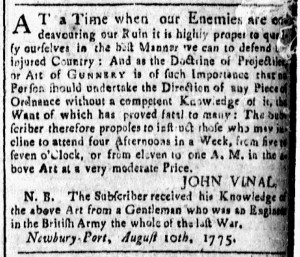
“The Doctrine of Projectiles, or Art of GUNNERY.”
In the spring of 1775, John Vinal advertised a “private School for the Youth of both Sexes” to open in Newburyport, Massachusetts, on April 3. His notice in the March 29 edition of the Essex Journal specified two locations, “the room he improved last Summer, nearly opposite Mr. Davenport’s Tavern,” with lessons commencing “at 11 o’Clock, A.M.” and “the Town School-House” from “5 to 7 o’Clock, P.M.” for “those who can best attend in the Afternoon.” The term began just two weeks before the battles at Lexington and Concord. Four months later, Vinal advertised a very different kind of instruction: “the Doctrine of Projectiles, or Art of GUNNERY.”
Circumstances had certainly changed in Newburyport, in Massachusetts, and throughout the colonies since Vinal announced the opening of his school. The siege of Boston and the Battle of Bunker Hill followed the skirmishes at Lexington and Concord. The Second Continental Congress convened in Philadelphia and appointed George Washington to command the Continental Army. Colonizers from New England to Georgia held local and provincial meetings to determine their own responses. “AT a Time when our Enemies are endeavouring our Ruin,” Vinal proclaimed, “it is highly proper to qualify ourselves in the best Manner we can to defend out injured Country.” To that end, some colonizers advertised military manuals and others recruited men to join artillery companies or other regiments to defend their liberties. Making his own contribution to those efforts, Vinal offered to “instruct those who may incline” to learn about the “Art of GUNNERY.” He explained that “no Person should undertake the Direction of any Piece of Ordnance without a competent Knowledge of it,” warning that “the Want of which has proved fatal to many.” What qualifications did the schoolmaster possess to teach “the Doctrine of Projectiles” rather than reading, writing, and arithmetic? He asserted that he “received his Knowledge … from a Gentleman who was an Engineer in the British Army the whole of the last War,” meaning the Seven Years War. Britain and the American colonies had worked together to defeat the French and their Indigenous allies in pursuit of imperial interests, but now the expertise of that “Engineer in the British Army” would support the American cause at a time when Parliament and British regulars had become “Enemies … endeavouring our Ruin.”
As had been the case with his “School for Youth of both Sexes,” Vinal provided lessons at two times. Students could “attend four Afternoons in a Week, from five to seven o’Clock.” Either the term for his school concluded or this endeavor displaced the lessons he otherwise would have offered. He also stated that he taught about ordnance “from eleven to one A.M.” Given the schedule for his school, he likely meant “eleven A.M. to one P.M.” rather than suggesting that he taught the class in the middle of the night. Hopefully his lessons emphasized greater precision!
[…] In the spring of 1775, John Vinal advertised a “private School for the Youth of both Sexes” to open in Newburyport, Massachusetts, on April 3. His notice in the March 29 edition of the Essex Journal specified two locations, “the room he improved last Summer, nearly opposite Mr. Davenport’s Tavern,” with lessons commencing “at 11 o’Clock, A.M.” and “the Town School-House” from “5 to 7 o’Clock, P.M.” for “those who can best attend in the Afternoon.” The term began just two weeks before the battles at Lexington and Concord. Four months later, Vinal advertised a very different kind of instruction: “the Doctrine of Projectiles, or Art of GUNNERY.” Circumstances had certainly changed in Newburyport, in Massachusetts, and throughout the colonies since Vinal announced the opening of his school. The siege of Boston and the Battle of Bunker Hill followed the skirmishes at Lexington and Concord. The Second Continental Congress convened in Philadelphia and appointed George Washington to command the Continental Army. Colonizers from New England to Georgia held local and provincial meetings to determine their own responses. “AT a Time when our Enemies are endeavouring our Ruin,” Vinal proclaimed, “it is highly proper to qualify ourselves in the best Manner we can to defend out injured Country.” To that end, some colonizers advertised military manuals and others recruited men to join artillery companies or other regiments to defend their liberties. Making his own contribution to those efforts, Vinal offered to “instruct those who may incline” to learn about the “Art of GUNNERY.” Read more… […]
[…] a school of this sort. In the summer of 1775, John Vinal advertised that he taught “the Doctrine of Projectiles, or Art of GUNNERY,” at his school in Newburyport, […]