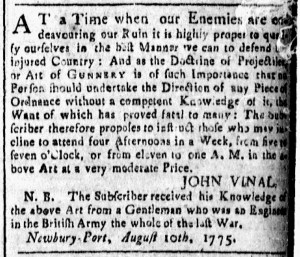
What was advertised in a revolutionary American newspaper 250 years ago today?
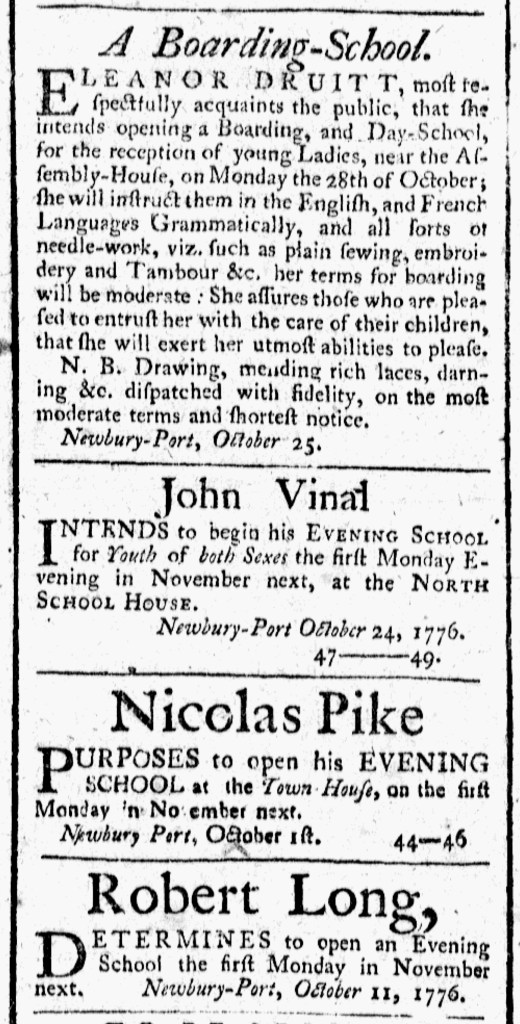
“A Boarding-School.”
“EVENING SCHOOL for Youth of Both Sexes.”
“EVENING SCHOOL at the Town-House.”
“An Evening School.”
Compositors usually did not cluster together newspaper advertisements inserted for similar purposes, yet that was the case for four advertisements for schools that appeared one after the other in the November 1, 1776, edition of the Essex Journal. Each advertisement also ran in the previous issue, but they were scattered throughout the other notices.
The first announced “A Boarding-School” in the headline. Eleanor Druitt relocated from Boston to Newburyport in the spring of 1775, about a month before the battles at Lexington and Concord. Despite the disruptions caused by the war, she operated “a Boarding, and Day-School, for the reception of young Ladies, near the Assembly-House.” She planned to begin a new term on “Monday the 28th of October,” so instruction had already commenced when her advertisement ran for the second time on November 1.
In the next advertisement, John Vinal declared his intention to open an “EVENING SCHOOL for Youth of both Sexes … at the NORTH SCHOOL HOUSE” on the “first Monday Evening in November.” Vinal’s school offered some competition for Druitt’s school, but competed even more directly against Nicolas Pike’s “EVENING SCHOOL at the Town-House” that would begin its new term “on the first Monday in November next.” Pike’s notice was dated October 1 and the notation that appeared on the final line, “44-46,” indicated that it was supposed to run in issues 144, 145, and 146 on October 4, 11, and 18. Vinal’s advertisement was dated October 24 with “47-49” on the final line to remind the compositor to insert it in the issues for October 25 and November 1 and 8.
Yet the Essex Journal did not discontinue Pike’s advertisement after the three insertions indicated in the notation. The fourth advertisement, dated October 11, may help to explain that. Robert Long proclaimed that he “DETERMINES to open an Evening School the first Monday in November next” in a notice that first ran on October 11 with “45.-47.” as the notation on the final line. Perhaps Pike saw the advertisement for the competing school and instructed the printing office to extend the run of his own notice. Long may have been similarly concerned and desired additional insertions of his advertisement. The notation with issue numbers disappeared on October 25, the first time that Druitt and Vinal ran their advertisements, though the compositor may have dropped the notation to achieve uniform length for each column on that page (and Long’s advertisement did appear at the bottom of the column). Alternately, perhaps neither Pike nor Long requested that their advertisements continue running in the Essex Journal. Both should have been discontinued before issue 148 on November 1, according to the original notations, yet the compositor may have continued running them to fill the page. An advertisement for an auction for a house with a “45.-47.” notation ran immediately below Long’s notice.
The schoolmasters and schoolmistress may have been deploying their advertisements strategically … or day-to-day operations in the printing office may have explained the additional insertions of some of the advertisements for schools opening in Newburyport in the fall of 1776. Whatever the explanation, four advertisements for schools running one after the other was an unusual example of clustering notices placed for a similar purpose. Early American newspapers did not tend to classify or categorize advertisements.