
What was advertised in a revolutionary American newspaper 250 years ago today?
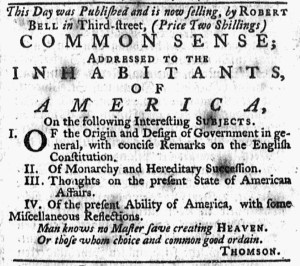
“COMMON SENSE; ADDRESSED TO THE INHABITANTS OF AMERICA.”
On January 16, 1776, Robert Bell’s advertisement for the first edition of Thomas Paine’s Comon Sense made its third appearance in the Pennsylvania Evening Post. That newspaper, the only triweekly published in Philadelphia at the time, was the first to carry Bell’s advertisement. It ran on January 9, 13, and 16, but not on January 11. During that week, Bell also inserted an advertisement for Common Sense in each of the other five newspapers printed in Philadelphia at the time. On January 16, Henrich Millers Pennsylvanische Staatsbote was the last to feature it, the only advertisement in that newspaper printed in English rather than German. Bell, already known for his savvy marketing, made sure that German settlers who could read English saw the political pamphlet advertised in the newspaper they were most likely to consult.
By that time, many of them may have already heard about the incendiary Common Sense, the way it mocked monarchy, and the arguments it made in favor of the colonies declaring independence. Throughout most of the imperial crisis, colonizers blamed Parliament for perpetrating various abuses. They sought redress for their grievances from the king. Over time, however, many identified George III as the author of their misfortune. The monarch, after all, possessed ultimate responsibility for what occurred in his realm. The Declaration of Independence listed more than two dozen grievances, assigning them all to the king rather than Parliament. The publication of Common Sense in January 1776 played a significant role in shifting attitudes about the role the king played in the imperial crisis and the war that began with the skirmishes at Lexington and Concord in April 1775.
Among the observations and arguments that Paine advanced, he stated that “in America THE LAW IS KING. For as in absolute governments, the King is law, so in free countries the law ought to be King and there ought to be no other.” It was an ideal embraced by the founding generation … and it is an ideal under threat today as the nation commemorates 250 years since the Revolutionary War and the Declaration of Independence. Citizens and the legislators who represent them must hold those who seek to be absolute rulers accountable to the rule of law so the republic remains a place where “THE LAW IS KING.”