March 15

What was advertised in a revolutionary American newspaper 250 years ago today?
Henrich Millers Pennsylvanischer Staatsbote (March 15, 1776).

“Gesunde Bernunft.”

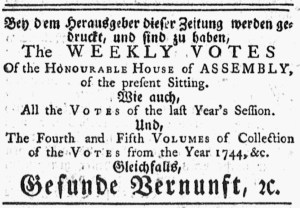
An advertisement partially in English and partially in German informed readers of the March 15, 1776, edition of Henrich Millers Pennsylvanischer Staatsbote that the printer stocked and sold several political journals, including “The WEEKLY VOTES Of the HONOURABLE HOUSE of ASSEMBLY, of the present Sitting,” “All the VOTES of the last Year’s Session,” and “The Fourth and Fifth VOLUMES of [the] Collection of the VOTES from the Year 1744.”  Miller offered his readers opportunities to learn more about current events as well as the political history of Pennsylvania over the past three decades.  “Gleichfalls” or likewise, he sold “Gesunde Bernunft,” a German translation of Thomas Paine’s Common Sense.  Among the many printers who had advertised the popular political pamphlet in the two months since Robert Bell published the first edition in Philadelphia on January 9, Miller was the first to list it as an item also available for purchase rather than making it the focal point of his advertisement.

That had not always been the case in the pages of Henrich Millers Pennsylvanischer Staatsbote.  On January 16, Bell inserted an advertisement (in English) that announced the publication and sale of Common Sense at his shop on Third Street.  A week later, Bell’s advertisement ran once again, this time competing with an advertisement (in German) that announced that Gesunde Bernunft “Es ist jebt under der Presse” or “is in the press” and soon to be published by Melchior Steiner and Carl Cist.  Although Steiner and Cist did not collaborate with Bell on their German edition, they replicated much of his advertisement.  That included giving readers an overview of the contents by listing the headings for the four sections of pamphlet and publishing an epigraph from “Liberty,” a poem by James Thomson.  A month later, Steiner and Cist ran another advertisement (in German) announcing publication of Gesunde Bernunft.  They charged one shilling for a single copy or nine shillings for a dozen.  Like other printers, they offered a discount for those who purchased in volume for retail sales or to distribute to family and friends.

The Adverts 250 Project continues to track the proliferation of local editions of Common Sense and newspaper advertisements intended to disseminate the pamphlet widely, yet a complete accounting cannot overlook the German translation, Gesunde Bernunft, published and advertised by Steiner and Cist.  Very shortly after the pamphlet grabbed the attention of English-speaking colonizers, Steiner and Cist set about making Paine’s radical ideas accessible to German-speaking colonizers in Philadelphia and the backcountry.
March 5

What was advertised in a revolutionary American newspaper 250 years ago today?

Henrich Millers Pennsylvanischer Staatsbote (March 5, 1776).

“Für Officiers und Soldaten.”

James Butland, a lacemaker who kept shop on Front Street in Philadelphia, placed his advertisements in several newspapers in 1775 and 1776.  Like many other entrepreneurs in urban ports, he inserted notices in multiple local newspapers, including the Pennsylvania Journal in February 1775 and the Pennsylvania Evening Post in July 1775.  Yet he did not confine his marketing solely to newspapers published in Philadelphia.  In December 1775, he ran an advertisement in the New-England Chronicle, published in Cambridge, Massachusetts.  With the Continental Army under the command of General George Washington continuing the siege of Boston, perhaps he thought that he could entice customers interested in “gold and silver epaulets for officers” and other adornments for military uniforms.

Pennsylvania Evening Post (February 10, 1776).

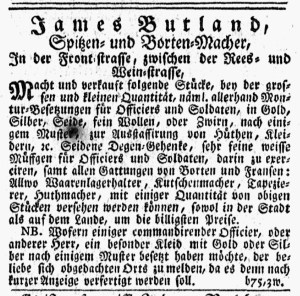
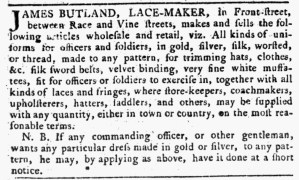
The lacemaker also continued seeking customers, including officers and soldiers, in Philadelphia.  In February 1776, he ran an advertisement for “All kinds of uniforms for officers and soldiers … made to any pattern,” “silk sword belts,” and “very fine white muffatees” (or fingerless gloves) “fit for officers or soldiers to exercise in.”  Butland added a nota bene, stating that “[i]f any commanding officer, or other gentleman, wants a particular dress made in gold or silver, to any pattern, he may … have it done at a short notice.”  Although he continued to make “all kinds of laces and fringes,” Butland took advantage of current events to cater to officers and soldiers.  He did so in two languages!  He inserted the same advertisement in Henrich Millers Pennsylvanischer Staatsbote, a newspaper published in Philadelphia to serve the community of German settlers that lived near the city and in the backcountry.  A nota bene in the masthead of that newspaper proclaimed, “All ADVERTISEMENTS to be inserted in this Paper, or printed single by HENRY MILLER, Publisher hereof, are by him translated gratis.”  Butland, who previously described himself as a “FRINGE and LACE-MAKER, from BRISTOL,” presumably availed himself of that service in his efforts to attract new customers.  He made bold decisions about where to place his newspaper advertisements as he sought to increase his share of the market.

January 16

What was advertised in a revolutionary American newspaper 250 years ago today?

Henrich Millers Pennsylvanischer Staatsbote (January 16, 1776).

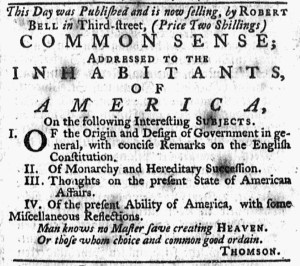
“COMMON SENSE; ADDRESSED TO THE INHABITANTS OF AMERICA.”

On January 16, 1776, Robert Bell’s advertisement for the first edition of Thomas Paine’s Comon Sense made its third appearance in the Pennsylvania Evening Post.  That newspaper, the only triweekly published in Philadelphia at the time, was the first to carry Bell’s advertisement.  It ran on January 9, 13, and 16, but not on January 11.  During that week, Bell also inserted an advertisement for Common Sense in each of the other five newspapers printed in Philadelphia at the time. On January 16, Henrich Millers Pennsylvanische Staatsbote was the last to feature it, the only advertisement in that newspaper printed in English rather than German.  Bell, already known for his savvy marketing, made sure that German settlers who could read English saw the political pamphlet advertised in the newspaper they were most likely to consult.

By that time, many of them may have already heard about the incendiary Common Sense, the way it mocked monarchy, and the arguments it made in favor of the colonies declaring independence.  Throughout most of the imperial crisis, colonizers blamed Parliament for perpetrating various abuses.  They sought redress for their grievances from the king. Over time, however, many identified George III as the author of their misfortune.  The monarch, after all, possessed ultimate responsibility for what occurred in his realm.  The Declaration of Independence listed more than two dozen grievances, assigning them all to the king rather than Parliament.  The publication of Common Sense in January 1776 played a significant role in shifting attitudes about the role the king played in the imperial crisis and the war that began with the skirmishes at Lexington and Concord in April 1775.

Among the observations and arguments that Paine advanced, he stated that “in America THE LAW IS KING.  For as in absolute governments, the King is law, so in free countries the law ought to be King and there ought to be no other.”  It was an ideal embraced by the founding generation … and it is an ideal under threat today as the nation commemorates 250 years since the Revolutionary War and the Declaration of Independence.  Citizens and the legislators who represent them must hold those who seek to be absolute rulers accountable to the rule of law so the republic remains a place where “THE LAW IS KING.”