
What was advertised in a revolutionary American newspaper 250 years ago today?
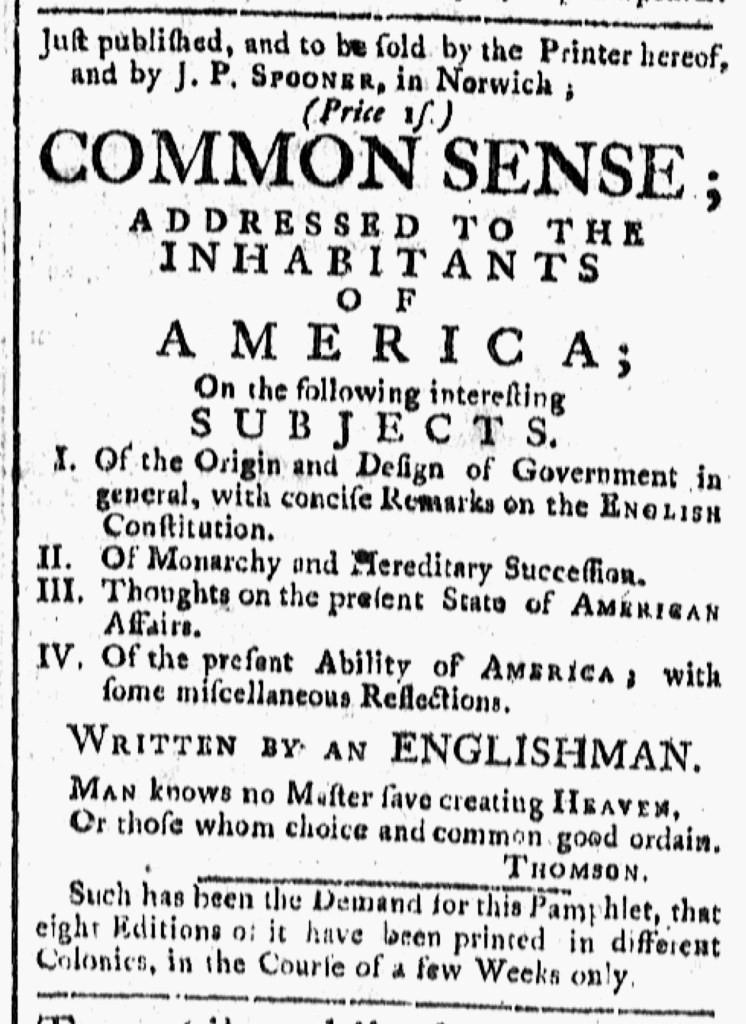
“Such has been the Demand for this Pamphlet, that eight Editions of it have been printed.”
Timothy Green, the printer of the Connecticut Gazette in New London, updated his advertisement for a local edition of Thomas Paine’s Common Sense that he jointly published with Judah P. Spooner, his brother-in-law and former apprentice who ran a printing office in Norwich. A week earlier, Green announced the imminent publication of the pamphlet in short advertisement: “To-morrow will be published, and sold by the Printer hereof, and by J.P. Spooner in Norwich; COMMON SENSE; ADDRESSED TO THE INHABITANTS OF AMERICA.” Green hoped to incite a sense of anticipation among prospective customers.
Once he had copies available for sale at his printing office in New London, Green ran a more extensive advertisement, one that resembled advertisements in other newspapers placed by publishers and booksellers who sold editions published in Philadelphia, New York, and Providence. In addition to the title of the pamphlet, the advertisement listed the “following interesting SUBJECTS” that Paine covered, replicating section headings that included “Of Monarchy and Hereditary Succession” and “Thoughts on the present State of AMERICAN Affairs.” Since Paine remained anonymous at that time, the advertisement stated that the pamphlet was “WRITTEN BY AN ENGLISHMAN.” Green also included the epigraph, two lines of “Liberty,” a poem by James Thomson, that appeared on the title page of the first edition and in advertisements for that and other editions.
In general, Green did not generate new copy for his advertisement for this edition of Common Sense, but he did add an original note at the end: “Such has been the Demand for this Pamphlet, that eight Editions of it have been printed in different Colonies, in the Course of a few Weeks only.” For those who had not heard about the incendiary pamphlet and the bold ideas that Paine presented, Green hoped that its popularity in other places would convince them not to miss reading it for themselves by purchasing a local edition. His tabulation of “eight Editions” suggested that he closely examined the advertisements in newspapers printed in other cities and towns delivered to his printing office as part of a network for sharing information and reprinting content from newspaper to newspaper to newspaper. Green did not peruse just the news accounts and editorials. He apparently took note of the competing editions published in Philadelphia and local editions advertised in other places. Bringing attention to such demand, he reasoned, would spur sales of a local edition of Common Sense in New London.