
What was advertised in a revolutionary American newspaper 250 years ago today?
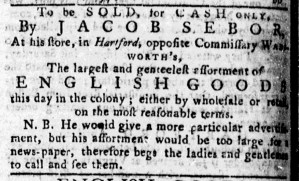
“His assortment would be too large for a news-paper.”
The April 29, 1776, edition of the Connecticut Courant featured a series of advertisements for imported “ENGLISH GOODS.” George Merrill, for instance, advertised an “Assortment of English and India GOODS” available “At the Sign of the UNICORN and MORTAR” in Hartford. An anonymous advertiser offered “ENGLISH GOODS, By WHOLESALE,” instructing interested parties to “Enquire of the Printer” for more information. None of the advertisements indicated when the imported goods had arrived in the colonies, but they had presumably done so before the Continental Association went into effect. In his advertisement for “English, India, and home goods,” Leonard Chester of Weathersfield declared, “Shops that mean to keep themselves alive, ‘till trade opens again, may be supplied with several articles in the wholesale way.” That suggested that the advertisers sold goods that had been imported before the Revolutionary War began and perhaps some time before that.
Apart from James Lamb and Son, advertisers who hawked imported goods did not publish lengthy advertisements that listed their merchandise in an effort to entice prospective customers, yet that did not mean that they refrained from emphasizing the choices they made available to consumers. Jacob Sebor claimed that he stocked the “largest and genteelest assortment of ENGLISH GOODS this day in the colony.” Rather than naming any of them, he resorted to a nota bene to explain that he “would give a more particular advertisement, but his assortment would be too large for a news-paper.” Merchants and shopkeepers sometimes made such claims, some even stating that it would be “too tedious” to enumerate their wares or impossible to do. Instead, they invited, usually implicitly, readers to visit their shops and warehouses to discover what they had in stock. Sebor extended that invitation explicitly, proclaiming that he “begs the ladies and gentlemen to call and see” his extensive inventory. He sought to activate their curiosity about what they might find at his store and encouraged them to examine the merchandise themselves rather than rely on brief descriptions in newspaper advertisements.