May 31

What was advertised in a revolutionary American newspaper 250 years ago today?
Thomas’s Massachusetts Spy (May 31, 1776).

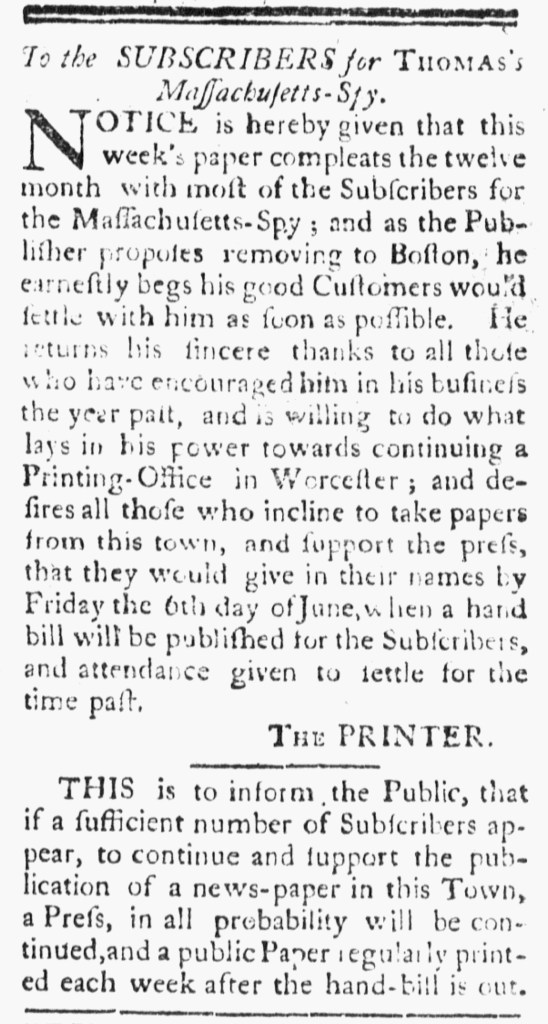
“A Press, in all probability will be continued, and a public Paper regularly printed each week.”

A notice “To the SUBSCRIBERS for THOMAS’s Massachusetts-Spy” in the May 31, 1776, edition informed that that “this week’s paper compleats the twelve month with most of the Subscribers.”  With the period for an annual subscription coming to an end, Isaiah Thomas “earnestly begs his good Customers would settle with him as soon as possible.”  That was even more imperative because the printer “proposes removing to Boston.”  Thomas had not intended to settle in Worcester.  In the winter and spring of 1775, he advertised plans to open a printing office in that town and set up a junior partner to oversee the business there, including publishing Worcester’s first newspaper.  Events in Boston, however, prompted Thomas to flee to Worcester and run the printing office himself.  He left shortly before the battles at Lexington and Concord and continued printing the Massachusetts Spy in Worcester during the siege of Boston.  After British forces evacuated the city on March 17, 1776, he contemplated returning to Boston.

What did that mean for Worcester?  Thomas expressed appreciation “to all those who have encouraged him in his business the year past” and declared that he “is willing to do what lays in his power towards continuing a Printing-Office in Worcester.”  With most of the annual subscriptions for Thomas’s Massachusetts Spy coming to an end, he needed to assess demand for continuing to publish a newspaper there.  To that end, he requested that “all those who incline to take papers from this town, and support the press, … would give in their names by Friday the 6th day of June.”  At that time, he would publish a handbill “for the Subscribers” with more information and collect subscription fees not yet paid.  Whether the printing office and Worcester’s first local newspaper closed depended on how many subscribers made a commitment to supporting the venture.  “[I]f a sufficient number of Subscribers appear, to continue and support the publication of a news-paper in this Town,” Thomas advised, “a Press, in all probability will be continued, and a public Paper regularly printed each week.”  With the May 31 edition, the printer suspended publication of the newspaper, yet his notice gained that “sufficient number of Subscribers” that three weeks later William Stearns and Daniel Bigelow distributed a new issue on June 21.  They altered the title from Thomas’s Massachusetts Spy to the Massachusetts Spy.  Two years later, Thomas returned to Worcester, resumed his role as printer, and changed the title back to Thomas’s Massachusetts Spy.
May 10

What was advertised in revolutionary American newspaper 250 years ago today?

Thomas’s Massachusetts Spy (May 10, 1776).

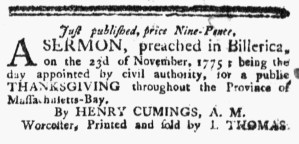
“A SERMON, preached [on] the day appointed by civil authority, for a public THANKSGIVING.”

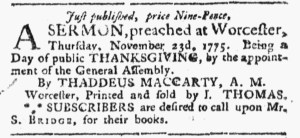
Like many other newspaper printers, Isaiah Thomas used the pages of his own newspaper to promote other items that came off his press.  On May 10, 1776, for instance, he ran two advertisements for sermons preached on November 23, 1775, a day designated as a “Public THANKSGIVING” by the Massachusetts Provincial Congress and announced in the November 16 edition of the New-England Chronicle.

The first of those advertisements appeared on the first page of the May 10 edition.  When setting the type, the compositor had enough space for news from Philadelphia and Charleston with just a small amount left at the bottom of the last column.  Several of the advertisements that ran on other pages would have fit there, but Thomas opted to give a privileged place to an advertisement for “A SERMON,” by Henry Cumings, “preached in Billerica on … the day appointed by civil authority, for a public THANKSGIVING throughout the Province of Massachusetts-Bay.”  The notice declared that the sermon was “Just published” and cost “Nine-Pence.”  Eighteenth-century readers knew that “Just published” meant that an item was now available for purchase, but it did not necessarily indicate that the advertiser who sold it had printed it.  In this case, however, Thomas clarified that he “Printed and sold” the sermon in Worcester.

Thomas’s Massachusetts Spy (May 10, 1775).

His advertisement for “A SERMON, preached at Worcester,” by Thaddeus MacCarty followed a similar format.  It opened with a header that declared, “Just published, price Nine-Pence,” and reminded readers that November 23 had been “a Day of public THANSKGIVING, by the appointment of the General Assembly.”  Once again, the printer stated that the pamphlet was “Printed and sold by I. THOMAS” rather than an item that he acquired from another printing office and retailed at his own.  Although this advertisement now appeared on the fourth page among paid notices placed for a variety of purposes, when the two advertisements first ran in the April 26, 1775, edition of Thomas’s Massachusetts Spy they appeared together on the third page as the first commercial notices following the news.  The printer sought to increase the chances that prospective customers would take note of advertisements for the sermons he published.

April 28

What was advertised in a revolutionary American newspaper 250 years ago this week?

Thomas’s Massachusetts Spy (April 26, 1776).

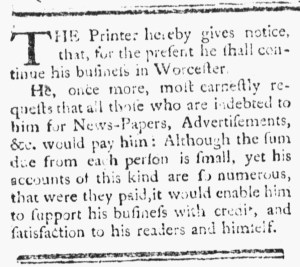
“He … most earnestly requests that all who are indebted to him for News-Papers, Advertisements, &c. would pay him.”

The April 26, 1776, edition of Thomas’s Massachusetts Spy opened with a notice from the printer, Isaiah Thomas.  “THE Printer hereby gives notice,” he declared, “that, for the present he shall continue his business in Worcester.”  Thomas had arrived in town a year earlier.  In the spring of 1775, he advertised his intention to establish Worcester’s first printing office and newspaper and entrust both to a junior partner.  As the imperial crisis intensified, however, he departed Boston just before the battles at Lexington and Concord, relocated to Worcester beyond the reach of the British, and set himself up as the town’s new printer.  On May 3, 1775, he published the first issue of the Massachusetts Spy printed in Worcester.  A year later, he considered whether he wished to remain following the British evacuation of Boston.  Although he announced that “for the present he shall continue his business in Worcester,” a month later he leased the newspaper to William Stearns and Daniel Bigelow.  Thomas moved to Salem “with an intention to commence business in that place; but many obstructions to the plan arising in consequence of the war, he sold the printing materials which he carried to that town, and, in 1778, returned to Worcester, took into possession the press which he had left there, and resumed publication of the Spy.”[1]

In late April 1776, Thomas had not yet decided to leave Worcester.  In hopes of maintaining he business he pursued there, he issued a call for customers to pay their bills.  Throughout the colonies, printers (and other entrepreneurs) frequently ran similar notices.  Thomas did so occasionally and “once more, earnestly requests that all those who are indebted to him for News-Papers, Advertisements, &c. would pay him.”  Like other printers, he extended generous credit to subscribers and other customers.  Doing so put his business in a difficult position: “Although the sum due from each person is small, yet his accounts of this kind are so numerous, they were they paid, it would enable him to support his business with credit, and satisfaction to his readers and himself.”  Thomas emphasized the benefits to readers and the public – the quality of the newspaper – rather than taking a more common approach, threatening legal action against those who disregarded his notice.  In the era of the American revolution, printers often proclaimed that their communities should give them credit for publishing newspapers as a public service.

Thomas indicated that customers owed him for both newspapers and advertisements.  Historians of the early American press sometimes assert that printers allowed credit for subscriptions but insisted that advertisers pay for notice in advance.  Thomas’s notice may suggest that he took a different approach, but it depends on what he meant by “Advertisements.”  He could have referred to newspaper notices, though not necessarily.  He might have meant broadsides, handbills, and other advertising materials printed separately.  Thomas’s account books and correspondence may clarify which kinds of advertisements qualified for credit and which had to be paid before they went to press.

**********

[1] Isaiah Thomas, The History of Printing in America: With a Biography of Printers and an Account of Newspapers (1810; New York: Weathervane Books, 1970), 181.

February 16

What was advertised in a revolutionary American newspaper 250 years ago today?

Thomas’s Massachusetts Spy (February 16, 1776).

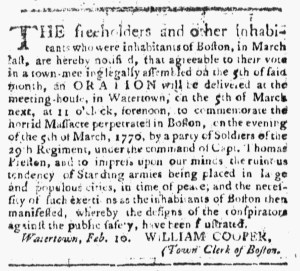
“An ORATION will be delivered … to commemorate the horrid Massacre perpetrated in Boston.”

It was an annual tradition that commenced the year after the Boston Massacre.  The residents of the town gathered for an oration that commemorated the event.  James Lovell spoke in 1771, Joseph Warren in 1772, Benjamin Church in 1773, and John Hancock in 1774Joseph Warren once again delivered the oration in 1775, about six weeks before the imperial crisis became an armed conflict at the battles at Lexington and Concord and just three months before Warren, a major general in the colony’s militia, was killed during the Battle of Bunker Hill.  As the siege of Boston continued in 1776, the tradition continued, though in Watertown where the Massachusetts Provincial Congress met rather than in occupied Boston

About three weeks in advance, Thomas’ Massachusetts Spy, which had relocated to Worcester from Boston just as hostilities commenced, carried a notice for the “freeholders and other inhabitants who were inhabitants of Boston, in March last.”  It advised that “agreeable to their vote in a town-meeting legally assembled on the 5th of said month,” the fifth anniversary of the Boston Massacre, “an ORATION will be delivered at the meeting-house, in Watertown, on the 5th of March next … to commemorate the horrid Massacre perpetrated in Boston … by a party of Soldiers of the 29th Regiment, under the command of Capt. Thomas Preston.”  As usual, the oration would not merely honor those who died when British soldiers fired into a crowd of protestors; the speaker would also “impress upon our minds the ruinous tendency of Standing armies being placed in large and populous cities, in time of peace.”  The presence of British soldiers in Boston led to what colonizers often called the “bloody Tragedy.”  The oration was also a call to action, asserting “the necessity of such exertions as the inhabitants of Boston then manifested, whereby the designs of the conspirators against the public safety, have been frustrated.”  The annual gathering had even greater significance now that colonizers were fighting a war against British troops and many of them increasingly contemplated declaring independence rather than seeking redress of their grievances within the imperial system.  With an advertisement in the public prints, the organizers hoped to draw crowds for the oration and, in turn, strengthen the resolve of those who attended.

January 26

What was advertised in a revolutionary American newspaper 250 years ago today?

Thomas’s Massachusetts Spy (January 26, 1775).

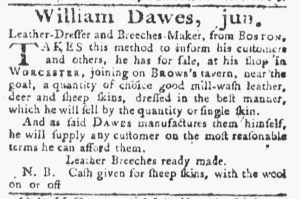
“Leather-Dresser and Breeches-Maker, from BOSTON.”

William Dawes, Jr., a “Leather-Dresser and Breeches-Maker, from BOSTON,” placed an advertisement in the January 26, 1776, edition of Thomas’s Massachusetts Spy.  Just as Isaiah Thomas had moved his printing press from tumultuous Boston to the relative security of Worcester just as the Revolutionary War began, Dawes relocated to the inland town.  According to his advertisement, he now ran a shop “in WORCESTER,” adjoining a tavern and near the jail.  Since he was a newcomer, he could not expect that prospective customers knew his location, so he identified familiar landmarks to help them find him.  He had on hand “a quantity of choice good mill-washed leather, [and] deer and sheep skins, dressed in the best manner,” selling them either individually or “by the quantity.”  Dawes processed or “manufacture[d]” the leather himself, allowing him to “supply any customer on the most reasonable terms he can afford them.”  To that end, he sought “sheep skins, with the wool on or off,” and offered cash to his suppliers.

Under other circumstances, identifying himself as an artisan “from BOSTON” would have told prospective customers something about his origins and suggested that he possessed the skills and knowledge of changing styles that allowed him to run a business in one of the largest urban ports in the colonies.  While that was still the case in this advertisement, noting that he was “from BOSTON” likely resonated in another way.  The residents of that town had endured a lot during the imperial crisis, especially after the Boston Port Act closed the harbor to commerce on June 1, 1774, in retaliation for the destruction of tea the previous December.  The situation became even more precarious once the fighting began at the battles at Lexington and Concord in April 1775.  A siege of Boston ensued.  The Second Continental Congress appointed George Washington as commander of the Continental Army and dispatched him to lead the American forces that surrounded Boston.  Early in the siege, the Sons of Liberty and other leaders negotiated with General Thomas Gage for an exchange, allowing Loyalists to enter Boston and Patriots and others to depart.  Dawes may have been among those refugees in search of better fortunes and greater safety in other towns in New England.  By introducing himself as a “Leather-Dresser and Breeches-Maker, from BOSTON,” he may have hoped to play on the sympathies of prospective customers, giving them one more reason to support his shop in Worcester.

November 24

What was advertised in a revolutionary American newspaper 250 years ago today?

Thomas’s Massachusetts Spy (November 24, 1775).

“This Almanack contains … a very particular Account of … the Battle of Lexington.”

In the fall of 1775, Isaiah Thomas promoted “The NORTH-AMERICAN’s ALMANACK, For the Year 1776.”  He advertised the handy reference manual in the November 24 edition of his newspaper, Thomas’s Massachusetts Spy, Or, American Oracle of Liberty.  According to the imprint on the title page, the almanac was printed in “MASSACHUSETTS-BAY … by I[SAIAH] THOMAS, in WORCESTER, B[ENJAMIN] EDES,” the printer of the Boston-Gazette, “in WATERTOWN; and S[AMUEL] & E[BENEZER] HALL,” the printers of the New-England Chronicle, “in CAMBRIDGE.”  The advertisement also indicated that each of those printing offices stocked and sold the almanac.

Each of those printers earned reputations for their support of the American cause.  In this instance, their marketing efforts reflected their politics.  The advertisement noted that the almanac included “many interesting and entertaining matters” in addition to “what is necessary and useful,” singling out “a very particular Account of the commencement of Hostilities between Great-Britain and America, and the Battle of Lexington, by the Rev. Wm. Gordon.”  The contents listed on the title page included other items that resonated with current events, including “Description of a Tory and a Whig,” “Directions for preserving the Health of the Soldiers in the Camp,” and “Sir Richard Rum’s advice to the Soldiers, shewing the good effects of Spirituous Liquors when they are used with moderation, and their pernicious effects when they are used to excess, with a cure for Drunkenness.”  Such moral lessons often appeared in almanacs, but it had new significance as the siege of Boston continued.

Thomas and his fellow printers considered the account of the Battle of Lexington “worthy to be preserved by every American,” signaling that their almanac featured more than just “interesting and entertaining matters.”  Readers had a patriotic duty to purchase The North-American’s Almanack and then commemorate the first battle of the Revolutionary War and renew their commitment to defending American liberties each time they consulted the almanac.  The printers sought to disseminate it widely, selling it “by the Thousand, Hundred, Groce, Dozen or single,” intending that retailers purchase in volume for resale.  The price on the title page offered a discount, “6 Coppers Single, and 20 Shillings the Dozen,” and the printers may have negotiated even better deals for those purchasing in even greater quantity.  At the same time that they earned their livelihoods by selling almanacs, they also seized an opportunity to commemorate the Battle of Lexington.  Consumers, they asserted, had a patriotic duty to choose this almanac over any of the alternatives.

November 17

What was advertised in a revolutionary American newspaper 250 years ago today?

Thomas’s Massachusetts Spy (November 17, 1775).

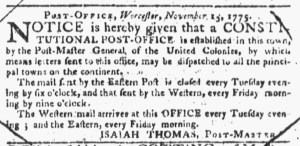
“A CONSTITUTIONAL POST-OFFICE is established in this town.”

Isaiah Thomas, the printer of Thomas’s Massachusetts Spy, gained a new title in the fall of 1775.  He became the postmaster for the “CONSTITUTIONAL POST-OFFICE” in Worcester.  In an advertisement in the November 17 edition of his newspaper, he informed the public that “the Post-Mater General of the United Colonies” established the post office in Worcester.  That meant that “letters sent to this office, may be dispatched to all the principal towns on the continent” via a network of post offices and riders authorized by the Second Continental Congress as an alternative to the imperial postal system.  Thomas provided a schedule.  Outgoing mail “sent by the Eastern Post is closed every Tuesday evening by six o’clock.”  For outgoing mail, the post office dispatched letter received “Friday morning by nine o’clock.”  That corresponded with the arrival of new mail: “The Western mail arrives at this OFFICE every Tuesday evening; and the Eastern, every Friday morning.”  Patrons who planned accordingly could use the new postal system to correspond with friends, relatives, and associates throughout the colonies.

Thomas gave this advertisement a prominent place when he published it, placing it immediately below a notice that the Second Continental Congress created a committee to compile a “just and well authenticated account of the hostilities committed by the ministerial troops and navy in America since March last,” including “proper evidence of the truth of the facts related.”  In documenting buildings destroyed, vessels seized, and stock taken, they justified their resistance and engaged in public relations to demonstrate that colonizers had legitimate grievances.  Thomas could have placed any number of other advertisements below that notice, yet he opted for one that promoted another effort undertaken by the Second Continental Congress to protect American liberties.  It was a fitting editorial decision for a newspaper with American Oracle of Liberty as its secondary title.  In this instance, Thomas deployed an advertisement as a continuation of news about current events, keeping readers updated not only about what occurred but also about how they could support the American cause.

September 13

What was advertised in a revolutionary American newspaper 250 years ago today?

Thomas’s Massachusetts Spy (September 13, 1775).

Furnish him with correct lists of the names of all gentlemen in office, proper for such a publication.”

The September 13, 1775, edition of Thomas’s Massachusetts Spy consisted almost entirely of news selected by the Isaiah Thomas.  It featured only a few advertisements.  Among them, one promoted one of printer’s upcoming projects.  He announced that he “intends publishing as soon as may be, a compleat ALMANACK and REGISTER for the ensuing year.”  The “REGISTER” portion would contain listings of officials, an especially useful resource at the beginning of the Revolutionary War.  Yet there had been so much upheaval in the five months since the battles at Lexington and Concord that Thomas needed assistance with this endeavor.  To that end, he asserted that he “will be much obliged to gentlemen in this and the neighbouring provinces … to furnish him with correct lists of the names of all gentlemen in office, proper for such a publication.”  He hoped that they would do so “with all convenient speed” so he had sufficient time to compile the almanac and register, take the combined volume to press, and market it before the new year.

Yet that was not the only information that Thomas wished to update in this annual publication.  He also requested that correspondents submit “[w]hatever alterations there may have been in the names of persons who keep public houses, since the publication of the Almanack last year.”  Taverns were important gathering places for discussing politics and current events as well as convenient places to deliver letters and newspapers.  Thomas likely desired that information to aid in conducting his own business, not solely for publishing in the almanac and register.  Other Patriot printers in Massachusetts joined Thomas in compiling an accurate list of the proprietors of public houses.  The notice indicated that Benjamin Edes, “Printer and Watertown,” and Samuel Hall and Ebenezer Hall, “Printers in Cambridge,” also collected that information.  Edes printed the Boston-Gazette and Country Journal, having briefly suspended the newspaper and moving out of Boston to Watertown once the fighting began.  The Halls printed the New-England Chronicle.  Until recently, they had published the Essex Gazette in Salem.  They relocated to Cambridge and renamed their newspaper as the newspapers in Boston ceased or suspended publication.  Although Thomas, Edes, and the Halls would eventually compete to sell almanacs, they pursued a common cause in compiling a listing of public houses.

Printers sometimes called on readers to participate in this eighteenth-century version of crowdsourcing.  A year earlier, Nathaniel Mills and John Hicks, printers of the Massachusetts Gazette and Boston Post-Boy, ran a notice to “beg the Favour” of tavernkeepers to submit their names for Bickerstaff’s Boston Almanack, for the Year of Our Redemption 1775.  Not long after that, they made a similar request for “Lists for their REGISTER,” asking “Gentlemen (both in this and the neighbouring Governments) that have been appointed into Office, either Civil, Military or Ecclesiastical” to submit their names for inclusion.  When Thomas issued his request in the fall of 1775, he utilized a familiar practice.