April 29

What was advertised in a revolutionary American newspaper 250 years ago today?
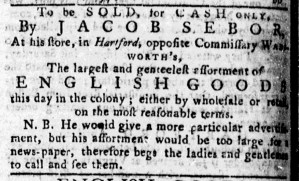
Connecticut Courant (April 29, 1776).

“His assortment would be too large for a news-paper.”

The April 29, 1776, edition of the Connecticut Courant featured a series of advertisements for imported “ENGLISH GOODS.”  George Merrill, for instance, advertised an “Assortment of English and India GOODS” available “At the Sign of the UNICORN and MORTAR” in Hartford.  An anonymous advertiser offered “ENGLISH GOODS, By WHOLESALE,” instructing interested parties to “Enquire of the Printer” for more information.  None of the advertisements indicated when the imported goods had arrived in the colonies, but they had presumably done so before the Continental Association went into effect.  In his advertisement for “English, India, and home goods,” Leonard Chester of Weathersfield declared, “Shops that mean to keep themselves alive, ‘till trade opens again, may be supplied with several articles in the wholesale way.”  That suggested that the advertisers sold goods that had been imported before the Revolutionary War began and perhaps some time before that.

Apart from James Lamb and Son, advertisers who hawked imported goods did not publish lengthy advertisements that listed their merchandise in an effort to entice prospective customers, yet that did not mean that they refrained from emphasizing the choices they made available to consumers.  Jacob Sebor claimed that he stocked the “largest and genteelest assortment of ENGLISH GOODS this day in the colony.”  Rather than naming any of them, he resorted to a nota bene to explain that he “would give a more particular advertisement, but his assortment would be too large for a news-paper.”  Merchants and shopkeepers sometimes made such claims, some even stating that it would be “too tedious” to enumerate their wares or impossible to do.  Instead, they invited, usually implicitly, readers to visit their shops and warehouses to discover what they had in stock.  Sebor extended that invitation explicitly, proclaiming that he “begs the ladies and gentlemen to call and see” his extensive inventory.  He sought to activate their curiosity about what they might find at his store and encouraged them to examine the merchandise themselves rather than rely on brief descriptions in newspaper advertisements.

August 14

What was advertised in a colonial American newspaper 250 years ago today?

Providence Gazette (August 14, 1773)

“Can be better recounted to any who shall be pleased to make personal Application.”

When Nicholas Tillinghast and William Holroyd built a new shop in the summer of 1773, they placed an advertisement in the Providence Gazette to inform “their old Customers, and the Public,” about their new location.  They provided extensive directions, but did not mention if the Sign of the Elephant continued to adorn their business.

The partners gave a brief overview of their “Assortment” or inventory, stating that it “consists of English Piece Goods, and Hard Ware of various Sorts, West-India Goods, Groceries and Wines of several Sorts.”  Some merchants and shopkeepers demonstrated the choices they made available to consumers with lists of merchandise.  Joseph Russell and William Russell, two of the most prominent merchants in Providence, did so in the advertisement immediately above Tillinghast and Holroyd’s notice.  In addition to declaring that they stocked a “general Assortment of ENGLISH and HARD-WARE GOODS,” they named dozens of items and arranged them into two columns.  Tillinghast and Holroyd took a different approach, exclaiming that “the Particulars” of their inventory “would be tedious to enumerate in an Advertisement.”  They had deployed that strategy in the past, asserting that “The Articles are too many to be particularly mentioned in an Advertisement.”

Instead, Tillinghast and Holroyd advised that their merchandise “can be better recounted to any who shall be pleased to make personal Application.”  They invited “old Customers, and the Public” to visit their shop, examine the merchandise, compare items, ask questions, get recommendations, and chat about the “Assortment.”  That gave Tillinghast and Holroyd opportunities to cultivate relationships with consumers and, in the process, encourage them to make purchases rather than merely browse.  They might even convince shoppers to buy items that they had not even previously considered before making “personal Application” at Tillinghast and Holroyd’s new shop.  In their advertisement, the partners emphasized interacting with “their good Customers” rather than treating sales as nothing more than transactions.  They apparently believed that many consumers responded better to that personal touch compared to lengthy lists of goods.

October 11

What was advertised in a colonial American newspaper 250 years ago this week?

Massachusetts Spy (October 8, 1772).

“He has almost every Article usually enquired for in that way.”

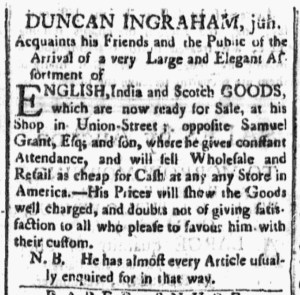
In the fall of 1772, Duncan Ingraham, Jr., took to the pages of the Massachusetts Spy to promote “a very Large and Elegant Assortment of ENGLISH, India and Scotch GOODS, which are now ready for Sale, at his Shop” on Union Street in Boston.  In an advertisement that ran in the October 8 edition, he made appeals to both price and choice in his efforts to entice consumers to shop at his establishment.  Ingraham made bold claims in both regards.  He trumpeted that he would “sell Wholesale and Retail as cheap for Cash [as] at any Store in America,” comparing his prices to those in other shops in Boston as well as Charleston, New York, Philadelphia, and other ports throughout the colonies.  Ingraham confidently stated that “His Prices will show the Goods well charged.”  In turn, he “doubts not of giving satisfaction to all who please to favour him with their custom.”

He had many competitors in Boston, including several who advertised in the Massachusetts Gazette and Boston Weekly News-Letter on the same day.  Herman Brimmer and Andrew Brimmer, Caleb Blanchard, Joshua Gardner, and William Jackson all placed advertisements that listed dozens of imported items available at their shops, demonstrating an array of choices for prospective customers.  The partnership of Amorys, Taylor, and Rogers also published what amounted to a catalog of their merchandise under a headline that promised “GOODS EXTREMELY CHEAP.”  Ingraham adopted a different strategy, choosing instead to market his “very Large and Elegant Assortment” of goods with a nota bene in which he declared that he “has almost every Article usually enquired for in that way.”  He left it to readers to imagine his merchandise on their own.  Even if he did not happen to carry an item a shopper desired, if such a bold claim managed to get them into his store, then he still had an opportunity to make a sale by recommending alternatives.

Ingraham may not have wished to pay to insert a lengthy list of his inventory in the public prints, but that did not mean that he did not attend to consumer choice in an effort to make himself competitive with other merchants and shopkeepers.  In some ways, he invocation of “almost every Article usually enquired for” made even bigger claims than the extensive lists in other advertisements.

November 16

What was advertised in a colonial American newspaper 250 years ago today?

Providence Gazette (November 16, 1771).

“The Articles are too many to be particularly mentioned in an Advertisement.”

Nicholas Tillinghast and William Holroyd stocked their store on King Street in Providence with “a Variety of well assorted GOODS … just imported in the last Ships from London.”  Their inventory included “a fine Assortment of Queen’s Ware,” but the partners declined to list other items, stating that the “Articles are too many to be particularly mentioned in an Advertisement.”  They made an appeal to consumer choice by suggesting that the choices were too extensive to do justice to them in a newspaper notice.  Prospective customers would have to visit their store to see for themselves what might strike their fancy.

Tillinghast and Holroyd were not the only advertisers who adopted that strategy in the November 16, 1771, edition of the Providence Gazette.  Nicholas Brown and Company informed readers that “[t]o enumerate the particular Articles” among their “compleat Assortment of English, India and Hard Ware GOODS” would “require much more room than can well be afforded in a News-Paper.”  They sweetened the deal by asserting that their inventory included “a great Number [of goods] not usually imported into this Town,” another means of leveraging curiosity to draw prospective customers into their store.  Stewart and Taylor selected a couple of dozen items from their “Variety of ENGLISH and INDIA GOODS” to list in their advertisement, but insisted that they carried “a variety of other articles, too tedious to mention.”  Jabez Brown cataloged an even greater number of items from his “neat Assortment of Fall and Winter GOODS,” bit concluded with “&c. &c. &c.”  He repeated the eighteenth-century abbreviation for et cetera three times to underscore the range of choices available.

Such advertisements gave the Providence Gazette a different appearance than many of the newspapers published in Boston, New York, and Philadelphia that same week.  Publications in those cities included many advertisements that incorporated extensive lists of merchandise, many of them extending half a column or more.  Similar advertisements sometimes ran in the Providence Gazette, but, at least for the moment, the merchants and shopkeepers in town opted for an economy of prose.  In general, advertising practices were not regionally distinctive in eighteenth-century America, but the number of merchants and shopkeepers who declared they sold “too many [items] to be particularly mentioned in an Advertisement” represents a trend toward a particularly strategy in Providence in the fall of 1771.  It suggests that advertisers did take note of the methods deployed by their competitors and adjusted their own notices accordingly.

October 19

What was advertised in a colonial American newspaper 250 years ago today?

Providence Gazette (October 19, 1771).

“To enumerate the Articles, would exceed the Limits of an Advertisement in a News-Paper.”

Nicholas Brown and Company took a very different approach to advertising their wares than Edward Thurber did in his advertisement in the October 19, 1771, edition of the Providence Gazette.  Both advertisers emphasized the choices they made available to consumers.  Brown and Company promoted a “general and compleat Assortment of GOODS,” while Thurber used similar language in marketing a “Very compleat Assortment of Goods.”  To help prospective customers imagine the choices, he included a list of everything from “Mantua silks” to “Dutch looking glasses” to “Frying and warming pans.”  For several categories of goods, he further underscored consumer choice, including a “compleat assortment of broadcloths,” a “fine assortment of womens cloth shoes,” and “All sorts of nails and brads.”  His catalog of goods lacked only an “&c.” (the eighteenth-century abbreviation for et cetera) at the end to suggest even more choices.

Brown and Company, on the other hand, did not attempt to impress consumers with lengthy lists or to overwhelm readers with the amount of space their advertisement occupied on the page.  Instead, the partners declared, “To enumerate the Articles, would exceed the Limits of an Advertisement in a News-Paper; but among them are a Number not usually imported into this Town.”  That proclamation may have suggested to some readers that Thurber’s list of goods was too brief and too limited in comparison.  Extending half a column, it was finite and not at all “compleat.”  Brown and Company’s notice filled only half as much space, but only because the partners deemed it impossible to “enumerate” the contents of their store and, as a result, did not attempt to provide even a truncated list.  Brown and Company relied on curiosity to propel consumers to their store, curiosity about what the “general and compleat Assortment” included and curiosity about what kinds of goods might have been among those “not usually imported into this Town.”  Surprises awaited anyone who ventured to Brown and Company’s store.

Although these notices do not reveal which strategy was more effective, they demonstrate that advertisers experimented with how to represent consumer choice to prospective customers.  Neither Thurber nor Brown and Company merely proclaimed that they recently imported goods and expected that would have been sufficient to draw customers to their stores.  Instead, they devised different means of elaborating on choice to make their inventory more attractive to readers of the Providence Gazette.

April 4

What was advertised in a colonial American newspaper 250 years ago today?

Massachusetts Gazette and Boston Weekly News-Letter (April 4, 1771).

“Too many Articles to be enumerated.”

Merchants and shopkeepers frequently published extensive advertisements in eighteenth-century newspapers.  Those advertisements served as catalogs of their inventory, listing all sorts of goods they offered for sale.  Both the length and the number of entries communicated the array of choices available to consumers.  In the April 4, 1771, edition of the Massachusetts Gazette and Boston Weekly News-Letter, for instance, Joshua Gardner inserted an advertisement that filled half a column.  In a dense paragraph, he enumerated scores of “ENGLISH GOODS,” everything from textiles and trimmings to housewares and hardware.  Like many of his peers, he concluded with a promise of “sundry other articles” that would not fit in his advertisement.

Other advertisers did not describe the scope of their wares in such detail.  Some, like Ebenezer Storer, merely stated that they had on hand an “Assortment of GOODS” and invited prospective customers to visit their shops to see for themselves.  Others provided a preview of their merchandise, but dismissed the long lists published by competitors.  Margaret Newman and Robert Hall both took that approach.  Newman promoted her “neat Assortment of English & India GOODS” as well as an “Assortment of Paper Hangings, Felt Hats, Cutlery Ware,” and textiles.  Reiterating “Assortment” underscored choices for consumers, so many choices that a newspaper advertisement could not contain all of them.  Newman proclaimed that she could not even attempt to list her goods because they “Consist[ed] of too many Articles to be enumerated.”  In his advertisement for a “fresh Parcel of Garden Seeds” and a “Collection of the Best Kind of Fruit-Trees,” Hall insisted that he had “too many Sorts to be inserted in an Advertisement.”  Most of his competitors who placed advertisements in the same issue listed dozens of seeds or trees.

Both Newman and Hall suggested that they carried the same variety of goods as their competitors who published long lists of merchandise.  Their insistence that they had “too many Articles to be enumerated” even implied that they might offer more choices than their competitors who provided extensive accounts of their inventory, such a vast array that they could not select only some to appear in their advertisements.  Publishing shorter advertisements may have been motivated by financial concerns, but advertisers like Newman and Hall devised ways of making the length work to their advantage.