Jack Healy is a senior at Assumption University in Worcester, Massachusetts. He is a History major with a minor in Theology. He describes himself as a history fanatic and a devout Catholic. His hobbies include collecting flags and prayer cards. He often uses the prayer cards as bookmarks. Jack made his contributions to the Adverts 250 Project and the Slavery Adverts 250 Project while enrolled in HIS 401 Revolutionary America, 1763-1815, in Fall 2023.
Grace Crowley is a senior double majoring in History and Secondary Education at Assumption University in Worcester, Massachusetts. Her interest in history includes history from the “bottom up,” switching the focus of history to everyday people living through historical events.
On campus, Grace is an active member of the Assumption community. She is an Admissions Ambassador, Orientation Leader, First Year COMPASS Facilitator, and a Student Ambassador for Alumni. She also serves as the Student Leader of the new ASPIRE Program. For the past two summers, Grace has worked as the Student Leader of the Argentinian Summer Exchange Program that Assumption hosts every summer. Grace worked with more than fifty high school students from Argentina and their teachers who came to take classes and immerse themselves in American culture for the month of July.
Grace is also an active member of Hound Sound A Capella, the National Honor Society of Leadership and Success, and Phi Alpha Theta, the National History Honor Society.
In the future, Grace hopes to pursue a career in higher education, focusing on the success of students in their academic lives and beyond. She would also like to visit all of her students in Argentina.
Elizabeth “Ellie” Chaclas is a senior majoring in History and minoring in Art History at Assumption University in Worcester, Massachusetts. She has loved reading her whole life and reads prolifically in her free time. She specializes in many different art forms, including, but not limited to, costuming, painting, mixed media illustration, writing, sculpture, analog photography, and film. Her work has appeared in art shows. On occasion, she performs on stage. Ellie is an equestrian on the university’s equestrian team. She has won several first places for the team and recently graduated to pre-novice class in shows. She has worked as a classroom learning assistant and has plans to a master’s program in Special Education as well as pursue her interests in art history and fashion history. Ellie made her contributions to the Adverts 250 Project and the Slavery Adverts 250 Project while enrolled in HIS 401 Revolutionary America, 1763-1815, in Fall 2023.
Caroline Branch is a senior at Assumption University in Worcester, Massachusetts. She is majoring in History and minoring in Political Science. She plans to get her master’s degree in library science and history. Caroline is very passionate about her role as Opinion Editor at Le Provocateur, Assumption University’s student newspaper, and as secretary of Secondhand Hounds. In her free time, she enjoys dance, art, and historic fashion. Caroline spends her summers working at Camp Bernadette in New Hampshire as an activity head. During the school year she works at Assumption’s d’Alzon Library as a front desk supervisor. Caroline made her contributions to the Adverts 250 Project and the Slavery Adverts 250 Project while enrolled in HIS 401 Revolutionary America, 1763-1815, in Fall 2023.
Kolbe Bell is a senior at Assumption University in Worcester, Massachusetts. He is a history major with a political science minor. He is also president of the Republicans’ Club on campus. He has always been history buff and, in particular, enjoys learning about the history of Central and Eastern Europe. He is an Eagle Scout; his Eagle Scout project was building bat houses to protect endangered brown bats in New England. Kolbe made his contributions to the Adverts 250 Project and the Slavery Adverts 250 Project while enrolled in HIS 401 Revolutionary America, 1763-1815, in Fall 2023.
The Slavery Adverts 250 Project chronicles the role of newspaper advertising in perpetuating slavery in the era of the American Revolution. The project seeks to reveal the ubiquity of slavery in eighteenth-century life from New England to Georgia by republishing advertisements about enslaved people – for sale as individuals or in groups, wanted to purchase or for hire for short periods, runaways who liberated themselves, and those who were subsequently captured and confined in jails and workhouses – in daily digests on this site as well as in real time via the @SlaveAdverts250 Twitter feed, utilizing twenty-first-century media to stand in for the print media of the eighteenth century.
The project aims to provide modern audiences with a sense of just how often colonizers encountered these advertisements in their daily lives. Enslaved men, women, and children appeared in print somewhere in the colonies almost every single day. Those advertisements served as a constant backdrop for social, cultural, economic, and political life in colonial and revolutionary America. Colonizers who did not purport to own enslaved people were still confronted with slavery as well as invited to maintain the system by purchasing enslaved men, women, and children or assisting in the capture of so-called “runaways” who sought to free themselves from bondage. The frequency of these newspaper advertisements suggests just how embedded slavery was in colonial and revolutionary American culture in everyday interactions beyond the printed page.
These advertisements also testify to the experiences of enslaved men, women, and children, though readers must consider that those experiences have been remediated through descriptions offered by enslavers rather than enslaved people themselves. Often unnamed in the advertisements, enslaved men, women, and children were not invisible or unimportant in early America.
These advertisements appeared in colonial American newspapers 250 years ago today.
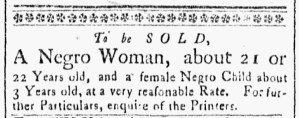
Essex Gazette (February 1, 1774).
**********
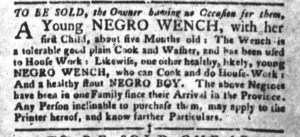
Essex Gazette (February 1, 1774).
**********
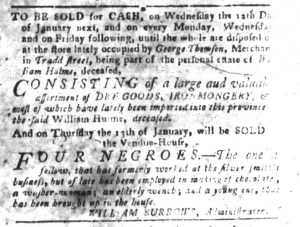
South-Carolina Gazette and Country Journal (February 1, 1774).
**********
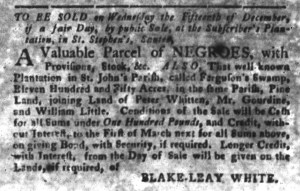
South-Carolina Gazette and Country Journal (February 1, 1774).
**********
South-Carolina Gazette and Country Journal (February 1, 1774).
**********
South-Carolina Gazette and Country Journal (February 1, 1774).
**********
South-Carolina Gazette and Country Journal (February 1, 1774).
**********
South-Carolina Gazette and Country Journal (February 1, 1774).
**********
South-Carolina Gazette and Country Journal (February 1, 1774).
**********
South-Carolina Gazette and Country Journal (February 1, 1774).
**********
South-Carolina Gazette and Country Journal (February 1, 1774).
Madeleine Arsenault is a senior at Assumption University in Worcester, Massachusetts. She is from Stow, Massachusetts. Madeleine is majoring in History and Secondary Education. She plans to become a high school history teacher. She is the oldest of four kids, which contributed to her decision to become a teacher. She spent a semester at Assumption’s Rome campus where she was surrounded by history and loved every second of it. She loves to travel and be outside. In the summer, she spends as much time at the beach (especially on Cape Cod) as possible and tries to go to as many Red Sox games as possible. She is also a camp counselor for second and third graders. Madeleine made her contributions to the Adverts 250 Project and the Slavery Adverts 250 Project while enrolled in HIS 401 Revolutionary America in Fall 2023.
What was advertised in a colonial American newspaper 250 years ago today?
Connecticut Gazette (January 21, 1774).
“Greatly contribute towards the elevation and enlivening of Literary Manufactures.”
Both before and after the American Revolution, Robert Bell, one of the most influential publishers and booksellers of the eighteenth century, set about creating an American market for books. That did not always mean publications by American authors but rather editions printed in America for American readers. More than any other printer, publisher, or bookseller, Bell devised advertising campaigns that spanned the colonies in the early 1770s, distributing subscription proposals and inserting notices in newspapers from New England to South Carolina. His advertisement addressing “SAGES and STUDENTS of the LAW, in AMERICA,” for instance, appeared in newspapers in several colonies, promoting “American editions” of “celebrated works” undertaken by “ROBERT BELL, Printer and Bookseller, of Philadelphia.”
Readers of the Connecticut Gazette, published in New London, encountered Bell’s “SAGES and STUDENTS” advertisement in the January 21, 1774, edition. By then, the advertisement had been in circulation in various newspapers for several months as Bell attempted to cultivate a community of readers and consumers not bounded by local geography but instead defined by their common interest in “the elevation and enlivening of Literary Manufactures in America.” To that end, readers in New London and other places near and far had “had an opportunity of seeing at most of the booksellers shops in the capital towns and cities on the Continent, printed proposals with conditions and specimens” for “American editions” of several books, including “BACON’s new abridgment of the law,” “FERGUSON’s essay on the history of Civil Society,” and “A second American edition of Judge BLACKSTONE’s Commentaries on the laws of England.” For some of those books, Bell asserted that they matched “page for page with the last London edition,” yet he charged only half the price for the American edition. The savvy publisher wedded bargain prices and supporting American industry at a time when relations with Parliament deteriorated in the wake of the Tea Act.
To learn more about subscribing to these various American editions, prospective customers could view the conditions in the printed proposals as well as examine specimens (or samples) to confirm that the quality of the type, paper, and printing was not inferior to imported editions. Bell’s marketing efforts thus incorporated several media, not newspaper advertisements alone. Bell cultivated a network of printers and booksellers to disseminate his various forms of advertising in the public prints and in their printing offices and bookshops, enlisting distant associates in the project of encouraging a market for American editions of important and popular books.
The Slavery Adverts 250 Project chronicles the role of newspaper advertising in perpetuating slavery in the era of the American Revolution. The project seeks to reveal the ubiquity of slavery in eighteenth-century life from New England to Georgia by republishing advertisements about enslaved people – for sale as individuals or in groups, wanted to purchase or for hire for short periods, runaways who liberated themselves, and those who were subsequently captured and confined in jails and workhouses – in daily digests on this site as well as in real time via the @SlaveAdverts250 Twitter feed, utilizing twenty-first-century media to stand in for the print media of the eighteenth century.
The project aims to provide modern audiences with a sense of just how often colonizers encountered these advertisements in their daily lives. Enslaved men, women, and children appeared in print somewhere in the colonies almost every single day. Those advertisements served as a constant backdrop for social, cultural, economic, and political life in colonial and revolutionary America. Colonizers who did not purport to own enslaved people were still confronted with slavery as well as invited to maintain the system by purchasing enslaved men, women, and children or assisting in the capture of so-called “runaways” who sought to free themselves from bondage. The frequency of these newspaper advertisements suggests just how embedded slavery was in colonial and revolutionary American culture in everyday interactions beyond the printed page.
These advertisements also testify to the experiences of enslaved men, women, and children, though readers must consider that those experiences have been remediated through descriptions offered by enslavers rather than enslaved people themselves. Often unnamed in the advertisements, enslaved men, women, and children were not invisible or unimportant in early America.
These advertisements appeared in colonial American newspapers 250 years ago today.
Connecticut Courant (December 14, 1773).
**********
Essex Gazette (December 14, 1773).
**********
South-Carolina Gazette and Country Journal (December 14, 1773).
**********
South-Carolina Gazette and Country Journal (December 14, 1773).
**********
South-Carolina Gazette and Country Journal (December 14, 1773).
**********
South-Carolina Gazette and Country Journal (December 14, 1773).
**********
South-Carolina Gazette and Country Journal (December 14, 1773).
**********
South-Carolina Gazette and Country Journal (December 14, 1773).
**********
South-Carolina Gazette and Country Journal (December 14, 1773).
**********
South-Carolina Gazette and Country Journal (December 14, 1773).
**********
South-Carolina Gazette and Country Journal (December 14, 1773).
**********
South-Carolina Gazette and Country Journal (December 14, 1773).
What was advertised in a colonial American newspaper 250 years ago this month?
Boston-Gazette (October 25, 1773).
“American Magazine. ‘To be, or not to be.’”
In the summer and fall of 1773, Isaiah Thomas advertised widely in his efforts to attract subscribers for the Royal American Magazine, a proposed publication that would become the only magazine published in the colonies at the time if the printer managed to generate enough interest to make it a viable venture. On October 25, he placed advertisements in the Boston-Gazette and the Massachusetts Gazette and Boston Post-Boy with a secondary headline that proclaimed “To be, or not to be,” a familiar quotation from Shakespeare’s Hamlet, to indicate that the prospects of the publication remained uncertain. In both newspapers, Thomas requested that anyone who recruited subscribers return the subscription papers with the lists of names by the middle of November “as by that Time he shall be able to determine, whether the said Magazine will be Published or not.” The advertisement in the Boston-Gazette also included a nota bene in which Thomas confided that “by the Appearance of the Subscription papers, in his Possession, there is the greatest Probability of its going forward.” Thomas would indeed publish the first issue in January 1774, though the magazine lasted only sixteen months due to the disruptions of the imperial crisis and, eventually, the war that began with the skirmishes at Lexington and Concord in April 1775.
The Adverts 250 Project has traced the advertising campaign that promoted the Royal American Magazine in June, July, August, and September. An even greater number of advertisements appeared in colonial newspapers in October than in any previous month, a total of twenty advertisements in ten newspapers in eight towns in six colonies. Three of those advertisements ran in Thomas’s own Massachusetts Spy, while other newspapers carried the vast majority of them. Fourteen of the advertisements appeared in newspapers published beyond Boston. Thomas sought subscribers who read newspapers published in Salem, Massachusetts; Portsmouth, New-Hampshire; Newport, Rhode Island; New Haven and New London in Connecticut; and New York and Philadelphia. Previously, the Connecticut Courant, published in Hartford, and the Providence Gazette also carried the subscription proposals for the Royal American Magazine. Thomas knew the number of prospective subscribers in Boston alone would not justify an investment of the time and resources required to publish a magazine. He devised an advertising campaign that extended to all of the colonies in New England as well as New York and Pennsylvania.
Newport Mercury (October 4, 1773).
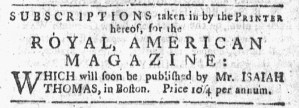
In October 1773, the subscription proposals appeared once again in the Connecticut Journal and the Pennsylvania Journal. The printer’s update addressed “To the Public” made additional appearances in the Boston-Gazette and the Massachusetts Spy. It also ran for the first time in the Essex Gazette, published in Salem, and had two more insertions during the month. Having published the subscription proposals in July and August, the Newport Mercury carried a unique advertisement, likely devised by Solomon Southwick, the printer and Thomas’s local agent for collecting the names of subscribers, rather than by Thomas himself. It announced, “SUBSCRIPTIONS taken in by the Printer hereof, FOR THE ROYAL AMERICAN MAGAZINE: WHICH will soon be published by Mr. ISAIAH THOMAS, in Boston. Price 10s4 per annum.”
Connecticut Journal (October 22, 1773).
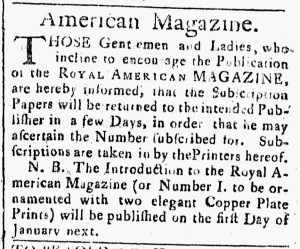
That advertisement expressed greater certainty about the prospects for the magazine than Thomas’s “To be, or not to be” notice that ran in Boston later in the month, as did another update that Thomas placed in newspapers in Connecticut, New Hampshire, and New York near the end of the month. That advertisement informed “Gentlemen and Ladies, who incline to encourage the Publication of the ROYAL AMERICAN MAGAZINE … that the Subscription Papers will be returned to the intended Publisher in a few Days, in order that he may ascertain the Number subscribed for.” Those who had not yet submitted their names to the local printing office had only a limited time to do so. As an enticement to those still contemplating whether they wished to subscribe, a nota bene promoted “two elegant Copper Plate Prints” that would accompany the first issue of the magazine. The nota bene also indicated a publication date, “the first Day of January next.” Along with the magazine, prospective subscribers did not have much time to qualify for these premiums. If they decided to subscribe at some time in the future, they would miss out on the gift given to those who supported the magazine even before the first issue went to press.
Thomas hoped to publish the Royal American Magazine, but first he needed to determine if a market existed to support it. His subscription proposals and other advertisements served a dual purpose: they incited demand for the magazine while also assessing interest and determining the total number of subscribers willing to pay for the publication. Some subscription proposals, no matter how widely they circulated, never resulted in publishing the proposed book, magazine, map, or other item. Over the course of several months, Thomas managed to identify and incite sufficient demand to publish the Royal American Magazine.
**********
Newspaper Advertisements for October 1773
Subscription Proposals
October 8 – Connecticut Journal (second known appearance; fourth possible appearance)
October 20 – Postscript to the Pennsylvania Journal (second appearance)
“To the PUBLIC” Update
October 4 – Boston-Gazette (third appearance)
October 7 – Massachusetts Spy (third appearance)
October 12 – Essex Gazette (first appearance)
October 14 – Massachusetts Spy (fourth appearance)
October 19 – Essex Gazette (second appearance)
October 21 – Massachusetts Spy (fifth appearance)
October 26 – Essex Gazette (third appearance)
“SUBSCRIPTIONS” Notice
October 4 – Newport Mercury (first appearance)
October 11 – Newport Mercury (second appearance)
October 18 – Newport Mercury (third appearance)
October 25 – Newport Mercury (fourth appearance)
“Subscription Papers will be returned” Update
October 22 – Connecticut Journal (first appearance)
October 22 – New-Hampshire Gazette (first appearance)
October 22 – New-London Gazette (first appearance)
October 28 – New-York Journal (first appearance)
October 29 – Connecticut Journal (second appearance)
“To be, or not to be” Update
October 25 – Boston-Gazette (first appearance)
October 25 – Massachusetts Gazette and Boston Post-Boy (first appearance)