
What was advertised in a revolutionary American newspaper 250 years ago today?
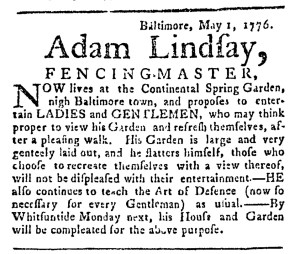
“The Continental Spring Garden, nigh Baltimore town.”
Adam Lindsay, a fencing master in Baltimore, advertised lessons in the “Art of Defence (now so necessary for every Gentleman” in the May 1, 1776, edition of the Maryland Journal, yet that was not the primary purpose of his notice. Instead, he informed readers that he “NOW lives at the Continental Spring Garden” near the town and “proposes to entertain LADIES and GENTLEMENT, who may think proper to view his Garden and refresh themselves, after a pleasing walk.” That sort of activity was part of what Vaughn Scribner has described as “a news sort of commercial leisure sector” that developed in the colonies during the second half of the eighteenth century.[1] Lindsay described his Continental Spring Garden as “large and genteelly laid out.” Furthermore, he believed that “those who choose to recreate themselves with a view thereof, will not be displeased with their entertainment.” An excursion to the Continental Spring Garden may have included light refreshments in a comfortable parlor since Lindsay invited guests to “his House and Garden.”
Scribner notes that the “fascination with commercial pleasure gardens coincided with Enlightenment notions of health, exercise, and natural romanticism,” some of the factors that contributed to the popularity of baths, spas, and mineral waters like the “COLD BATH” advertised in the Pennsylvania Evening Post the day before Lindsay’s notice ran in the Maryland Journal.[2] He documents the founding and operation of pleasure gardens in or near the largest urban ports – Boston, Charleston, New York, and Philadelphia – as well as Baltimore and Providence. The Adverts 250 Project has featured advertisements for some of those sites, including Ranelagh Garden and Vauxhall Garden (both named after famous attractions in London) in New York. At the time that Lindsay established the Continental Spring Garden and advertised it, Baltimore was growing and becoming a more important port. It was becoming a rival to Annapolis and would eventually overshadow the colonial capitol. Just three years earlier, William Goddard commenced publication of the city’s first newspaper, the Maryland Journal. The city quickly became a more significant center for commerce, prompting John Dunlap to introduce a second newspaper in 1775, which meant that Baltimore now had more newspapers than the sole Maryland Gazette published in Annapolis. With such growth, Lindasy joined in an effort, as Scribner puts it, “to harness the verdant nature of their surroundings to make their cities more urbane, and healthy, spaces.”[3] The Continental Spring Garden was part of a larger project undertaken in and near major ports along the Atlantic coast.
**********
[1] Vaughn Scribner, “The World of Nature,” in A Cultural History of Leisure in the Enlightenment, ed. Peter Borsay and Jan Hein Furnee (London: Bloomsbury Press, 2024), 183.
[2] Scribner, “World of Nature,” 184.
[3] Scribner, “World of Nature,” 183.