October 19

What was advertised in a colonial American newspaper 250 years ago today?

Pennsylvania Gazette (October 19, 1774).

“I … am really sorry that my Fellow-Citizens should be so unfriendly to me.”

Tensions rose in the fall of 1774 as the harbor in Boston remained closed and blockaded due to the Boston Port Act and the rest of the Coercive Acts went into effect as punishment for the Boston Tea Party.  Yet that port was not the only place that experienced discord.  John Head’s advertisement, published in both the Pennsylvania Gazette and the Pennsylvania Journal on October 19, revealed his frustration with rumors and accusations that he sought to take advantage of the situation through unscrupulous business practices.

He reported that “a Number of unkind People have industriously propagated through this City, Philadelphia, “I made it my Business to purchase a large Quantity of several Sorts of dry Goods, in order to sell them again at an advanced Price.” Head, like many other colonizers, anticipated that the First Continental Congress, meeting in Philadelphia at the time, would enact some sort of nonimportation agreement in response to the Coercive Acts.  His critics accused him of attempting to sidestep such measures by stocking up on merchandise in advance, thus not having to make the same sacrifices as truly patriotic merchants.  To make matters worse, they insinuated that once goods became scare because of a nonimportation agreement that Head would jack up his prices and gouge consumers who did not have the usual range of choices available to them.

Head vigorously denied those rumors.  That “Report,” he asserted, “I do declare to be false.”  Furthermore, he challenged “any Person to appear to my Face, and prove that I have bought to the Amount of One Shilling’s Worth of Goods from them, since the Arrival of said Ships.”  Continuing to make his case, Head declared that “on a cool Reflection, I cannot recollect that I have bought to the Amount of Fifty Pounds Worth of dry Goods on Speculation since I have been in Trade.”  He did not have a history of acquiring goods in large quantities, nor had he done so recently, despite whatever his adversaries claimed.  Head expressed his disappointment over the gossip that made it necessary to take to the public prints to defend his reputation.  He lamented that “my Fellow-Citizens should be so unfriendly to me, and unjust to themselves, as to propagate a Report of this Sort.”  In so doing, he positioned himself among the ranks of citizens and patriots, confirming his fidelity to their cause.
October 12

What was advertised in a colonial American newspaper 250 years ago today?

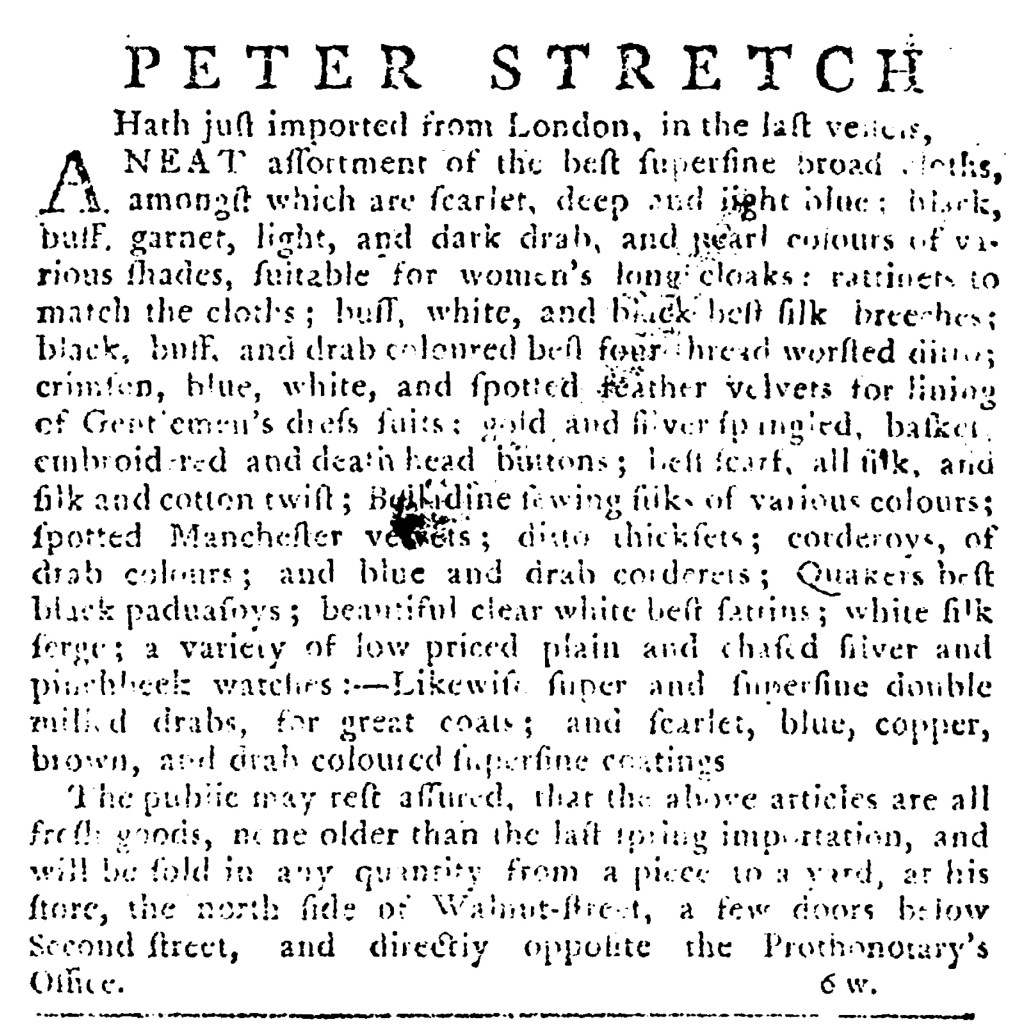
Pennsylvania Journal (October 12, 1774).

“The above articles are all fresh goods, none older than the last spring importation.”

In the fall of 1774, Peter Stretch advertised a “NEAT assortment” of textiles and accessories that he “Hath just imported from London, in the last vessels.”  In an advertisement in the October 12 edition of the Pennsylvania Journal, he listed many of those items, including “the best superfine broad cloths, amongst which are scarlet, deep and light blue, black, buff, garnet, light, and dark drab and pearl colours of various shades, suitable for women’s long cloaks,” “crimson, blue, white, and spotted feather velvets for lining of Gentlemen’s dress suits,” and “gold and silver spangled, basket, embroidered and death head buttons.”

In stating that he had recently imported his wares “in the last vessels,” Stretch deployed language commonly used by merchants and shopkeepers in their marketing efforts.  Elsewhere on the same page, for instance, Barclay and Mitchell declared that they stocked merchandise “Imported in the last vessels from England.”  Yet Stretch decided to provide further details about when he received his inventory at the end of his advertisement.  “The public may rest assured,” he confided, “that the above articles are all fresh goods, none older than the last spring importation.”  Stretch was in a bit of an awkward position.  He wanted the public to think of his goods as new rather than as leftovers that had been lingering on the shelves or in the storeroom, yet not too new.  As the First Continental Congress continued to meet in Philadelphia, just a short distance from Stretch’s store, the colonies prepared to adopt a nonimportation agreement in protest of the Coercive Acts imposed by Parliament following the Boston Tea Party.  Stretch seemingly did not want the public to get the impression that he had imported surplus goods with the intention of sidestepping any nonimportation agreement when it went into effect.  That would have meant allegations that he technically lived up to the letter of the pact but not the spirit.  Rather than hoarding goods in recent months to sell once a nonimportation made imported wares scarce, Stretch “assured” the public that he acquired much of his inventory during “the last spring importation” before the colonies knew about the Boston Port Act, the Massachusetts Government Act, and other legislation passed by Parliament.  He hoped that made it acceptable for patriots to make purchases at his store even as they became wary of the goods carried by his competitors.