Happy Birthday, Benjamin Franklin!

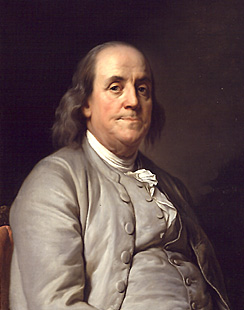
Today is an important day for specialists in early American print culture, for Benjamin Franklin was born on January 17, 1706 (January 6, 1705, Old Style), in Boston. Among his many other accomplishments, Franklin is known as the “Father of American Advertising.” Although I have argued elsewhere that this title should more accurately be bestowed upon Mathew Carey (in my view more prolific and innovative in the realm of advertising as a printer, publisher, and advocate of marketing), I recognize that Franklin deserves credit as well. Franklin is often known as “The First American,” so it not surprising that others should rank him first among the founders of advertising in America.
benjamin-franklin
Benjamin Franklin (Joseph Siffred Duplessis, ca. 1785).  National Portrait Gallery.

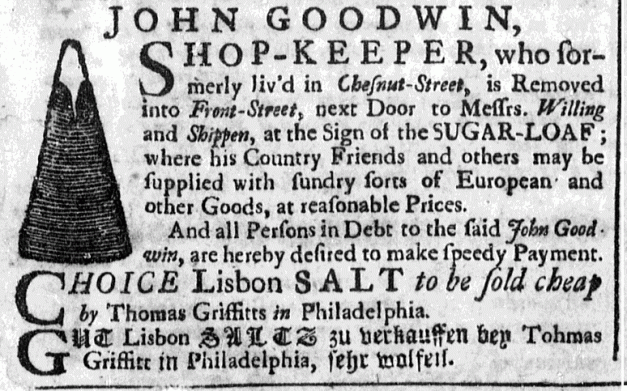
Franklin purchased the Pennsylvania Gazette in 1729. In the wake of becoming printer, he experimented with the visual layout of advertisements that appeared in the weekly newspaper, incorporating significantly more white space and varying font sizes in order to better attract readers’ and potential customers’ attention. Advertising flourished in the Pennsylvania Gazette, which expanded from two to four pages in part to accommodate the greater number of commercial notices.
jan-17-pennsylvania-gazette-19-161736
Advertisements with white space, varying sizes of font, capitals and italics, and a woodcut from Benjamin Franklin’s Pennsylvania Gazette (December 9-16, 1736).

Many historians of the press and print culture in early America have noted that Franklin became wealthy and retired as a printer in favor of a multitude of other pursuits in part because of the revenue he collected from advertising. Others, especially David Waldstreicher, have underscored that this wealth was amassed through participation in the colonial slave trade. The advertisements for goods and services featured in the Pennsylvania Gazette included announcements about buying and selling enslaved men, women, and children as well as notices offering rewards for those who escaped from bondage.

jan-17-pennsylvania-gazette-slave-19-161736
Advertisement for an enslaved woman and an enslaved child from Benjamin Franklin’s Pennsylvania Gazette (December 9-16, 1736).

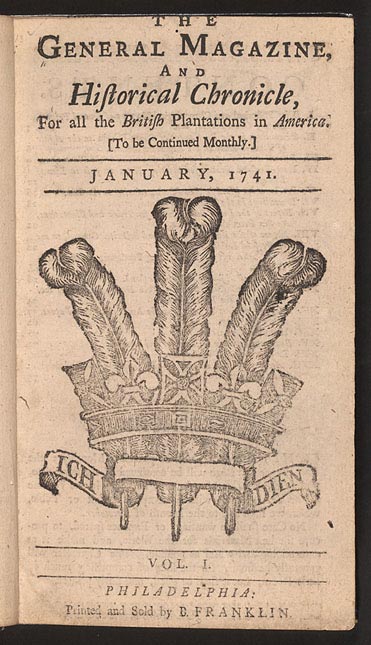
In 1741 Franklin published one of colonial America’s first magazines, The General Magazine and Historical Chronicle, for all the British Plantations in America (which barely missed out on being the first American magazine, a distinction earned by Franklin’s competitor, Andrew Bradford, with The American Magazine or Monthly View of the Political State of the British Colonies). The magazine lasted only a handful of issues, but that was sufficient for Franklin to become the first American printer to include an advertisement in a magazine (though advertising did not become a standard part of magazine publication until special advertising wrappers were developed later in the century — and Mathew Carey was unarguably the master of that medium).
general-magazine
General Magazine and Historical Chronicle, For all the British Plantations in America (January 1741).  Library of Congress.

In 1744 Franklin published an octavo-sized Catalogue of Choice and Valuable Books, including 445 entries. This is the first known American book catalogue aimed at consumers (though the Library Company of Philadelphia previously published catalogs listing their holdings in 1733, 1735, and 1741). Later that same year, Franklin printed a Catalogue of Books to Be Sold at Auction.

Franklin pursued advertising through many media in eighteenth-century America, earning recognition as one of the founders of American advertising. Happy 320th birthday, Benjamin Franklin!

December 20

What was advertised in a revolutionary American newspaper 250 years ago today?

Pennsylvania Journal (December 20, 1775).

“Any person desirous of information concerning the character … of Mrs. Brodeau, may apply to … B. FRANKLIN.”

When she arrived in Philadelphia, “Mrs. BRODEAU, from England,” placed advertisements in the Pennsylvania Gazette and the Pennsylvania Journal as a means of “acquainting her friends and the public in general, that she has opened a boarding school in Walnut-street.”  She sought pupils of a certain status, pledging that “young ladies will be genteelly boarded, and taught to read and speak the French and English language; the tambour embroidery, and every kind of useful and ornamental needle work.”  In addition to the curriculum, Brodeau promoted her supervision of her charges, stating that she “hopes to prove by her assiduity and attention to the morals and behaviour of these ladies entrusted to her care, that she in some measure merits the recommendations she has been favoured with from her native country.”  Like many other schoolmasters and schoolmistresses who advertised in Philadelphia’s newspapers during the era of the American Revolution, Brodeau emphasized moral development as well as curriculum.[1]

The parents and guardians of prospective students did not have to take Brodeau’s word for it.  Instead, she inserted a testimonial from Robert Morris, the influential merchant, and Benjamin Franklin, the retired printer turned politician and diplomat.  “Any person desirous of information concerning the character and recommendations of Mrs. Brodeau,” they stated, “may apply to either of us.”  According to Claude-Anne Lopez, associated editor of the Papers of Benjamin Franklin, that was, “so far as we know, the only time that Franklin backed an enterprise of that kind with his name.”[2]  Lopez further explains that Anna Brodeau “suddenly and rather mysteriously appeared in Philadelphia with a baby daughter in her arms,”[3] yet “[n]othing is known about a Mr. Brodeau.”  If residents of Philadelphia had any concerns about Brodeau’s background, the endorsement from Franklin and Morris likely countered their concerns.  Still, the advertisement apparently did not garner as much response as Brodeau hoped when she placed it in the December 6 edition of the Pennsylvania Gazette, the newspaper that Franklin formerly printed.  Two weeks later she placed the same advertisement in the Pennsylvania Journal.  Those efforts helped launch her boarding school.  By the end of the Revolutionary War, Franklin’s daughter, Sarah Bache, wrote to her father that Brodeau “has made a handsome fortune.”  Despite the disruptions of the war, she established her boarding school and her reputation.  Lopez chronicles other accolades for Brodeau that appeared in print, including a poem by an anonymous contributor to the Columbian Magazine in 1786 and her obituary in the National Intelligencer in 1836.  With words of support from Franklin and Morris, Brodeau soon “attracted students from the best families in Philadelphia.”[4]  Her marketing incorporated the eighteenth-century version of a celebrity endorsement.

**********

[1] Carl Robert Keyes, “Selling Gentility and Pretending Morality: Education and Newspaper Advertisements in Philadelphia, 1765-1775,” Pennsylvania Magazine of History and Biography 141, no. 3 (October 2017): 245-274.

[2] Claude-Anne Lopez, “Benjamin Franklin and William Dodd: A New Look at an Old Vause Célèbre,” Proceedings of the American Philosophical Society 129, no. 3 (September 1985): 262.

[3] Lopez, “Benjamin Franklin and William Dodd,” 262, 263.

[4]Lopez, “Benjamin Franklin and William Dodd,” 263.

Happy Birthday, Benjamin Franklin!

Today is an important day for specialists in early American print culture, for Benjamin Franklin was born on January 17, 1706 (January 6, 1705, Old Style), in Boston. Among his many other accomplishments, Franklin is known as the “Father of American Advertising.” Although I have argued elsewhere that this title should more accurately be bestowed upon Mathew Carey (in my view more prolific and innovative in the realm of advertising as a printer, publisher, and advocate of marketing), I recognize that Franklin deserves credit as well. Franklin is often known as “The First American,” so it not surprising that others should rank him first among the founders of advertising in America.

benjamin-franklin
Benjamin Franklin (Joseph Siffred Duplessis, ca. 1785).  National Portrait Gallery.

Franklin purchased the Pennsylvania Gazette in 1729. In the wake of becoming printer, he experimented with the visual layout of advertisements that appeared in the weekly newspaper, incorporating significantly more white space and varying font sizes in order to better attract readers’ and potential customers’ attention. Advertising flourished in the Pennsylvania Gazette, which expanded from two to four pages in part to accommodate the greater number of commercial notices.

jan-17-pennsylvania-gazette-19-161736
Advertisements with white space, varying sizes of font, capitals and italics, and a woodcut from Benjamin Franklin’s Pennsylvania Gazette (December 9-16, 1736).

Many historians of the press and print culture in early America have noted that Franklin became wealthy and retired as a printer in favor of a multitude of other pursuits in part because of the revenue he collected from advertising. Others, especially David Waldstreicher, have underscored that this wealth was amassed through participation in the colonial slave trade. The advertisements for goods and services featured in the Pennsylvania Gazette included announcements about buying and selling enslaved men, women, and children as well as notices offering rewards for those who escaped from bondage.

jan-17-pennsylvania-gazette-slave-19-161736
Advertisement for an enslaved woman and an enslaved child from Benjamin Franklin’s Pennsylvania Gazette (December 9-16, 1736).

In 1741 Franklin published one of colonial America’s first magazines, The General Magazine and Historical Chronicle, for all the British Plantations in America (which barely missed out on being the first American magazine, a distinction earned by Franklin’s competitor, Andrew Bradford, with The American Magazine or Monthly View of the Political State of the British Colonies). The magazine lasted only a handful of issues, but that was sufficient for Franklin to become the first American printer to include an advertisement in a magazine (though advertising did not become a standard part of magazine publication until special advertising wrappers were developed later in the century — and Mathew Carey was unarguably the master of that medium).

general-magazine
General Magazine and Historical Chronicle, For all the British Plantations in America (January 1741).  Library of Congress.

In 1744 Franklin published an octavo-sized Catalogue of Choice and Valuable Books, including 445 entries. This is the first known American book catalogue aimed at consumers (though the Library Company of Philadelphia previously published catalogs listing their holdings in 1733, 1735, and 1741). Later that same year, Franklin printed a Catalogue of Books to Be Sold at Auction.

Franklin pursued advertising through many media in eighteenth-century America, earning recognition as one of the founders of American advertising. Happy 319th birthday, Benjamin Franklin!

Happy Birthday, Benjamin Franklin!

Today is an important day for specialists in early American print culture, for Benjamin Franklin was born on January 17, 1706 (January 6, 1705, Old Style), in Boston. Among his many other accomplishments, Franklin is known as the “Father of American Advertising.” Although I have argued elsewhere that this title should more accurately be bestowed upon Mathew Carey (in my view more prolific and innovative in the realm of advertising as a printer, publisher, and advocate of marketing), I recognize that Franklin deserves credit as well. Franklin is often known as “The First American,” so it not surprising that others should rank him first among the founders of advertising in America.

benjamin-franklin
Benjamin Franklin (Joseph Siffred Duplessis, ca. 1785).  National Portrait Gallery.

Franklin purchased the Pennsylvania Gazette in 1729. In the wake of becoming printer, he experimented with the visual layout of advertisements that appeared in the weekly newspaper, incorporating significantly more white space and varying font sizes in order to better attract readers’ and potential customers’ attention. Advertising flourished in the Pennsylvania Gazette, which expanded from two to four pages in part to accommodate the greater number of commercial notices.

jan-17-pennsylvania-gazette-19-161736
Advertisements with white space, varying sizes of font, capitals and italics, and a woodcut from Benjamin Franklin’s Pennsylvania Gazette (December 9-16, 1736).

Many historians of the press and print culture in early America have noted that Franklin became wealthy and retired as a printer in favor of a multitude of other pursuits in part because of the revenue he collected from advertising. Others, especially David Waldstreicher, have underscored that this wealth was amassed through participation in the colonial slave trade. The advertisements for goods and services featured in the Pennsylvania Gazette included announcements about buying and selling enslaved men, women, and children as well as notices offering rewards for those who escaped from bondage.

jan-17-pennsylvania-gazette-slave-19-161736
Advertisement for an enslaved woman and an enslaved child from Benjamin Franklin’s Pennsylvania Gazette (December 9-16, 1736).

In 1741 Franklin published one of colonial America’s first magazines, The General Magazine and Historical Chronicle, for all the British Plantations in America (which barely missed out on being the first American magazine, a distinction earned by Franklin’s competitor, Andrew Bradford, with The American Magazine or Monthly View of the Political State of the British Colonies). The magazine lasted only a handful of issues, but that was sufficient for Franklin to become the first American printer to include an advertisement in a magazine (though advertising did not become a standard part of magazine publication until special advertising wrappers were developed later in the century — and Mathew Carey was unarguably the master of that medium).

general-magazine
General Magazine and Historical Chronicle, For all the British Plantations in America (January 1741).  Library of Congress.

In 1744 Franklin published an octavo-sized Catalogue of Choice and Valuable Books, including 445 entries. This is the first known American book catalogue aimed at consumers (though the Library Company of Philadelphia previously published catalogs listing their holdings in 1733, 1735, and 1741). Later that same year, Franklin printed a Catalogue of Books to Be Sold at Auction.

Franklin pursued advertising through many media in eighteenth-century America, earning recognition as one of the founders of American advertising. Happy 318th birthday, Benjamin Franklin!

Happy Birthday, Benjamin Franklin!

Today is an important day for specialists in early American print culture, for Benjamin Franklin was born on January 17, 1706 (January 6, 1705, Old Style), in Boston. Among his many other accomplishments, Franklin is known as the “Father of American Advertising.” Although I have argued elsewhere that this title should more accurately be bestowed upon Mathew Carey (in my view more prolific and innovative in the realm of advertising as a printer, publisher, and advocate of marketing), I recognize that Franklin deserves credit as well. Franklin is often known as “The First American,” so it not surprising that others should rank him first among the founders of advertising in America.

benjamin-franklin
Benjamin Franklin (Joseph Siffred Duplessis, ca. 1785).  National Portrait Gallery.

Franklin purchased the Pennsylvania Gazette in 1729. In the wake of becoming printer, he experimented with the visual layout of advertisements that appeared in the weekly newspaper, incorporating significantly more white space and varying font sizes in order to better attract readers’ and potential customers’ attention. Advertising flourished in the Pennsylvania Gazette, which expanded from two to four pages in part to accommodate the greater number of commercial notices.

jan-17-pennsylvania-gazette-19-161736
Advertisements with white space, varying sizes of font, capitals and italics, and a woodcut from Benjamin Franklin’s Pennsylvania Gazette (December 9-16, 1736).

Many historians of the press and print culture in early America have noted that Franklin became wealthy and retired as a printer in favor of a multitude of other pursuits in part because of the revenue he collected from advertising. Others, especially David Waldstreicher, have underscored that this wealth was amassed through participation in the colonial slave trade. The advertisements for goods and services featured in the Pennsylvania Gazette included announcements about buying and selling enslaved men, women, and children as well as notices offering rewards for those who escaped from bondage.

jan-17-pennsylvania-gazette-slave-19-161736
Advertisement for an enslaved woman and an enslaved child from Benjamin Franklin’s Pennsylvania Gazette (December 9-16, 1736).

In 1741 Franklin published one of colonial America’s first magazines, The General Magazine and Historical Chronicle, for all the British Plantations in America (which barely missed out on being the first American magazine, a distinction earned by Franklin’s competitor, Andrew Bradford, with The American Magazine or Monthly View of the Political State of the British Colonies). The magazine lasted only a handful of issues, but that was sufficient for Franklin to become the first American printer to include an advertisement in a magazine (though advertising did not become a standard part of magazine publication until special advertising wrappers were developed later in the century — and Mathew Carey was unarguably the master of that medium).

general-magazine
General Magazine and Historical Chronicle, For all the British Plantations in America (January 1741).  Library of Congress.

In 1744 Franklin published an octavo-sized Catalogue of Choice and Valuable Books, including 445 entries. This is the first known American book catalogue aimed at consumers (though the Library Company of Philadelphia previously published catalogs listing their holdings in 1733, 1735, and 1741). Later that same year, Franklin printed a Catalogue of Books to Be Sold at Auction.

Franklin pursued advertising through many media in eighteenth-century America, earning recognition as one of the founders of American advertising. Happy 317th birthday, Benjamin Franklin!

Happy Birthday, Benjamin Franklin!

Today is an important day for specialists in early American print culture, for Benjamin Franklin was born on January 17, 1706 (January 6, 1705, Old Style), in Boston. Among his many other accomplishments, Franklin is known as the “Father of American Advertising.” Although I have argued elsewhere that this title should more accurately be bestowed upon Mathew Carey (in my view more prolific and innovative in the realm of advertising as a printer, publisher, and advocate of marketing), I recognize that Franklin deserves credit as well. Franklin is often known as “The First American,” so it not surprising that others should rank him first among the founders of advertising in America.

benjamin-franklin
Benjamin Franklin (Joseph Siffred Duplessis, ca. 1785).  National Portrait Gallery.

Franklin purchased the Pennsylvania Gazette in 1729. In the wake of becoming printer, he experimented with the visual layout of advertisements that appeared in the weekly newspaper, incorporating significantly more white space and varying font sizes in order to better attract readers’ and potential customers’ attention. Advertising flourished in the Pennsylvania Gazette, which expanded from two to four pages in part to accommodate the greater number of commercial notices.

jan-17-pennsylvania-gazette-19-161736
Advertisements with white space, varying sizes of font, capitals and italics, and a woodcut from Benjamin Franklin’s Pennsylvania Gazette (December 9-16, 1736).

Many historians of the press and print culture in early America have noted that Franklin became wealthy and retired as a printer in favor of a multitude of other pursuits in part because of the revenue he collected from advertising. Others, especially David Waldstreicher, have underscored that this wealth was amassed through participation in the colonial slave trade. The advertisements for goods and services featured in the Pennsylvania Gazette included announcements about buying and selling enslaved men, women, and children as well as notices offering rewards for those who escaped from bondage.

jan-17-pennsylvania-gazette-slave-19-161736
Advertisement for an enslaved woman and an enslaved child from Benjamin Franklin’s Pennsylvania Gazette (December 9-16, 1736).

In 1741 Franklin published one of colonial America’s first magazines, The General Magazine and Historical Chronicle, for all the British Plantations in America (which barely missed out on being the first American magazine, a distinction earned by Franklin’s competitor, Andrew Bradford, with The American Magazine or Monthly View of the Political State of the British Colonies). The magazine lasted only a handful of issues, but that was sufficient for Franklin to become the first American printer to include an advertisement in a magazine (though advertising did not become a standard part of magazine publication until special advertising wrappers were developed later in the century — and Mathew Carey was unarguably the master of that medium).

general-magazine
General Magazine and Historical Chronicle, For all the British Plantations in America (January 1741).  Library of Congress.

In 1744 Franklin published an octavo-sized Catalogue of Choice and Valuable Books, including 445 entries. This is the first known American book catalogue aimed at consumers (though the Library Company of Philadelphia previously published catalogs listing their holdings in 1733, 1735, and 1741). Later that same year, Franklin printed a Catalogue of Books to Be Sold at Auction.

Franklin pursued advertising through many media in eighteenth-century America, earning recognition as one of the founders of American advertising. Happy 316th birthday, Benjamin Franklin!

Happy Birthday, Benjamin Franklin!

Today is an important day for specialists in early American print culture, for Benjamin Franklin was born on January 17, 1706 (January 6, 1705, Old Style), in Boston. Among his many other accomplishments, Franklin is known as the “Father of American Advertising.” Although I have argued elsewhere that this title should more accurately be bestowed upon Mathew Carey (in my view more prolific and innovative in the realm of advertising as a printer, publisher, and advocate of marketing), I recognize that Franklin deserves credit as well. Franklin is often known as “The First American,” so it not surprising that others should rank him first among the founders of advertising in America.

benjamin-franklin
Benjamin Franklin (Joseph Siffred Duplessis, ca. 1785).  National Portrait Gallery.

Franklin purchased the Pennsylvania Gazette in 1729. In the wake of becoming printer, he experimented with the visual layout of advertisements that appeared in the weekly newspaper, incorporating significantly more white space and varying font sizes in order to better attract readers’ and potential customers’ attention. Advertising flourished in the Pennsylvania Gazette, which expanded from two to four pages in part to accommodate the greater number of commercial notices.

jan-17-pennsylvania-gazette-19-161736
Advertisements with white space, varying sizes of font, capitals and italics, and a woodcut from Benjamin Franklin’s Pennsylvania Gazette (December 9-16, 1736).

Many historians of the press and print culture in early America have noted that Franklin became wealthy and retired as a printer in favor of a multitude of other pursuits in part because of the revenue he collected from advertising. Others, especially David Waldstreicher, have underscored that this wealth was amassed through participation in the colonial slave trade. The advertisements for goods and services featured in the Pennsylvania Gazette included announcements about buying and selling enslaved men, women, and children as well as notices offering rewards for those who escaped from bondage.

jan-17-pennsylvania-gazette-slave-19-161736
Advertisement for an enslaved woman and an enslaved child from Benjamin Franklin’s Pennsylvania Gazette (December 9-16, 1736).

In 1741 Franklin published one of colonial America’s first magazines, The General Magazine and Historical Chronicle, for all the British Plantations in America (which barely missed out on being the first American magazine, a distinction earned by Franklin’s competitor, Andrew Bradford, with The American Magazine or Monthly View of the Political State of the British Colonies). The magazine lasted only a handful of issues, but that was sufficient for Franklin to become the first American printer to include an advertisement in a magazine (though advertising did not become a standard part of magazine publication until special advertising wrappers were developed later in the century — and Mathew Carey was unarguably the master of that medium).

general-magazine
General Magazine and Historical Chronicle, For all the British Plantations in America (January 1741).  Library of Congress.

In 1744 Franklin published an octavo-sized Catalogue of Choice and Valuable Books, including 445 entries. This is the first known American book catalogue aimed at consumers (though the Library Company of Philadelphia previously published catalogs listing their holdings in 1733, 1735, and 1741). Later that same year, Franklin printed a Catalogue of Books to Be Sold at Auction.

Franklin pursued advertising through many media in eighteenth-century America, earning recognition as one of the founders of American advertising. Happy 315th birthday, Benjamin Franklin!

March 10

What was advertised in a colonial American newspaper 250 years ago today?

Mar 10 - 3:10:1770 Providence Gazette
Providence Gazette (March 10, 1770).

“WEST’s … ACCOUNT of the TRANSIT of VENUS.”

John Carter, printer of the Providence Gazette, inserted a familiar advertisement in the March 10, 1770, edition.  It announced “WEST’s ALMANACKS, For the present Year, Likewise, his ACCOUNT of the TRANSIT of VENUS, To be sold by the Printer hereof.”  Carter also happened to be the printer of both of those volumes penned by West, an astronomer, mathematician, and professor at Rhode Island College (now Brown University).  Given the practices of colonial printers, it might be tempting to assume that Carter inserted the short advertisement in order to complete the final column on the last page of that issue when lacking other content … or that he once again attempted to rid himself of surplus copies of an almanac that became more obsolete with each passing day.  Careful examination of the news items in that issue of the Providence Gazette, however, suggest that Carter may have had another motive.

The second page featured an item reprinted “From the MASSACHUSETTS GAZETTE” that filled an entire column and then some.  It detailed “THE COMET, which we saw in the beginning of September,” declaring that it disappeared from visibility “for near six weeks in the neighbourhood of the Sun” and then “shewed itself again towards the end of October on the other side of the Sun.”  Unsigned, this account was probably written by John Winthrop (1714-1779), described by Frederick E. Brasch as “America’s First Astronomer.”  According to Brasch, “In 1769 Winthrop published an account in the Boston journals of the observations of the brilliant comet which appeared on September 1st.  The remarkable feature of this comet was the length of its tail.”[1]  Colonial printers frequently copied news items and editorials from one newspaper to another as they traded their publications through exchange networks.

Carter may have glimpsed an opportunity to tie a book about astronomy he had recently published an account of a comet that he republished, hoping that the latter incited demand for the former.  He could have intended for Winthrop’s extensive description of the comet to whet the appetites of readers interested in astronomy.  He offered them more, reminding them that he sold West’s “ACCOUNT of the TRANSIT of VENUS.”  The printer engaged in a sort of product placement.  Though certainly not as sophisticated as modern practices, it was an innovation in eighteenth-century America.

**********

[1] Frederick E. Brasch, “John Winthrop (1714-1779), America’s First Astronomer, and the Science of His Period, Publications of the Astronomical Society of the Pacific 28, no. 165 (August-October 1916):  169.

Happy Birthday, Benjamin Franklin!

Today is an important day for specialists in early American print culture, for Benjamin Franklin was born on January 17, 1706 (January 6, 1705, Old Style), in Boston. Among his many other accomplishments, Franklin is known as the “Father of American Advertising.” Although I have argued elsewhere that this title should more accurately be bestowed upon Mathew Carey (in my view more prolific and innovative in the realm of advertising as a printer, publisher, and advocate of marketing), I recognize that Franklin deserves credit as well. Franklin is often known as “The First American,” so it not surprising that others should rank him first among the founders of advertising in America.

benjamin-franklin
Benjamin Franklin (Joseph Siffred Duplessis, ca. 1785).  National Portrait Gallery.

Franklin purchased the Pennsylvania Gazette in 1729. In the wake of becoming printer, he experimented with the visual layout of advertisements that appeared in the weekly newspaper, incorporating significantly more white space and varying font sizes in order to better attract readers’ and potential customers’ attention. Advertising flourished in the Pennsylvania Gazette, which expanded from two to four pages in part to accommodate the greater number of commercial notices.

jan-17-pennsylvania-gazette-19-161736
Advertisements with white space, varying sizes of font, capitals and italics, and a woodcut from Benjamin Franklin’s Pennsylvania Gazette (December 9-16, 1736).

Many historians of the press and print culture in early America have noted that Franklin became wealthy and retired as a printer in favor of a multitude of other pursuits in part because of the revenue he collected from advertising. Others, especially David Waldstreicher, have underscored that this wealth was amassed through participation in the colonial slave trade. The advertisements for goods and services featured in the Pennsylvania Gazette included announcements about buying and selling enslaved men, women, and children as well as notices offering rewards for those who escaped from bondage.

jan-17-pennsylvania-gazette-slave-19-161736
Advertisement for an enslaved woman and an enslaved child from Benjamin Franklin’s Pennsylvania Gazette (December 9-16, 1736).

In 1741 Franklin published one of colonial America’s first magazines, The General Magazine and Historical Chronicle, for all the British Plantations in America (which barely missed out on being the first American magazine, a distinction earned by Franklin’s competitor, Andrew Bradford, with The American Magazine or Monthly View of the Political State of the British Colonies). The magazine lasted only a handful of issues, but that was sufficient for Franklin to become the first American printer to include an advertisement in a magazine (though advertising did not become a standard part of magazine publication until special advertising wrappers were developed later in the century — and Mathew Carey was unarguably the master of that medium).

general-magazine
General Magazine and Historical Chronicle, For all the British Plantations in America (January 1741).  Library of Congress.

In 1744 Franklin published an octavo-sized Catalogue of Choice and Valuable Books, including 445 entries. This is the first known American book catalogue aimed at consumers (though the Library Company of Philadelphia previously published catalogs listing their holdings in 1733, 1735, and 1741). Later that same year, Franklin printed a Catalogue of Books to Be Sold at Auction.

Franklin pursued advertising through many media in eighteenth-century America, earning recognition as one of the founders of American advertising. Happy 314th birthday, Benjamin Franklin!

Happy Birthday, Benjamin Franklin!

Today is an important day for specialists in early American print culture, for Benjamin Franklin was born on January 17, 1706 (January 6, 1705, Old Style), in Boston. Among his many other accomplishments, Franklin is known as the “Father of American Advertising.” Although I have argued elsewhere that this title should more accurately be bestowed upon Mathew Carey (in my view more prolific and innovative in the realm of advertising as a printer, publisher, and advocate of marketing), I recognize that Franklin deserves credit as well. Franklin is often known as “The First American,” so it not surprising that others should rank him first among the founders of advertising in America.

benjamin-franklin
Benjamin Franklin (Joseph Siffred Duplessis, ca. 1785).  National Portrait Gallery.

Franklin purchased the Pennsylvania Gazette in 1729. In the wake of becoming printer, he experimented with the visual layout of advertisements that appeared in the weekly newspaper, incorporating significantly more white space and varying font sizes in order to better attract readers’ and potential customers’ attention. Advertising flourished in the Pennsylvania Gazette, which expanded from two to four pages in part to accommodate the greater number of commercial notices.

jan-17-pennsylvania-gazette-19-161736
Advertisements with white space, varying sizes of font, capitals and italics, and a woodcut from Benjamin Franklin’s Pennsylvania Gazette (December 9-16, 1736).

Many historians of the press and print culture in early America have noted that Franklin became wealthy and retired as a printer in favor of a multitude of other pursuits in part because of the revenue he collected from advertising. Others, especially David Waldstreicher, have underscored that this wealth was amassed through participation in the colonial slave trade. The advertisements for goods and services featured in the Pennsylvania Gazette included announcements about buying and selling slaves as well as notices offering rewards for runaways.

jan-17-pennsylvania-gazette-slave-19-161736
An advertisement for slaves from Benjamin Franklin’s Pennsylvania Gazette (December 9-16, 1736).

In 1741 Franklin published one of colonial America’s first magazines, The General Magazine and Historical Chronicle, for all the British Plantations in America (which barely missed out on being the first American magazine, a distinction earned by Franklin’s competitor, Andrew Bradford, with The American Magazine or Monthly View of the Political State of the British Colonies). The magazine lasted only a handful of issues, but that was sufficient for Franklin to become the first American printer to include an advertisement in a magazine (though advertising did not become a standard part of magazine publication until special advertising wrappers were developed later in the century — and Mathew Carey was unarguably the master of that medium).

general-magazine
General Magazine and Historical Chronicle, For all the British Plantations in America (January 1741).  Library of Congress.

In 1744 Franklin published an octavo-sized Catalogue of Choice and Valuable Books, including 445 entries. This is the first known American book catalogue aimed at consumers (though the Library Company of Philadelphia previously published catalogs listing their holdings in 1733, 1735, and 1741). Later that same year, Franklin printed a Catalogue of Books to Be Sold at Auction.

Franklin pursued advertising through many media in eighteenth-century America, earning recognition as one of the founders of American advertising. Happy 313th birthday, Benjamin Franklin!