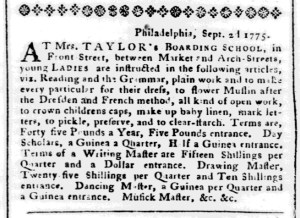
What was advertised in a revolutionary American newspaper 250 years ago today?

“Any person desirous of information concerning the character … of Mrs. Brodeau, may apply to … B. FRANKLIN.”
When she arrived in Philadelphia, “Mrs. BRODEAU, from England,” placed advertisements in the Pennsylvania Gazette and the Pennsylvania Journal as a means of “acquainting her friends and the public in general, that she has opened a boarding school in Walnut-street.” She sought pupils of a certain status, pledging that “young ladies will be genteelly boarded, and taught to read and speak the French and English language; the tambour embroidery, and every kind of useful and ornamental needle work.” In addition to the curriculum, Brodeau promoted her supervision of her charges, stating that she “hopes to prove by her assiduity and attention to the morals and behaviour of these ladies entrusted to her care, that she in some measure merits the recommendations she has been favoured with from her native country.” Like many other schoolmasters and schoolmistresses who advertised in Philadelphia’s newspapers during the era of the American Revolution, Brodeau emphasized moral development as well as curriculum.[1]
The parents and guardians of prospective students did not have to take Brodeau’s word for it. Instead, she inserted a testimonial from Robert Morris, the influential merchant, and Benjamin Franklin, the retired printer turned politician and diplomat. “Any person desirous of information concerning the character and recommendations of Mrs. Brodeau,” they stated, “may apply to either of us.” According to Claude-Anne Lopez, associated editor of the Papers of Benjamin Franklin, that was, “so far as we know, the only time that Franklin backed an enterprise of that kind with his name.”[2] Lopez further explains that Anna Brodeau “suddenly and rather mysteriously appeared in Philadelphia with a baby daughter in her arms,”[3] yet “[n]othing is known about a Mr. Brodeau.” If residents of Philadelphia had any concerns about Brodeau’s background, the endorsement from Franklin and Morris likely countered their concerns. Still, the advertisement apparently did not garner as much response as Brodeau hoped when she placed it in the December 6 edition of the Pennsylvania Gazette, the newspaper that Franklin formerly printed. Two weeks later she placed the same advertisement in the Pennsylvania Journal. Those efforts helped launch her boarding school. By the end of the Revolutionary War, Franklin’s daughter, Sarah Bache, wrote to her father that Brodeau “has made a handsome fortune.” Despite the disruptions of the war, she established her boarding school and her reputation. Lopez chronicles other accolades for Brodeau that appeared in print, including a poem by an anonymous contributor to the Columbian Magazine in 1786 and her obituary in the National Intelligencer in 1836. With words of support from Franklin and Morris, Brodeau soon “attracted students from the best families in Philadelphia.”[4] Her marketing incorporated the eighteenth-century version of a celebrity endorsement.
**********
[1] Carl Robert Keyes, “Selling Gentility and Pretending Morality: Education and Newspaper Advertisements in Philadelphia, 1765-1775,” Pennsylvania Magazine of History and Biography 141, no. 3 (October 2017): 245-274.
[2] Claude-Anne Lopez, “Benjamin Franklin and William Dodd: A New Look at an Old Vause Célèbre,” Proceedings of the American Philosophical Society 129, no. 3 (September 1985): 262.
[3] Lopez, “Benjamin Franklin and William Dodd,” 262, 263.
[4]Lopez, “Benjamin Franklin and William Dodd,” 263.