April 2

What was advertised in a colonial American newspaper 250 years ago today?

Providence Gazette (April 2, 1774).

“Genteel Boarding, FOR Gentlemen, Strangers and others.”

Thomas Russell provided “Genteel Boarding … at the House lately occupied by Mr. Benjamin Bagnall, deceased, near the State-House” in Boston.  He did not, however, place his advertisement in the Boston-Gazette or the Massachusetts Spyor any of the several other newspapers printed in that city.  Instead, he ran it in the Providence Gazette for six weeks in the spring of 1774.  For “Gentlemen, Strangers and others” who planned to visit Boston, Russell presented an option for accommodations and made planning their journey that much easier.

To convince prospective guests that his establishment was a good choice, he assured readers that the house was “a very noted Place for this Business” as well as “well known to be a large and commodious House.”  For anyone not familiar with its reputation, including those who lived any distance from Boston, they “have only to apply, to be convinced how agreeably they can be accommodated.”  Russell’s hospitality and the amenities he offered, he suggested, would become immediately apparent upon meeting.

Boston and other American towns had not yet adopted standardized street numbers, so Russell provided travelers with general directions to get them to the vicinity of the house and enough information to find it once they spoke with some locals.  Anyone who made their way to the “State-House” could then ask anyone they encountered about Russell’s boarding house, though they might more efficiently find it by invoking Benjamin Bagnall’s name since Russell apparently only recently acquired the property.  Describing the landmark according to local knowledge would get guests to Russell’s door.

In promoting his boarding house, Russell joined entrepreneurs who ran taverns and inns who advertised in newspapers published in other cities.  While they certainly welcomed local custom, they believed that marketing their establishments in publications in other towns would generate additional business.  Russell seemed certain enough of it that he invested in advertising in the Providence Gazette for six weeks rather than starting with the standard three-week run for his advertisement.  With the arrival of spring, he likely anticipated more travelers from Providence and its environs making their way to Boston.  Russell stood ready to provide them with lodgings.
August 1

What was advertised in a colonial American newspaper 250 years ago today?

Aug 1 - 8:1:1767 Providence Gazette
Providence Gazette (August 1, 1767).

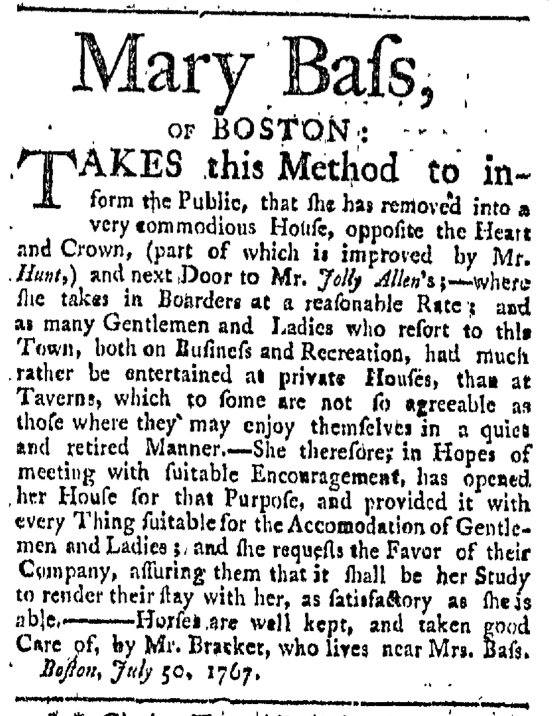
“She takes in Boarders at a reasonable Rate.”

Mary Bass of Boston placed an advertisement in the Providence Gazette to inform its readers that she had “removed into a very commodious House … where she takes in Boarders at a reasonable Rate.” In the 1760s, most advertisers who offered boarding usually offered their services to local residents or, at the very least, confined their notices to newspapers published in their town. Bass’s decision to advertise in the Providence Gazette rather than any of the four newspapers printed in Boston was out of the ordinary, but she had a particular kind of client in mind: “Gentlemen and Ladies who resort to this Town, both on Business and Recreation.”

Bass believed that she had identified a market for her services. Many travelers, she explained, “had much rather be entertained at private Houses, than at Taverns.” Part of this was due to the patrons and atmosphere often associated with taverns, which some travelers might not find “so agreeable.” Bass offered an alternative, a place where travelers could “enjoy themselves in a quiet and retired Manner.” She marketed the ambiance of her boarding house, which she also noted had been “improved” by a previous resident. To further encourage visitors to stay with her, Bass also let them know that they could stable their horses nearby.

In addition, Bass made sure that out-of-town visitors could find her residence easily. By way of directions, she indicated it was “opposite the Heart and Crown … and next Door to Mr. Jolly Allen’s.” Visitors unfamiliar with Boston would have had no difficulty finding Bass’s house once they asked any local resident to point them in the direction of the Heart and Crown, the printing shop where T. and J. Fleet printed the Boston Evening-Post. Alternately, locals also would have known where to find Jolley Allen, a prominent shopkeeper and prolific advertiser.

Men and women who made some or all of their living by taking in boarders frequently placed advertisements in the 1760s, but most of them did not identify a specialized market for their services. Mary Bass, on the other hand, intentionally promoted her boarding house to out-of-town visitors who would find her residence more comfortable than lodging at a loud and busy tavern. In an effort to attract travelers before they arrived in Boston, she placed advertisements in newspapers published in other places, anticipating the broad dissemination of advertising undertaken by the modern hospitality and tourism industries.