November 26

What was advertised in a revolutionary American newspaper 250 years ago this week?
Virginia Gazette [Dixon and Hunter] (November 25, 1775).

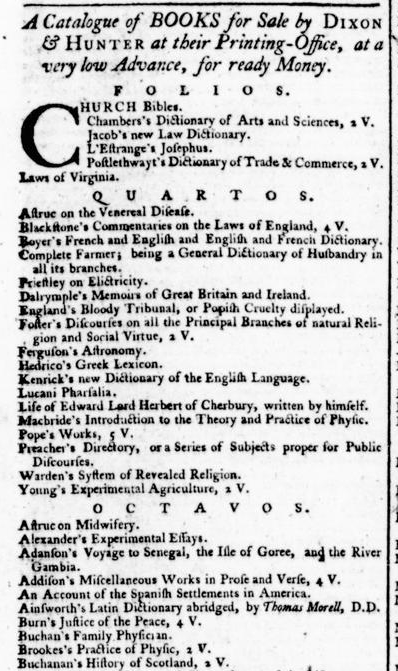
“FOLIOS … QUARTOS … OCTAVOS … DUODECIMOS.”

John Dixon and William Hunter, printers of the Virginia Gazette, published a “Catalogue of BOOKS for Saleat their Printing-Office” in the November 25, 1775, edition.  It covered most of the first page, except for the masthead and a short advertisement in which William Hewitt announced his intention to leave the colony and called on associates to settle accounts, and continued onto the second page, where it filled an entire column and overflowed into another.  Overall, Dixon and Hunter’s book catalog accounted for four of the twelve columns of news and advertising in that issue.  The printers could have printed a separate catalog (and very well may have done so), but disseminating the list of books they sold in the newspaper guaranteed that they reached consumers throughout the colony and beyond.

The printers deployed two principles in organizing the contents of their book catalog.  First, they separated the books by size – folios, quartos, octavos, and duodecimos – and then they roughly alphabetized them.  The catalog featured only half a dozen folios, including “CHURCH Bibles,” “Chambers’s Dictionary of Arts and Sciences” in two volumes, and the “Laws of Virginia,” along with nearly a score of quartos.  Dixon and Hunter stocked many more octavos and duodecimos with more than one hundred of each for prospective customers to choose.  In roughly alphabetizing the titles, they first indicated the author and then, if the book did not have an author associated with it, the title.  They clustered titles together by the first letter, but they did not observe strict alphabetical order within those clusters.  For example, the entries for “A” among the duodecimos appeared in this order:

     Addison’s Mescellaneous Works in prose and verse, 4 V.
Adventurer, 4 V.
American Gazetteer, 3 V.
Adventures of a Jesuit, with several remarkable Characters and Scenes in real Life, 2 V.
Agreeable Ugliness, or the Triumph of the Graces.
Apocrypha.
Alleine’s, Alarm to Unconverted Sinners.

A single entry for “Y” – “Yorrick’s Sermons, 7 V.” – appeared at the end of the catalog, immediately above “INTELLIGENCE from the Northern Papers.”

Even with all the “INTELLIGENCE” from London and Philadelphia and proclamation from the royal governor of Virginia, Dixon and Hunter made room in the Virginia Gazette for their book catalog.  They delivered news to their readers, but they also depended on book sales to supplement subscriptions, advertising, and job printing.  Compared to many book catalogs published earlier in the century, they presented a more organized list of titles.  Earlier book catalogs often separated titles by size.  By roughly alphabetizing the entries, Dixon and Hunter attempted to help prospective customers find the titles that interested them.
November 18

What was advertised in a revolutionary American newspaper 250 years ago today?

Pennsylvania Evening Post (November 18, 1775).

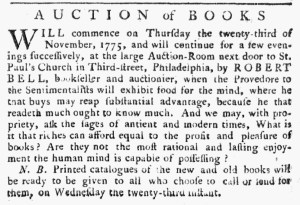
“The Provedore to the Sentimentalists will exhibit food for the mind.”

Readers of the November 18, 1775, edition of the Pennsylvania Evening Post encountered two advertisements promoting an “AUCTION of BOOKS,” one placed by Charles Mouse, “auctionier,” and the other by Robert Bell, “bookseller and auctionier.”  Mouse operated a “vendue store,” a combination of an auction house and a flea market, where he had a “large and choice collection of the most useful and entertaining [books].”  He invited those who had books to sell and “will[ing] to take their chance by auction” to deliver them to his vendue store on Second Street in Philadelphia.  The auctions would begin “precisely at six each evening” and “continue till the whole are sold.”  Mouse provided a straightforward account of this endeavor.

Robert Bell, on the other hand, crafted a more elaborate advertisement.  One of the most prominent American booksellers in the second half of the eighteenth century, Bell already established a reputation throughout the colonies by the time he advertised an auction “at the large Auction-Room next door to St. Paul’s Church in Third-street, Philadelphia,” scheduled for November 23.  He colorfully referred to himself in the third person as “the Provedore to the Sentimentalists” who would “exhibit food for the mind” to bidders and curious observers.  Those who made purchases, Bell declared, “may reap substantial advantage, because he that readeth much ought to know much.”  He further mused that “we may, with propriety, ask the sages of antient and modern times, What is it that riches can afford equal to the profit and pleasure of books?  Are they not the most rational and lasting enjoyment the human mind is capable of possessing?”  Mouse’s description of his “large and choice collection of the most useful and entertaining [books]” paled in comparison to the appeals that Bell made to readers.

Bell deployed another strategy to entice prospective bidders.  In a nota bene, he informed them that “[p]rinted catalogues of the new and old books will be ready to be given to all who choose to call or send for them.”  Those catalogues gave a preview of the sale and allowed Bell to disseminate information about the books up for bids more widely.  Those who visited his “Auction-Room” to collect a catalogue likely had an opportunity to browse the books, yet they could take their time going through the entries in the catalogue in the comfort of their own homes or offices or even at a coffeehouse with friends.  Those who sent for catalogues enjoyed the same benefit.  By distributing catalogs, Bell encouraged interest and prompted readers to imagine themselves bidding on the books they selected in advance.  He may have believed that prospective bidders were more likely to bid higher prices if they had spent time with the catalogue in advance and, as a result, became more committed to acquiring the books that interested them.

August 5

What was advertised in a colonial American newspaper 250 years ago today?

South-Carolina and American General Gazette (August 5, 1774).

“*Extract from Dr. RUSH’s Oration.”

Robert Wells had sufficient content to fill a four-page supplement (though printed on a smaller sheet) as well as the standard four-page issue when he took the August 5, 1774, edition of the South-Carolina and American General Gazetteto press.  With so much space to fill, he devoted the entire final page of the standard issue to a book catalog, listing dozens and dozens of titles in four columns.  His inventory represented an array of subjects, though he did not classify or categorize his offerings under headings like other booksellers sometimes did.  Instead, he left it to readers to discover the variety as they perused the catalog.  Among the many titles, he hawked “THE VISIONS of THOMAS SAY of the City of Philadelphia, which he saw in a Trance.”  Wells was either unaware that Say had disavowed that publication in an advertisement in the Pennsylvania Gazette several months earlier or he disregarded it in favor of generating revenue from selling the curious work.

The printer and bookseller also stocked “AN ORATION delivered … before the American Philosophical Society at Philadelphia, containing an Enquiry into the NATURAL HISTORY of MEDICINE among the INDIANS in NORTH-AMERICA … By BENJAMIN RUSH, M.D. Professor of Chemistry in the College of Philadelphia*.”  The asterisk directed readers to an “*Extract from Dr. RUSH’s Oration” that filled the bottom third of the column.  Despite the title, the excerpt (starting on page 67) warned against “luxury and effeminacy” among colonizers, stating that the damage was not so extensive that it could not be remedied.  He offered a series of recommendations, including improved education for children and temperance for adults, while some of them reflected the imperial crisis.  Politics and medicine intertwined when Rush commented on “the ravages which Tea is making upon the health and populousness of our country.  Had I a double portion of all that eloquence which has been employed in describing the political evils which lately accompanied this East-India herb, it would be too little to set forth the numerous and complicated diseases which it has introduced among us.”  The doctor described tea as a hydra, asserting that colonizers needed the strength of Hercules “to vanquish monsters.”  Parliament, the East India Company, and colonizers’ own desire for tea were presumably among the many heads of that monstrous hydra.  The excerpt concluded with an argument that “America is a theatre where human nature will probably receive her last and principal literary, civil and military honours.”

Wells almost certainly selected passages intended to pique the curiosity of readers and leave them wanting more.  They could examine Rush’s entire argument and learn what his comments about education, temperance, and tea had to do with “MEDICINE among the INDIANS” by purchasing the book.  Just as modern publishers provide excerpts to entice prospective customers, Wells published an “Extract” to help boost sales.

South-Carolina and American General Gazette (August 5, 1774).