August 23

What was advertised in a colonial American newspaper 250 years ago this week?

Aug 23 - 8:17:1767 New York Gazette
New-York Gazette (August 17, 1767).

“They will be presented to the Publick in a Catalogue.”

Garret Noel continued to stock “A Very extensive Assortment of Books” nearly a month after his advertisement concerning a shipment that just arrived on the Amelia first appeared in the July 20, 1767, edition of the New-York Gazette. That the second line of his notice, proclaiming that he “Has this Day receiv’d” new inventory, was slightly outdated mattered little compared to two other aspects of the advertisement.

Noel, a prolific advertiser, informed potential customers that his “extensive Assortment of Books” covered a wide variety of topics, including “History, Divinity, Law, Physic, [and] Poetry.” In fact, he now carried so many new books that they were “too numerous” to list all the titles in newspaper advertisements. Instead, he resorted to another medium, a book catalog printed separately and often distributed free of charge as a means of inciting demand. Noel indicated that his catalog was “publishing with all the speed possible.” No extant copy exists, but that does not mean that Noel’s catalog never made it to press. According to the American Antiquarian Society’s online catalog, Noel previously published four other catalogs in 1754/55, 1755, 1759, and 1762. The partnership of Noel and Hazard later published a catalog in 1771. Perhaps Noel never printed the catalog promised in this advertisement but instead suggested that it existed as a means of luring potential customers to his shop, but the evidence suggests a fairly good chance that he did indeed publish this marketing tool to supplement his frequent newspaper advertisements. While fairly complete collections of many eighteenth-century newspapers have survived into the twenty-first century, other printed materials have not. Newspaper advertisements suggest that many more book catalogs likely circulated in the eighteenth century than can be found in archives today.

While awaiting publication of the catalog, Noel also informed existing customers who had placed orders that they could send for them. This announcement did matter more at the time the bookseller originally inserted the advertisement in the New-York Gazette. With a new shipment that had just arrived he likely had not yet had time to send notices to every customer awaiting an order. An announcement in the newspaper presented an opportunity for eager customers to obtain their purchases as quickly as possible (and potentially saved the bookseller time and energy in contacting customers individually). That this portion of Noel’s notice continued to run for so many weeks also served to inform potential customers that they could also submit special orders.

Garret Noel offered two forms of customer service intended to cater to consumers and convince them to purchase his merchandise. He distributed a catalog detailing his “Very extensive Assortment of Books,” introducing potential customers to titles they may not have previously considered. He also accepted orders and informed clients as soon as they arrived, exhibiting how eagerly he sought to serve his patrons.

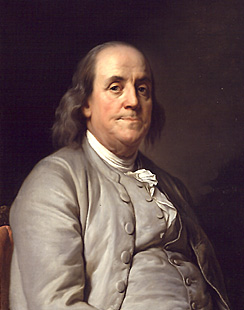
Happy Birthday, Benjamin Franklin!

Today is an important day for specialists in early American print culture, for Benjamin Franklin was born on January 17, 1706, in Boston.  Among his many other accomplishments, Franklin is known as the “Father of American Advertising.”  Although I have argued elsewhere that this title should more accurately be bestowed upon Mathew Carey (in my view more prolific and innovative in the realm of advertising as a printer, publisher, and advocate of marketing), I recognize that Franklin deserves credit as well.  Franklin is often known as “The First American,” so it not surprising that others should rank him first among the founders of advertising in America.

Benjamin Franklin
Benjamin Franklin (Joseph Siffred Duplessis, ca. 1785).  National Portrait Gallery.

Franklin purchased the Pennsylvania Gazette in 1729.  In the wake of becoming printer, he experimented with the visual layout of advertisements that appeared in the weekly newspaper, incorporating significantly more white space and varying font sizes in order to better attract readers’ and potential customers’ attention.  Advertising flourished in the Pennsylvania Gazette, which expanded from two to four pages in part to accommodate the greater number of commercial notices.

Jan 17 - Pennsylvania Gazette 1:9-16:1736
Advertisements with white space, varying sizes of font, capitals and italics, and a woodcut from Benjamin Franklin’s Pennsylvania Gazette (December 9-16, 1736).

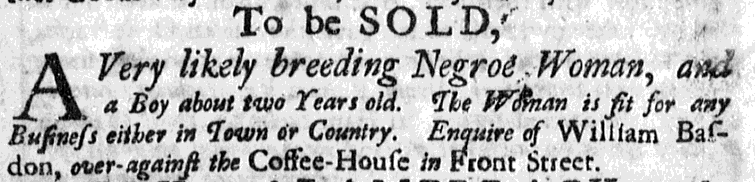
Many historians of the press and print culture in early America have noted that Franklin became wealthy and retired as a printer in favor of a multitude of other pursuits in part because of the revenue he collected from advertising.  Others, especially David Waldstreicher, have underscored that this wealth was amassed through participation in the colonial slave trade.  The advertisements for goods and services featured in the Pennsylvania Gazette included announcements about buying and selling slaves as well as notices offering rewards for runaways.

Jan 17 - Pennsylvania Gazette slave 1:9-16:1736.gif
An advertisement for slaves from Benjamin Franklin’s Pennsylvania Gazette (December 9-16, 1736)

In 1741 Franklin published one of colonial America’s first magazines, The General Magazine and Historical Chronicle, for all the British Plantations in America (which barely missed out on being the first American magazine, a distinction earned by Franklin’s competitor, Andrew Bradford, with The American Magazine or Monthly View of the Political State of the British Colonies).  The magazine lasted only a handful of issues, but that was sufficient for Franklin to become the first American printer to include an advertisement in a magazine (though advertising did not become a standard part of magazine publication until special advertising wrappers were developed later in the century — and Mathew Carey was unarguably the master of that medium).

General Magazine.jpg
General Magazine and Historical Chronicle, For all the British Plantations in America (January 1741).  Library of Congress.

In 1744 Franklin published an octavo-sized Catalogue of Choice and Valuable Books, including 445 entries.  This is the first known American book catalogue aimed at consumers (though the Library Company of Philadelphia previously published catalogs listing their holdings in 1733, 1735, and 1741).  Later that same year, Franklin printed a Catalogue of Books to Be Sold at Auction.

Franklin pursued advertising through many media in eighteenth-century America, earning recognition as one of the founders of American advertising.  Happy 311th birthday, Benjamin Franklin!

May 20

What was advertised in a colonial newspaper 250 years ago this week?

May 20 - 5:19:1766 Boston Evening-Post
Boston Evening-Post (May 19, 1766).

“CATALOGUES to be had gratis at the London Book-Store.”

Bookseller John Mein published an advertisement that offered to deliver and distribute another advertising medium to potential customers: his book catalogue. Residents of Boston could pick up a free catalogue “at the London Book-Store, a few Days before the Sale.” While they were there, they could also examine the books, stoking their anticipation of the auction scheduled to take place at the end of the month. Mein also offered to send catalogues to potential customers who lived in the city’s hinterland. (Mein addressed them as “GENTLEMEN in the COUNTRY,” though women read books too.)

May 20 - Catalog Cover
John Mein, A Catalogue of Curious and Valuable Books, To Be Sold at the London Book-Store (Boston:  William McAlpine(?), 1766).  American Antiquarian Society.

Some early American bookseller’s catalogues have been lost over the years, but Robert B. Winans has compiled A Descriptive Checklist of Books Catalogues, Separately Printed in America, 1693-1800 that includes 278 catalogues still extant.[1] In addition, Winans identified eight others not extant but for which good evidence can be found that they were printed, 138 other unlocated catalogues, and 265 references to additional unlocated catalogues from another bibliographer’s American Book Auction Catalogues. Though less than half have survived, book catalogues were a common marketing medium in eighteenth-century America.

May 20 - Catalog Interior
John Mein, A Catalogue of Curious and Valuable Books, To Be Sold at the London Book-Store (Boston:  William McAlpine(?), 1766).  American Antiquarian Society.
May 20 - Catalog Final Page
John Mein, A Catalogue of Curious and Valuable Books, To Be Sold at the London Book-Store (Boston:  William McAlpine(?), 1766).  American Antiquarian Society.

Here’s the main body of Winan’s entry for the catalogue mentioned in today’s advertisement:

Bookseller’s catalogue: total of 1741 consecutively numbered short author entries, 367 in the first catalogue , arranged by format, and 1375 (numbers 368-1741) in the second, arrangement not consistent, partly by format and partly by subject. Subject headings: [miscellaneous]; classics; law; physic and surgery; books of entertainment (the largest group); divinity; tragedies; comedies and operas; pretty little books for children; magazines; political pamphlets, poems, &c.; maps; Bibles, prayerbooks, &c. Date: Mein advertised the catalogue in the Boston Evening-Post, May 19, 1766.

**********

[1] Robert B. Winans, A Descriptive Checklist of Book Catalogues Separately Printed in America, 1693-1800 (Worcester: American Antiquarian Society, 1981).

In Which Book Catalogues Encouraged a Revolution in Reading

Last week I examined a bookseller’s newspaper advertisement that could have doubled as a broadside book catalogue. This week I would like to continue an exploration of eighteenth-century book catalogues, focusing primarily on the evolution of this method of advertising among Philadelphia’s booksellers. The earliest catalogues were broadsides that could be posted in a public place or folded and sent through the post. Later catalogues became pamphlets and were often bound at the front or back of a book, inserted in magazines, or available free of charge as stand-alone items at booksellers’ shops. Printers and booksellers sometimes concluded their newspaper advertisements by noting that customers could get a more complete sense of their stock if they visited their shop to peruse the catalogue.

The first book catalogues were typically undifferentiated lists of goods, but booksellers steadily made innovations in format to make their catalogues a distinctive medium. In 1754, David Hall issued Philadelphia’s first broadside catalogue.[1] It included 425 short author entries in two columns, the items grouped by size with octavos and duodecimos far outnumbering folios and quartos. This method privileged some of the most expensive books by listing them first, and it also allowed potential customers to visualize the physical appearance of a book. Those who valued books as a symbol of consumption could choose a folio edition of Swan’s British Architecture and Designs that would definitely draw attention when placed on a desk or table. Another customer might prefer to continue purchasing octavo-sized volumes that would have an orderly appearance on the bookshelf. Within each size category, the books were listed in continuous paragraphs. In contrast, William Bradford distributed a broadside catalogue five years later that featured only one title per line in each of its three columns. Bradford’s style of organizing his advertisement may have made for easier skimming or reading but at the expense of limiting the number of titles he could list – only half as many as featured on Hall’s catalogue.[2] Running competing bookshops in a city of less than 30,000 inhabitants, Hall and Bradford most likely examined each other’s catalogues. The two booksellers apparently believed that potential customers preferred the format of their catalogue to that of their competition as both booksellers continued publishing their catalogues in their original format for quite some time. Fifteen years after his first catalogue appeared, Hall issued a broadsheet catalogue that closely resembled his initial catalogue: two columns with the books categorized by size and set in continuous paragraphs. That same year, William and Thomas Bradford distributed a broadsheet catalogue that listed one title per line, this time divided into four columns rather than three.[3] These early catalogues sought to attract customers solely by providing a list of books in stock, a strategy repeatedly employed in the years before the Revolution. Until the 1770s, most booksellers’ catalogues followed Hall’s or Bradford’s method for listing their stock. New innovations began to appear in the last decades of the century as booksellers increasingly targeted specialized reading audiences.

As inventories increased and booksellers experimented with different styles and formats, their catalogues became more elaborate. Generally, the earliest booksellers’ catalogues were broadsides or broadsheets listing a couple of hundred authors or titles. Although some booksellers continued to issues broadsides even into the 1790s, most switched to octavo- and duodecimo-sized volumes featuring one thousand or more books listed on dozens of pages. One extraordinary volume, a 215-page duodecimo catalogue that contained nearly 2,700 titles described by Clarence Brigham as “the most extensive and elaborate catalogue published in the eighteenth century,” was issued by H. Caritat of New York in 1799.[4] Such catalogues sometimes gave the impression that a bookseller’s stock had great depth, but often he only carried one or two copies of most of the volumes listed.

In the final three decades of the eighteenth century, book catalogues became more innovative, partially as the result of attempts to appeal to readers with special interests. Broadsides and broadsheets became slender volumes consisting of dozens of pages, and printers, booksellers, and publishers began to market particular products to specific readers. Rather than grouping books according to size, booksellers began to categorize them by topic so potential customers could more easily find books that might be of interest. Alternately, some began to alphabetize the titles to assist readers looking for a particular book. Some catalogues even alphabetized titles within topics or provided excerpts or puffs that were intended to hook the reader and create desire for a book that he or she might not have previously considered purchasing. Mathew Carey emphasized that these innovations probably led to better sales. In a letter to his colleague Timothy Brundige, he offered the following advice: “If you were to take the trouble to draw out your lists in alphab. Order classing each Kind of Books together, such as law, medical, historical, religion &c it would be very complete & be much more serviceable than in the present confused mode.”[5]

Carey spoke from experience. He had inserted his “Catalogue of Books” in his own magazine, the American Museum, during its final years of publication, if not sooner. Carey’s catalogues offered a more systematic and sophisticated method of advertising than many earlier booksellers’ catalogues and newspaper notices, and his method of distribution allowed him to court customers who had already expressed an interest in the historical, political, and belle lettres essays that appeared in his magazine. Starting at twelve pages and eventually expanding to twenty-four, Carey’s catalogues further subdivided his merchandise into categories such as Law; Medical, Surgical, and Chemical Books; Religious Books; History, Voyages, and Travels; Poetry and Drama; and Books of Navigation.[6] His approach increased the chances that readers who discovered various advertisements stuffed in the magazine might take notice of the catalogue and helped potential customers to quickly find items matching their own interests. Carey de-emphasized his stationery wares and other items more than most other booksellers. His first catalogues inserted in the American Museum included short lists of printed blanks and stationery items, but mentioned no other goods. Carey eventually discontinued listing anything except books as his business endeavors became increasingly specialized.

By the end of the century, booksellers became increasingly specialized in their use of several advertising media, developing advertisements meant to target potential customers with particular interests, whether they were professionals, like doctors and lawyers, members of polite society interested in belles lettres, or merchants and sea captains. For instance, in the 1790s George Davis posted at least three broadside catalogues that featured law books exclusively.[7] Although others might find some volumes of interest, Davis directly addressed “Gentlemen of the Bar and their Students.” Curiously, broadside catalogues did not achieve the level of sophistication evident in contemporary octavo-sized multi-page catalogues by the end of the century. Rather than list his books by topic, Davis continued to divide them according to size. Other booksellers, such as Rice and Company, loosely grouped books together by topic but did not include any headings to aid potential customers in finding books or pamphlets they might find most interesting.[8]

The evolution of book catalogues in early America offers a glimpse of the intersection of the reading revolution and consumer revolution that simultaneously occurred in the eighteenth century. Advertisers sought to hasten the transformation of reading habits from intensive consideration of bibles and devotional works to extensive reading of a different kinds of books, including reading novels for pleasure. Book catalogues from the period demonstrate how booksellers, printers, and publishers classified their stock as well as suggest how their potential customers – readers – imagined and assessed their wares in new ways.

**********

[1] David Hall, Imported in the Last Ships from London, and To Be Sold by David Hall, at the New-Printing Office, In Market-Street, Philadelphia, the Following Books (Philadelphia: B. Franklin and D. Hall, 1754).

[2] William Bradford, A Catalogue of Books. Just Imported from London, and To Be Sold by W. Bradford, at the London-Coffee-House, Philadelphia, Wholseale and Retail. With Good Allowance for Those That Take a Quantity (Philadelphia: William Bradford, 1759).

[3] William and Thomas Bradford, Imported in the Last Vessels from London, and To Be Sold by William and Thomas Bradford, Printers, Booksellers, and Stationers, At Their Book-Store in Market-Street, Adjoining the London Coffee-House; Or By Thomas Bradford, At His House in Second-Street, One Door from Arch-Street, and Nearly Opposite the Sign of St. George, A Large and Neat Assortment of Books and Stationary (Philadelphia: [William and Thomas Bradford,] 1769); and David Hall, David Hall, At the New Printing-Office, in Market-Street, Philadelphia, Has to Dispose Of, Wholesale and Retail, the Following Books, &c. (Philadelphia: D. Hall and W. Sellers, 1769).

[4] Clarence S. Brigham, “American Booksellers’ Catalogues, 1734-1800,” in Essays Honoring Lawrence C. Wroth, ed. Frederick R. Goff (Portland, ME: Anthoensen Press, 1951), 62.

[5] Mathew Carey to T. Brundige, 20 March 1795, Mathew Carey Letterbook, Lea & Febiger Collection, Historical Society of Pennsylvania.

[6] Mathew Carey, Mathew Carey’s Catalogue of Books, for August, 1792 (Philadelphia: [Mathew Carey,] 1792), inserted in American Museum, July 1792, Library Company of Philadelphia; ibid., Mathew Carey’s Catalogue of Books, for September, 1792 (Philadelphia: [Mathew Carey,] 1792), inserted in American Museum, August 1792, Library Company of Philadelphia; ibid., Mathew Carey, No. 118 Market-Street, Philadelphia, Has Imported from London, Dublin, and Glasgow, an Extensive Assortment of Books [October 1792] (Philadelphia: [Mathew Carey,] 1792), inserted in American Museum, September 1792, Library Company of Philadelphia; ibid., Mathew Carey, No. 118 Market-Street, Philadelphia, Has Imported from London, Dublin, and Glasgow, an Extensive Assortment of Books [November 1792] (Philadelphia: [Mathew Carey,] 1792), inserted in American Museum, October 1792, Library Company of Philadelphia; and ibid., Mathew Carey, No. 118 Market-Street, Philadelphia, Has Imported from London, Dublin, and Glasgow, an Extensive Assortment of Books [January 1793] (Philadelphia: [Mathew Carey,] 1792), inserted in American Museum, December 1792, Michael Zinman Collection, Library Company of Philadelphia.

[7] George Davis, Law Books (Philadelphia: 1792); ibid., Law Books — Latest Editions (Philadelphia: 1794); and ibid., Law Books — Latest Irish Editions (Philadelphia: 1795). Also see his four-page catalogue devoted solely to law books: Davis’s Law Catalogue, for 1799. Latest London and Irish Editions (Philadelphia: Zachariah Poulson, Jr., 1799).

[8] Rice and Company, Rice and Co. Booksellers and Stationers, South Side of Market-Street, Next Door But One to Second-Street, Philadelphia; Have Imported in the Last Vessels from London, Dublin, and Glasgow, a Large and General Assortment of Books, and Stationary Ware, Which They Will Dispose Of By Wholesale and Retail on Very Moderate Terms (Philadelphia: 1789).

Happy Birthday, Benjamin Franklin!

Today is an important day for specialists in early American print culture, for Benjamin Franklin was born on January 17, 1706, in Boston.  Among his many other accomplishments, Franklin is known as the “Father of American Advertising.”  Although I have argued elsewhere that this title should more accurately be bestowed upon Mathew Carey (in my view more prolific and innovative in the realm of advertising as a printer, publisher, and advocate of marketing), I recognize that Franklin deserves credit as well.  Franklin is often known as “The First American,” so it not surprising that others should rank him first among the founders of advertising in America.

Benjamin Franklin
Benjamin Franklin (Joseph Siffred Duplessis, ca. 1785).  National Portrait Gallery.

Franklin purchased the Pennsylvania Gazette in 1729.  In the wake of becoming printer, he experimented with the visual layout of advertisements that appeared in the weekly newspaper, incorporating significantly more white space and varying font sizes in order to better attract readers’ and potential customers’ attention.  Advertising flourished in the Pennsylvania Gazette, which expanded from two to four pages in part to accommodate the greater number of commercial notices.

Jan 17 - Pennsylvania Gazette 1:9-16:1736
Advertisements with white space, varying sizes of font, capitals and italics, and a woodcut from Benjamin Franklin’s Pennsylvania Gazette (December 9-16, 1736).

Many historians of the press and print culture in early America have noted that Franklin became wealthy and retired as a printer in favor of a multitude of other pursuits in part because of the revenue he collected from advertising.  Others, especially David Waldstreicher, have underscored that this wealth was amassed through participation in the colonial slave trade.  The advertisements for goods and services featured in the Pennsylvania Gazette included announcements about buying and selling slaves as well as notices offering rewards for runaways.

Jan 17 - Pennsylvania Gazette slave 1:9-16:1736.gif
An advertisement for slaves from Benjamin Franklin’s Pennsylvania Gazette (December 9-16, 1736)

In 1741 Franklin published one of colonial America’s first magazines, The General Magazine and Historical Chronicle, for all the British Plantations in America (which barely missed out on being the first American magazine, a distinction earned by Franklin’s competitor, Andrew Bradford, with The American Magazine or Monthly View of the Political State of the British Colonies).  The magazine lasted only a handful of issues, but that was sufficient for Franklin to become the first American printer to include an advertisement in a magazine (though advertising did not become a standard part of magazine publication until special advertising wrappers were developed later in the century — and Mathew Carey was unarguably the master of that medium).

General Magazine.jpg
General Magazine and Historical Chronicle, For all the British Plantations in America (January 1741).  Library of Congress.

In 1744 Franklin published an octavo-sized Catalogue of Choice and Valuable Books, including 445 entries.  This is the first known American book catalogue aimed at consumers (though the Library Company of Philadelphia previously published catalogs listing their holdings in 1733, 1735, and 1741).  Later that same year, Franklin printed a Catalogue of Books to Be Sold at Auction.

Franklin pursued advertising through many media in eighteenth-century America, earning recognition as one of the founders of American advertising.  Happy 310th birthday, Benjamin Franklin!