October 25

What was advertised in a revolutionary American newspaper 250 years ago today?
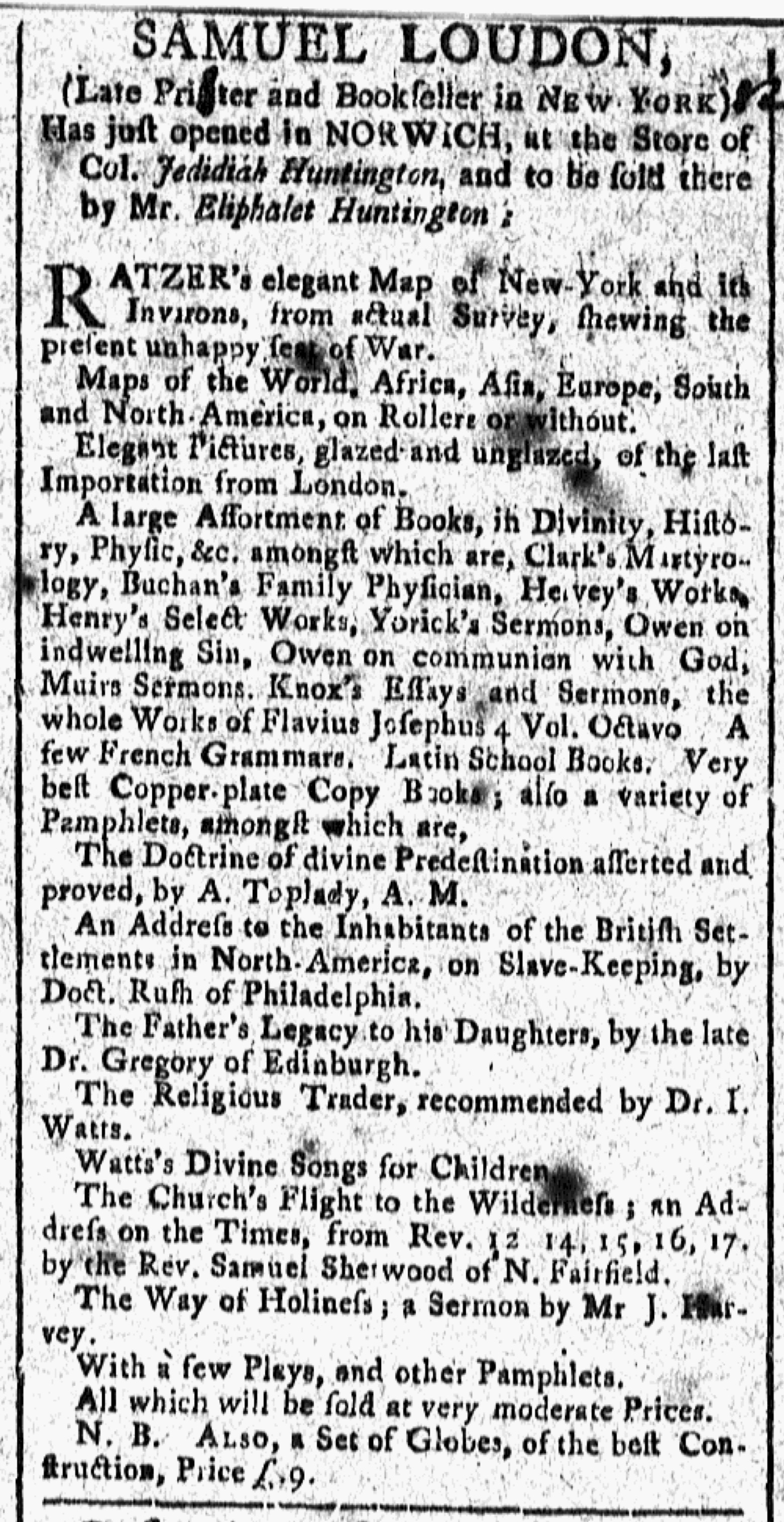
Connecticut Gazette (October 25, 1776).

“SAMUEL LOUDON, (Late Printer and Bookseller in NEW YORK).”

When the British invaded New York late in the summer of 1776, Samuel Loudon, a printer and bookseller who was, according to Isaiah Thomas, “decidedly a whig,” decided that it was time to suspend the newspaper he established in January, the New York Packet, and get out of the city.[1]  In an advertisement in the September 2 edition of the New-York Gazette and Weekly Mercury, he announced that he was “removing his Printing-Office to FISH-KILLS, where the Provincial Congress now resides” because the “City of New-York, is now invaded by a powerful Fleet and Army.”  He advised other “Inhabitants” of the city “to seek a Retreat ion the Country.”  He resumed publication of the New York Packet in Fishkill on January 16, 1777, and continued printing it there throughout the war.  After the war ended, Loudon returned to New York and once again published his newspaper there.

Before he managed to resume printing the New York Packet in Fishkill, Loudon got involved in another venture.  The October 25, 1776, edition of the Connecticut Gazette, published in New London, carried an advertisement that announced that “SAMUEL LOUDON, (Late Printer and Bookseller in NEW YORK) Has just opened in NORWICH” a store that stocked a “large Assortment of Books, In Divinity, History, Physic,” and other subjects as well as “a variety of Pamphlets.”  At first glance, it appeared that Loudon operated the store himself.  After all, his name appeared in capital letters as the deadline for the advertisement.  On closer inspection, however, readers learned that “Mr. Eliphalet Huntington” sold the books, pamphlets, maps, prints, and “a Set of Globes, of the best Construction” listed in the advertisement.  Loudon and Huntington apparently entered some sort of partnership, perhaps on an equal basis or perhaps Loudon employed Huntington.  Whatever the arrangement, they attempted to leverage the visibility that Loudon had achieved as a bookseller and, especially, the printer of the New York Packet, to entice prospective customers to visit the bookstore in Norwich or to send orders for any of the items listed in the advertisement.  Curiously, the advertisement that ran in the Norwich Packet on October 21 did not mention Eliphalet Huntington at all.  It deployed Loudon’s name as the headline, like the advertisement in the Connecticut Gazette, and stated that he “Has just opened at Col. JEDEDIAH HUNTINGTON’S Store … A Neat Assortment of BOOKS, to be Sold cheap.”  Perhaps Huntington was merely an employee rather than even a junior partner.  If that was the case, then, like so many artisans who received sole credit for the work of journeymen, apprentices, enslaved workers, and others who labored in their workshops, the proprietor of the new bookstore in Norwich was the public face of the business even though customers primarily or exclusively interacted with an employee.

**********

[1] Isaiah Thomas, The History of Printing in America with a Biography of Printers and an Account of Newspapers (1810; New York: Weathervane Books, 1970), 482.

October 22

What was advertised in a revolutionary American newspaper 250 years ago today?

Pennsylvania Evening Post (October 22, 1776).

“THE curious in ancient literary works on the ART of HEALING … may not purchase [a] variety of Latin authors.”

Robert Bell, one of the most prominent American printers and booksellers during the era of the American Revolution, achieved his reputation, in part, through advertising extensively.  Advertisements for books and pamphlets that he printed or sold regularly appeared in newspapers published in Philadelphia, where he ran a “book-store, next door to St. Paul’s church, in Third-street,” in 1776.  Before the war, he frequently inserted subscription proposals for books he intended to publish if enough customers subscribed (or reserved copies in advance) in newspapers from New England to South Carolina.  That made him a familiar figure to readers throughout the colonies.  In 1776, however, he confined his advertising mostly to Philadelphia.

In an advertisement that ran in the October 22, 1776, edition of the Pennsylvania Evening Post, Bell targeted prospective customers interested in medical texts.  He had a special flair for describing both himself and his customers.  For instance, he had previously named himself “the Provedore to the Sentimentalists.”  In this advertisement, Bell addressed the “curious in ancient literary works on the ART of HEALING,” informing them that they “may now purchase [a] variety of Latin authors.”  In case that subject matter was too obscure, he also promoted alternatives that some readers might have considered more practical.  Bell stocked “a few modern English writers on medicinal and surgical subjects.”

Bell could have left it at that, but he chose to add a nota bene to remind prospective customers that he also sold books from other genres.  “All the military authors lately published may be had at said BELL’s,” he proclaimed, in case readers had not noticed the many advertisements for military manuals that he frequently placed in the Pennsylvania Evening Post and other newspapers.  A reminder certainly did not hurt, he likely reasoned, since so many printers and booksellers also advertised an array of military manuals published in Philadelphia in 1775 and 1776.  For readers not interested in medical texts and military manuals, Bell also offered “numbers of miscellaneous, instructive, and entertaining works, in various branches of literature” that they could browse when they visited his shop.  He intentionally targeted certain readers, while also extending an invitation to all readers to see which books and pamphlets they could purchase at “BELL’s book-store.”

November 23

What was advertised in a colonial American newspaper 250 years ago today?

Boston-Gazette (November 23, 1772).

“A General Supply of the most modern BOOKS.”

Like many modern booksellers, James Foster Condy sold books and more at his store on Union Street in Boston in the early 1770s.  In a lengthy advertisement that ran in the November 23, 1772, edition of the Boston-Gazette, he highlighted several aspects of his business, promoting his merchandise, his prices, and his customer service.

Condy began with an announcement about a new publication, “A POEM, Entitled, the GRAVE. By Robert Blair.”  That volume also included “An ELEGY written in a Country Church-Yard. By Mr. Gray.”  In addition to listing the price, just one shilling, Condy appealed to colonizers who considered themselves refined consumers of literature, assuring them that the “Pamphlet will fully recommend itself, to the best Judges and Lovers of Poetry.”  The bookseller had a particular interest in this pamphlet, having made arrangements with a local printer to produce a new edition.

The portion of Condy’s advertisement that hawked the poems could have stood on its own as a separate notice, but the bookseller determined that it served as a good introduction to an overview of his wares.  In addition to the poetry, printed in Boston, he also stocked a “General Supply of the most modern BOOKS” imported from London.  Rather than list any titles, Condy highlighted various genres, including “Law, Physick, History, Divinity, and every Branch of polite Literature” as well as bibles and other devotional materials.  He even had “Books for the Amusement and Instruction of Children.”

The bookseller also carried an assortment of stationery and writing supplies.  That portion of his advertisement occupied almost as much space as the portion about the poetry and more than the portion about other books.  Condy listed everything from “Writing Paper of every Sort” and “Account Books of every Size and Quality” to “various Sorts of Penknives” and “Quills,” to “Glass Ink Potts” and “red and black Sealing Wax.”  In yet another section of the advertisement, he called attention to other kinds of merchandise, some of it related to the books and stationery he sold.  Condy stocked “reading Glasses” and “Glasses for near-sighted Persons” as well as “Diagonal Machines for viewing of Prints” and “a Convex Glass for drawing Landscapes.”

The bookseller concluded with a pitch that extended beyond his merchandise.  He proclaimed that he offered the lowest prices that consumers would encounter not only in the city but anywhere in the colonies, asserting that “All those Persons who please to purchase at said Store, may depend on buying as cheap as at any Store in BOSTON or AMERICA.”  He was so confident in that claim that he declared its veracity “without Exception.”  In addition, his customers would be “used” or treated “in such a Manner as will leave no Room for Complaint, but give entire Satisfaction.”  In other words, Condy considered customer service an important aspect of his business.

With all of the books, stationery, writing supplies, glasses, and other merchandise, the inventory at Condy’s bookstore looked much the same to consumers in eighteenth-century America as modern bookstores appear to customers who browse an array of goods.  Condy did not rely on a single revenue stream.  Instead, he marketed and sold a variety of wares, using price and customer service to further entice prospective clients.