December 21

What was advertised in a colonial American newspaper 250 years ago today?
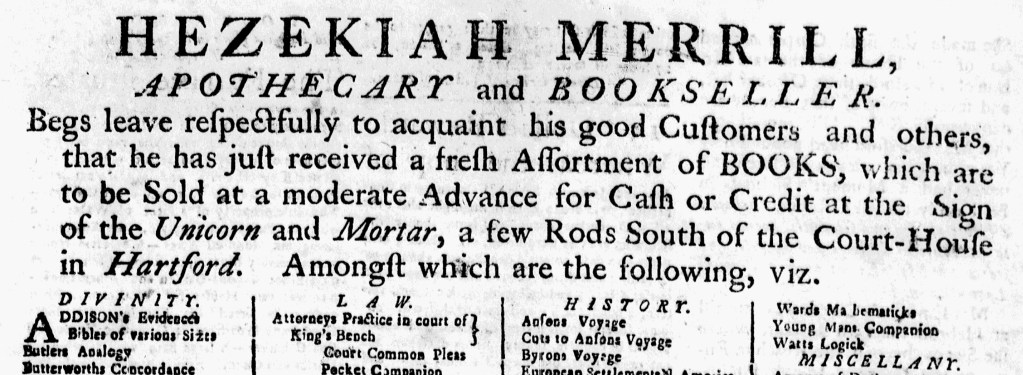
Connecticut Courant (December 21, 1773).

“He has just received a fresh Assortment of BOOKS.”

Hezekiah Merrill, “APOTHECARY and BOOKSELLER … at the Sign of the Unicorn and Mortar” in Hartford, ran a full-page advertisement in the December 21, 1773, edition of the Connecticut Courant.  His name and occupation served as headlines running across the top of the page, followed by an introduction that gave his location and announced that he “just received a fresh Assortment of BOOKS,” which also ran across the entire page.  To aid prospective customers in navigating the advertisement, Merrill divided the books by genre with headings that included “DIVINITY,” “LAW,” “PHYSIC & SURGERY,” “HISTORY,” “SCHOOL BOOKS,” and “MISCELLANY.”  In smaller type, four columns listed individual titles for sale, compared to three columns for news, editorials, advertising, and other contents on the other three pages of the newspaper.  A nota bene in the same size font as the list of titles, ran across the entire page at the bottom.  In it, Merrill promoted stationery, writing supplies, and a variety of items often sold by apothecaries.  In many ways, Merrill’s advertisement dominated that issue of the Connecticut Courant.  It accounted for one-quarter of the total space as well as more space than the other advertisements combined.  When readers perused the issue, Merrill’s advertisement became visible to others gathered nearby.

It was not the first time that the bookseller and apothecary published an oversized advertisement in his local newspaper.  On May 11, 1773, he ran an advertisement that filled two of the three columns on the second page.  He may have made arrangements with Ebenezer Watson, the printer, to produce the advertisement separately as handbills or broadside book catalogs, though no such items have been identified in research libraries, historical societies, or private collections.  Compared to newspapers, often preserved by printers or subscribers in complete or nearly complete runs, handbills and broadside book catalogs were much more ephemeral advertising media.  Still, in the case of Smith and Coit’s broadside book catalog that also ran as a full-page advertisement in the Connecticut Courant in July 1773, Watson had experience producing advertisements in more than one format for his clients.  For Smith and Coit, Watson reset the type, using five columns in the broadside but only four in the newspaper.  He could have done the same for Merrill or, even more easily, printed the newspaper advertisement as a separate handbill or broadside book catalog without making any adjustments to type already set.  Either way, Merrill, Smith and Coit, other booksellers, and other retailers likely distributed more advertisements in the eighteenth century than happen to survive today.

Connecticut Courant (December 21, 1773).

July 13

What was advertised in a colonial American newspaper 250 years ago today?

Connecticut Courant (July 13, 1773).

“A Universal Assortment of DRUGS and MEDICINES … together with the following BOOKS.”

At the same time that booksellers Smith and Coit advertised in the Connecticut Courant in the summer of 1773 they also distributed a broadside book catalog that listed hundreds of titles available at their shop in Hartford.  While booksellers sometimes placed full-page newspaper advertisements that doubled as broadsides, that was not quite the case here.  A single page of the Connecticut Courant did not have sufficient space to accommodate all five columns of titles that appeared on the broadside.  As a result, four of those columns ran on the second page of the July 13 edition, amounting to a full-page advertisement, of sorts, and the final column ran on the third page.

That required some revisions on the part of the compositor.  Both the newspaper advertisement and the broadside book catalog featured the date “5th July, 1773.”  The printing office likely produced the broadside first, at about the same time the July 6 edition of the newspaper went to press, and then the compositor adapted type already set to fit in the next issue of the Connecticut Courant.  The same introductory material ran across the top of both the broadside and the newspaper advertisement, but the compositor did have to rest that portion to run across only four columns instead of five.  The entries in the columns themselves, however, remained the same, with the exception of “Robinson Crusoe” moving from the bottom of the fourth column to the top of the fifth column on the facing page.

The compositor also removed a list of additional merchandise, including stationery, writing supplies, and groceries, that ran across all five columns at the bottom of the broadside.  Those items did not disappear from the newspaper advertisement.  Instead, the compositor reset the type so it fit at the bottom of the additional column that appeared on the third page.  When readers held open the issue to peruse the interior pages, they saw the entire advertisement in a slightly different format than what appeared on the broadside.  The contents of Smith and Coit’s entire broadside book catalog made it into the newspaper, appearing for only a single week.  Still, that demonstrated the determination of the booksellers to disseminate multiple forms of marketing materials and the ingenuity of the compositor in making it happen.  In addition, it likely was not the first time that Smith and Coit simultaneously distributed a broadsided book catalog and a newspaper advertisement.

Smith and Coit’s Broadside Book Catalog (1773). Courtesy Huntington Library.