June 15

What was advertised in a colonial American newspaper 250 years ago today?
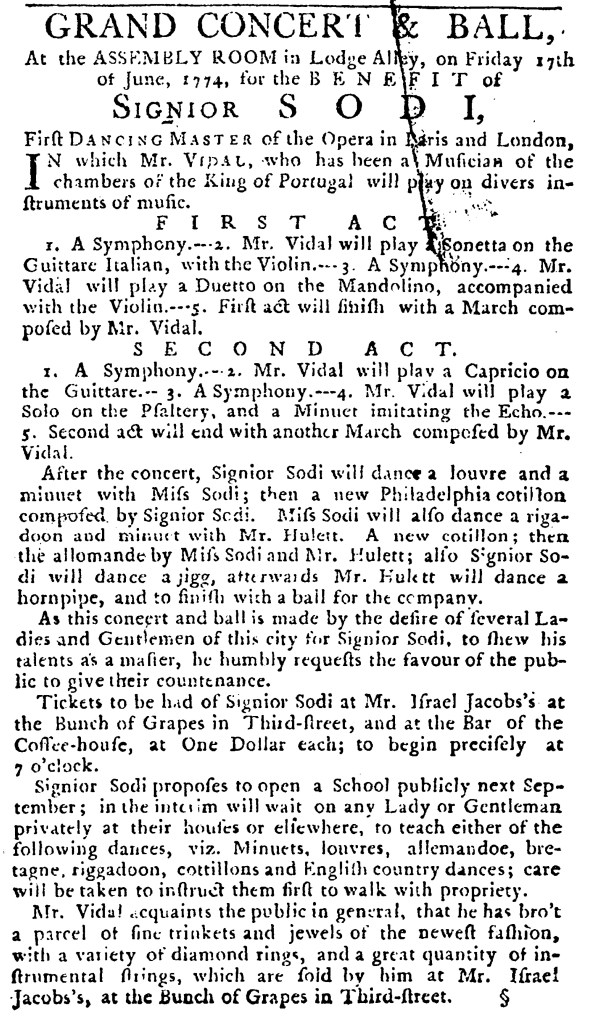
Pennsylvania Journal (June 15, 1774).

“This concert and ball is made by the desire of several Ladies and Gentlemen of this city.”

Genteel residents of Philadelphia did not want to miss the “GRAND CONCERT & BALL, At the ASSEMBLY TOOM in Lodge Alley” on June 17, 1774.  At least that was the intention of Signior Sodi, “First DANCING MASTER of the Opera in Paris and London,” when he advertised the event in the Pennsylvania Journal.  Sodi worked with “Mr. VIDAL, who has been a Musician of the chambers of the King of Portugal,” in putting together a program that included ten musical performances in two acts followed by demonstrations of Sodi’s dancing.  He claimed that he hosted the event “by the desire of several Ladies and Gentlemen of this city” who wished for him “to shew his talents as a master.”  For his part, he “humbly requests the favour of the public to give their countenance.”  To do that, the audience needed to purchase tickets, either from Sodi “at the Bunch of Grapes” on Third Street or “at the Bar” at the London Coffee House, a popular place for socializing and conducting business.

Whether or not “Ladies and Gentlemen of this city” encouraged Sodi to host a concert and ball, he used the opportunity to market other endeavors to support himself beyond ticket sales for that event.  He used the occasion to announce that he planned to “open a School” in September.  Until then, he “will wait on any Lady or Gentleman privately at their houses or elsewhere” to give lessons.  In addition to learning the steps for several dances, his students would also receive instruction “to walk with propriety.”  His pupils, Sodi suggested, would demonstrate more grace both on and off the dance floor, an important goal for colonizers anxious about so many aspects of their comportment.  Indeed, those interested in lessons from Sodi may have also taken note of lessons that Francis Daymon, “Master of the French and Latin Languages,” advertised in the same column in the Pennsylvania Journal.  Yet Sodi did not stake his entire livelihood on teaching the genteel and those aspiring to join their ranks to dance.  He also “acquaints the public in general” that he “bro’t a parcel of fine trinkets and jewels of the newest fashion, with a variety of diamond rings, and a great quantity of instrumental strings.”  He offered those items for sale at the Bunch of Grapes.  His “GRAND CONCERT & BALL” presented an opportunity for merchandising, not unlike the modern entertainment industry.

November 4

What was advertised in a colonial American newspaper 250 years ago this week?

Pennsylvania Journal (November 1, 1770).

“His house is extremely well calculated for the accommodation of GRAND and SHERIFF’S JURIES.”

Josiah F. Davenport operated an inn and tavern, the Bunch of Grapes, in Philadelphia in the late 1760s and early 1770s.  He occasionally placed newspaper advertisements, both in that in city and in New York to attract the attention of travelers who planned to visit for business or pleasure.  When he commenced operations, Davenport focused on the amenities in his marketing efforts.  He promoted the quality of the neighborhood, the food and drink served at the inn, the convenient stables, and the customer service extended to all guests.  His advertisements often included a woodcut depicting a bunch of grapes, a logo that supplemented his branding efforts.

In an advertisement in the November 1, 1770, edition of the Pennsylvania Journal, Davenport deployed another marketing strategy.  Rather than entice individual visitors, he invited groups to make use of his facilities.  The innkeeper proclaimed that “his house is extremely well calculated for the accommodation of GRAND and SHERIFF’S JURIES.”  Davenport suggested that he had already established a foothold in that market, asserting that such juries had “honoured him with their commands for two years past.”  Based on when his advertisements indicate he began operations, Davenport had been serving those patrons almost from the start even if he did not incorporate that part of his business model into his advertisements until the fall of 1770.

For all of his customers, the innkeeper pledged “his constant and unwearied attention to give them satisfaction” and promised that he “furnish[ed] himself with everything necessary for that purpose.”  He hoped that such hospitality would attract the attention of colonists planning meetings, realizing that providing accommodations for groups generated greater revenues than working solely with individual patrons.  Davenport likely figured that guests who stayed there on business would choose his house of entertainment over competitors on other occasions.  That juries would select the Bunch of Grapes also enhanced the establishment’s reputation.  Before the hospitality industry became the distinct segment of the economy that it is today, Davenport identified the benefits of promoting his inn and tavern as an attractive location for meetings and events.

June 26

What was advertised in a colonial American newspaper 250 years ago this week?

Jun 26 - 6:23:1768 Pennsylvania Gazette
Pennsylvania Gazette (June 23, 1768).

“The BUNCH of GRAPES.”

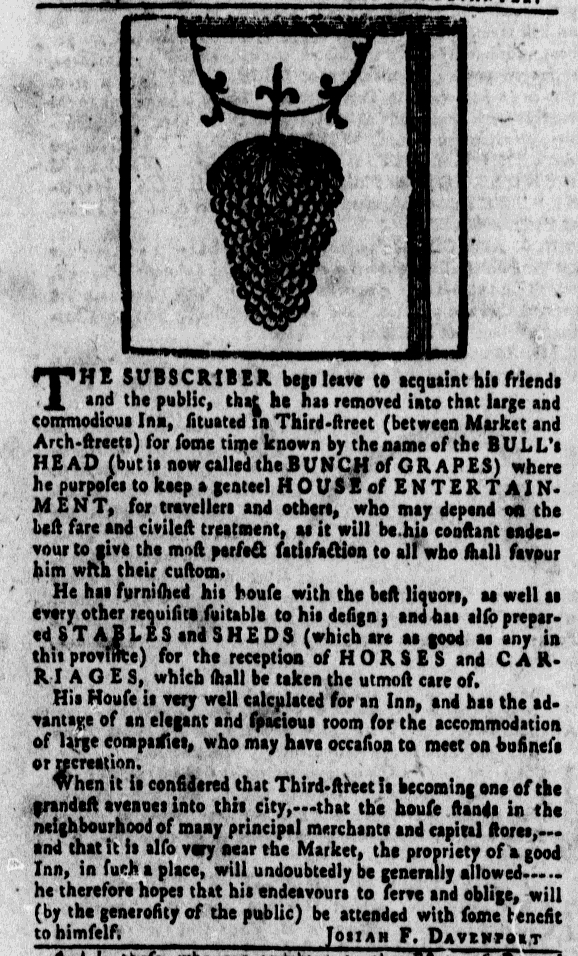
When Josiah F. Davenport opened the Bunch of Grapes inn and tavern in Philadelphia in the late spring of 1768 he placed advertisements in newspapers published in both New York and Philadelphia, alerting travelers and local residents alike to the many entertainments and amenities he provided. Davenport’s first advertisements in the Pennsylvania Chronicle included a woodcut that presumably depicted the sign that marked the location of his establishment: a bunch of grapes suspended from a signpost. Such a specialized woodcut, specific to Davenport’s business, certainly enhanced the advertisement and increased the probability that it would attract the attention of potential patrons, but it was also an additional expense. Unlike the woodcuts of horses, houses, ships, and slaves that were part of any newspaper printer’s collection of type, other woodcuts that appeared in eighteenth-century advertisements belonged to the advertisers who had commissioned them.

Such was the case with Davenport’s woodcut that replicated his sign. He likely considered it an important investment when it came to building his brand, especially since the Bunch of Grapes occupied an inn “for some time known by the name of the BULL’s HEAD.” The success of his new enterprise depended in part on those previously familiar with the former tavern now associating the same location with the Bunch of Grapes. Both the sign and the woodcut aided in strengthening his brand recognition among residents of Philadelphia he hoped would visit his “genteel HOUSE of ENTERTAINEMNT … for the best fare and civilest treatment,” whether they gathered for “business or recreation.”

Yet there were limits to how much Davenport considered necessary to invest in visual representations of his brand. He did not commission separate woodcuts to accompany his advertisements that appeared in newspapers published in Philadelphia. Instead, he had one woodcut that first accompanied his advertisements in the Pennsylvania Chronicle before reappearing in advertisements in the Pennsylvania Gazette. A notch or indentation in the upright portion of the signpost confirms that Davenport shuttled a single woodcut between printing offices. He was not the only advertiser who made that choice. In New York, Gerardus Duyckninck inserted his elaborate woodcut in multiple newspapers, one after the other in succession. Although an effective means of making advertisements distinctive, woodcuts incurred additional expenses. Some advertisers who commissioned them attempted to maximize the returns on their investments by rotating them through several newspapers.

June 6

What was advertised in a colonial American newspaper 250 years ago today?

Jun 6 - 6:6:1768 New-York Gazette Weekly Post-Boy
New-York Gazette: Or, the Weekly Post- Boy (June 6, 1768).

“His House is very well calculated for an Inn.”

When Josiah F. Davenport opened an inn on Third Street in Philadelphia, he advertised in newspapers published in both Philadelphia and New York. Doing so made sense since he billed “the Bunch of Grapes” as “a genteel House of Entertainment, for Travellers and others, who may depend on the best Fare and civilest Treatment.” Davenport positioned his tavern and inn as a destination not only for visitors to the city but also for local residents “who may have Occasion to meet on Business or Recreation.” In addition to the “best Liquors” and the “elegant and spacious” accommodations for guests, Davenport also promoted the location. He proclaimed that Third Street “is becoming one of the grandest Avenues into this City.” The Bunch of Grapes “stands in the Neighbourhood of many principal Merchants and capital Stores.” Furthermore, it was also located “very near the Market.” Visitors traveling to Philadelphia on business could lodge in an establishment close to their associates, one that also happened to be in a swank neighborhood. Local patrons could also take advantage of the convenient location for conducting business or enjoying the various entertainments at the Bunch of Grapes.

Jun 6 - 6:6:1768 Pennsylvania Chronicle
Pennsylvania Chronicle (June 6, 1768).

Davenport submitted identical copy to the New-York Gazette: Or, the Weekly Post-Boy and the Pennsylvania Chronicle (but the compositors for each made their own decisions about capitalization and italics throughout the advertisement). He also adorned the notice in the Chronicle with a woodcut depicting the sign that marked his establishment, a bunch of grapes suspended from a signpost. He acknowledged that the “large and commodious Inn” he now operated had been “for some time known by the Name of the Bull’s Head.” However, it was now known as the Bunch of Grapes under the management of the new proprietor. The new sign and an image in one of the city’s newspapers helped to cement the switch in branding for the inn. This was especially important considering that the Bull’s Head had established its own reputation for operating at that location.

Davenport realized that the success of the Bunch of Grapes depended on attracting a mixture of customers, both residents of Philadelphia who patronized his “House of Entertainment” for an afternoon or evening and visitors from other places who spent one or more nights. Accordingly, he highlighted a variety of amenities and, especially, the location of the inn in newspapers published in more than one city. Through his marketing efforts, he encouraged travelers to think of the Bunch of Grapes, rather than Philadelphia, as their destination.