
What was advertised in a colonial American newspaper 250 years ago today?
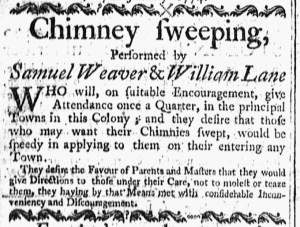
“They desire that those who may want their Chimnies swept, would be speedy in applying to them on their entering any Town.”
Samuel Weaver and William Lane worked as itinerant chimney sweeps in Connecticut in the 1770s. In addition to word-of-mouth recommendations and calling on previous customers when they arrived in town, they also inserted an advertisement in the Connecticut Gazette in their efforts to build their clientele. Although published in New London, the Connecticut Gazette circulated throughout the colony, reaching prospective clients in many towns.
In their advertisement, Weaver and Lane explained that their circuit brought them to “the principal Towns in this Colony” four times a year. Accordingly, they provided regular maintenance for those who hired their services. To keep to their schedule, they requested that “those who may want their Chimnies swept, would be speedy in applying to them on their entering any Town.” That allowed them to efficiently tend to their business in each town and then move along to the next.
The chimney sweeps concluded their notice with other guidance to their patrons. “They desire the Favour of Parents and Masters,” Weaver and Lane wrote, “that they would give Directions to those under their Care, not to molest of teaze them.” In other words, the head of the household should instruct their children, apprentices, indentured servants, enslaved people, and anyone else residing or visiting there not to bother the chimney sweeps as they went about their jobs. Weaver and Lane did not indicate what kind of abuse they had previously encountered, but apparently it merited mention in their advertisement. They did admit that they previously “met with considerable Inconveniency and Discouragement” at the hands of children and others who interfered with their work.
Weaver and Lane hoped to prevent difficulties when they accepted jobs from clients in New London and other towns. Their request appeared in a smaller font than the rest of their advertisement, perhaps the decision of the compositor who set the type or perhaps according to their instructions. They made their services the central focus of their notice, while also addressing an issue that arose often enough to deserve mentioning. The chimney sweeps primed their customers to exercise vigilance about how members of their households treated strangers providing services.