October 6

What was advertised in a colonial American newspaper 250 years ago today?
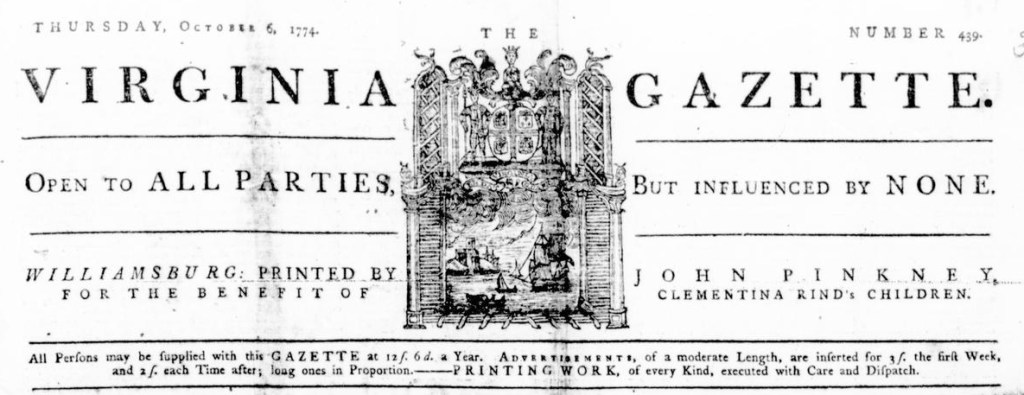
Virginia Gazette [Pinkney] (October 6, 1774).

“ADVERTISEMENTS, of a moderate Length, are inserted for 3s. the first Week.”

It was the third version of the masthead for the Virginia Gazette in three weeks.  Clementina Rind had been printing the newspaper for more than a year since her husband, William, died in August 1773.  During that time, the masthead included the title and the motto, “OPEN TO ALL PARTIES, BUT INFLUENCED BY NONE,” as well as the colophon.  It also incorporated an advertisement for subscribing, placing advertisements, and job printing undertaken in the printing office.  Placing the colophon with the masthead aided in distinguishing Rind’s Virginia Gazette from a newspaper of the same name printed by Alexander Purdie and John Dixon.  For their part, Rind’s competitors similarly presented their names in the masthead of their newspaper rather than placing the colophon at the bottom of the last page.  They did, however, reserve that space for an advertisement about subscriptions, advertisements, and job printing.

On September 22, 1774, the colophon for Rind’s Virginia Gazette stated, “PRINTED BY CLEMENTINA RIND,” for the last time.  The following week, it read, “PRINTED BY JOHN PINKNEY, FOR THE BENEFIT OF CLEMENTINA RIND’s ESTATE.”  At a glance, readers knew that a death had occurred: the thin lines that usually separated the title, motto, colophon, and advertisement had been replaced with much thicker lines that resembled the mourning borders that often appeared in early American newspapers.  Pinkney reverted to the thin lines for the October 6 edition, also updating the colophon once again.  Now it declared, “PRINTED BY JOHN PINKNEY, FOR THE BENEFIT OF CLEMENTINA RIND’s CHILDREN.”  The local news included a poem, “ON THE DEATH OF MRS. RIND,” submitted by a “CONSTANT READER.”

The conditions for subscribing remained the same.  Pinkney charged twelve shilling and six pence per year, the same price as Purdie and Dixon’s Virginia Gazette.  The fees for advertising also continued.  Customers could place notices “of a moderate Length” for three shillings for the first week and two shillings for each additional insertion.  The extra shilling in the first week covered the costs for setting the type.  As was the case in newspapers throughout the colonies, the rate changed for lengthier advertisements: “long ones in Proportion” to the base price.  Purdie and Dixon charged the same prices for advertising in their newspaper.  The advertisement in the masthead also advised, “PRINTING WORK, of every Kind, executed with Care and Dispatch.”  Publication of the Virginia Gazette continued with little disruption to subscribers and advertisers despite the death of the printer.  Pinkney had likely worked in the printing office with Rind during her tenure as printer, ready to assume responsibility for the business when she died.
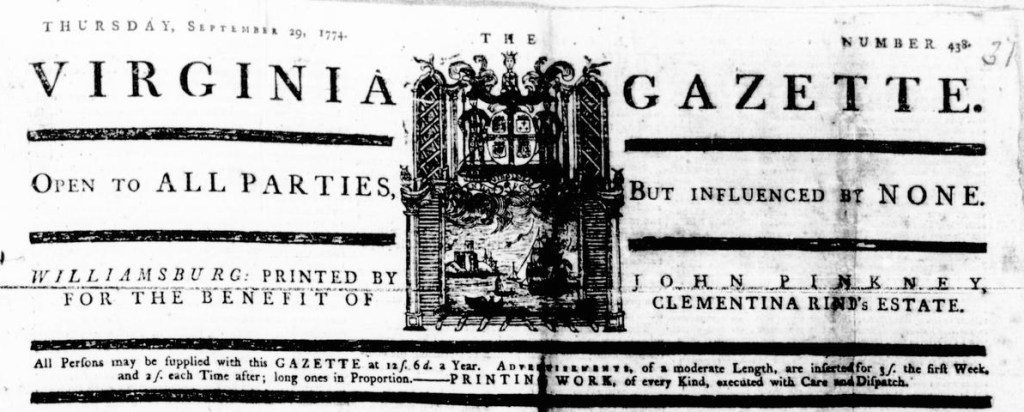
Virginia Gazette [Pinkney] (September 20, 1774).

April 17

What was advertised in a colonial American newspaper 250 years ago this week?

Virginia Gazette [Rind] (April 17, 1774).

“Advertisements, blanks, and many other kinds of printing work, she ardently hopes, may be discharged at the general courts.”

Clementina Rind printed the Virginia Gazette and operated the printing office following the death of her husband in August 1773.  That included keeping the books and calling on customers to settle accounts.  She issued such a notice in the April 14, 1774, edition of her newspaper, at the same time outlining improvements to the publication that payments would help support.  She asserted that she had “lately considerably enlarged her paper,” providing more content to subscribers and other readers.  In addition, she ordered and “expect[ed] shortly an elegant set of types from London, … together with all other materials relative to the printing business.”  Rind expressed pride in “the dignity of her gazette” while simultaneously noting that those who owed money had a role to play in her goal of “keeping it at a fixed standard.”

To that end, she called on subscribers to submit annual payments.  In the eighteenth century, many newspaper subscribers notoriously went for years without settling accounts with printers.  Advertising revenue offset those delinquent payments, yet not all printers demanded that advertisers pay for their notices in advance, contrary to common assumptions about how they ran their businesses.  Rind’s notice suggests that she may have published advertisements on credit but does not definitively demonstrate that was the case.  She requested that customers pay what they owed for “advertisements, blanks, and many other kinds of printing work … at the general courts.”  She may have meant newspaper notices, but “advertisements” could have also referred to handbills, broadsides, and other job printing for the purposes of marketing goods and services or disseminating information to the public.  The masthead listed prices for subscriptions (“12 s. 6 d. a Year”) and advertisements “of a moderate length” (“3 s. the first Week, and 2 s. each Time after”), while also promoting “PRINTING WORK, of every Kind,” which would have included blanks (or forms for legal and commercial transactions), handbills, and broadsides, but that does not clarify what Rind meant by “advertisements” in her notice.  That other printers sometimes allowed credit for newspaper advertisements leaves open the possibility that Rind may have done so as well.  If that was the case, it made it even more imperative that advertisers discharge their debts to “enable her the better to carry on her paper with that spirit which is so necessary to such an undertaking.”

Virginia Gazette [Rind] (April 14, 1774).

August 29

What was advertised in a colonial American newspaper 250 years ago this week?

Virginia Gazette [Rind] (August 26, 1773).

“WILLIAMSBURG: Printed by CLEMENTINA RIND, at the NEW PRINTING OFFICE.”

It was the first time that Clementina Rind’s name appeared in the colophon of the Virginia Gazette, formerly published by her late husband.  William Rind died on August 19, 1773.  A week later, his widow revised the colophon to read: “WILLIAMSBURG: Printed by CLEMENTINA RIND, at the NEW PRINTING OFFICE, on the Main Street.”  Clementina continued her husband’s practice of using the colophon as an advertisement for subscriptions and advertising.  “All Persons may be supplied with this GAZETTE,” the colophon continued to inform readers, “at 12s6 per Year.  ADVERTISEMENTS of a moderate Length are inserted for 3s. the first Week, and 2s. each Time after; and long ones in Proportion.”  A thick border, indicative of mourning, separated the colophon from the rest of the content on the final page.  Similarly, mourning borders appeared in the masthead as well, alerting readers of a significant loss.

Due to a variety of factors, the death notice in digitized copy of Rind’s Virginia Gazette is not fully legible.  His fellow printers, Alexander Purdie and John Dixon, however, ran an even more extensive tribute to their former competitor in their own Virginia Gazette, though lacking mourning borders.  They first described William as “an affectionate Husband, kind Parent, and a benevolent Man” before lauding his work as “publick Printer to the Colony.”  Purdie and Dixon memorialized a colleague whose “Impartiality on the Conduct of his Gazette, by publishing the Productions of the several contending Parties that have lately appeared in this Country, cannot fail of securing to his Memory the Estee, of all who are sensible how much the Freedom of the Press contributes to maintain and extend the most sacred Rights of Humanity.”  Purdie and Dixon underscored the important contributions of all printers in paying their respects to the departed William.  They also gave an extensive account of the funeral rituals undertaken by “the ancient and honourable Fraternity of Free and Accepted Masons” in memory of “so worthy a Brother.”

Clementina printed the Virginia Gazette for thirteen months.  Following her death on September 25, 1774, John Pinkney became the printer.  Clementina was not the only female printer producing and distributing a newspaper in the colonies at the time.  In Annapolis, Anne Catherine Green and Son published the Maryland Gazette.  The widow of Jonas Green, Anne Catherine printed the newspaper upon his death, sometimes as sole publisher and sometimes in partnership with a son.  The Adverts 250 Project has also traced some of the work of Sarah Goddard, printer of the Providence Gazette in the late 1760s.  Female printers joined their male counterparts in contributing to the dissemination of information (and advertising) during the era of the American Revolution.

Virginia Gazette [Rind] (August 26, 1773).