January 28

What was advertised in a revolutionary American newspaper 250 years ago this week?

Virginia Gazette [Dixon and Hunter] (January 27, 1776).

“I cannot publish such Advertisements as ought to have appeared this Week.”

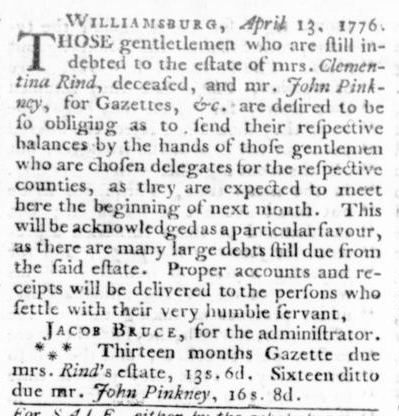
John Pinkney should have printed and distributed an edition of his weekly newspaper, the Virginia Gazette, on January 27, 1776, but he did not.  Instead, he placed a notice in the newspaper printed by John Dixon and William Hunter, also named the Virginia Gazette.  “AFTER having received so many Instances of public Favour,” he explained, “I should think myself inexcusable did I not make known the Reason why I do not this Week publish a Gazette.”  It turned out that he experienced the same disruption in his supply of paper that many other printers faced during the first year of the Revolutionary War.  He did not publish a new issue “owing to a Disappointment in receiving Paper from the Northward.”  In their own notice on the next page, Dixon and Hunter confirmed that “a stock of printing-paper … at this time is very scarce” and acquiring it involved “an infinite deal of trouble and expence in transporting it from Pennsylvania.”  Pinkney claimed that “no human Prudence could have prevented” the situation.

He also informed readers that “Next Week … or in a short Time, I expect a very considerable Quantity” and when it arrived he would “endeavour to make up for all Deficiencies.”  Through “unwearied Diligence,” he would continue to collate and disseminate items of “instructive Amusement” and “every Piece of authentic Intelligence.”  He concluded with an acknowledgement for advertisers: “It gives me the greatest Uneasiness that I cannot publish such Advertisements as ought to have appeared this Week, but as far as a Restitution of Money can atone for the Disappointment, it shall be made.”  Advertising was an important revenue stream for most printers who published newspapers.  This “Restitution of Money” put Pinkney in an even more precarious position, especially since Dixon and Hunter indicated that paper “cannot be had without cash.”  Pinkney could not purchase paper on credit.  He managed to get his hands on enough paper to print a new issue on February 3, as promised in his notice, but most likely did not continue printing for long after that.  The February 3 edition is the last known.  Disruptions in Pinkney’s supply of paper likely played a significant role in his Virginia Gazette folding.

October 6

What was advertised in a colonial American newspaper 250 years ago today?
Virginia Gazette [Pinkney] (October 6, 1774).

“ADVERTISEMENTS, of a moderate Length, are inserted for 3s. the first Week.”

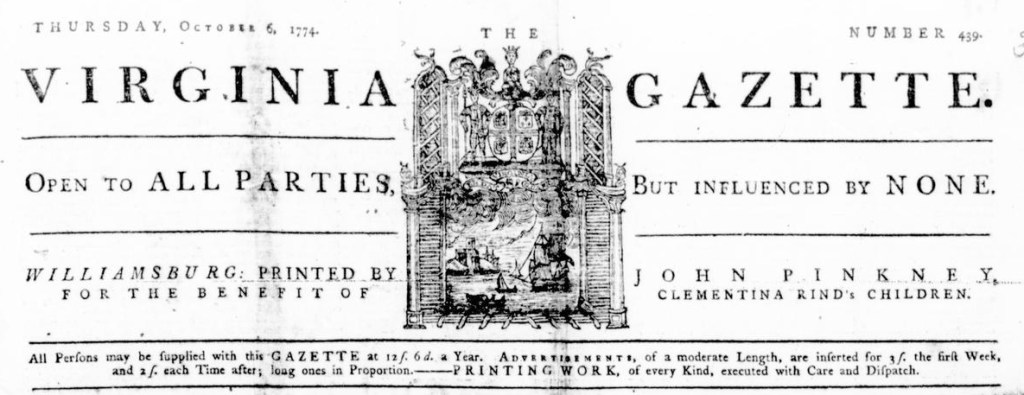
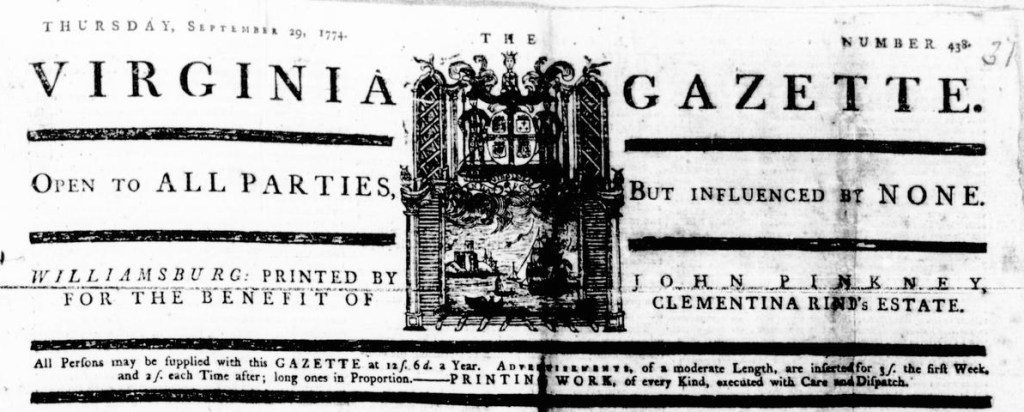
It was the third version of the masthead for the Virginia Gazette in three weeks.  Clementina Rind had been printing the newspaper for more than a year since her husband, William, died in August 1773.  During that time, the masthead included the title and the motto, “OPEN TO ALL PARTIES, BUT INFLUENCED BY NONE,” as well as the colophon.  It also incorporated an advertisement for subscribing, placing advertisements, and job printing undertaken in the printing office.  Placing the colophon with the masthead aided in distinguishing Rind’s Virginia Gazette from a newspaper of the same name printed by Alexander Purdie and John Dixon.  For their part, Rind’s competitors similarly presented their names in the masthead of their newspaper rather than placing the colophon at the bottom of the last page.  They did, however, reserve that space for an advertisement about subscriptions, advertisements, and job printing.

On September 22, 1774, the colophon for Rind’s Virginia Gazette stated, “PRINTED BY CLEMENTINA RIND,” for the last time.  The following week, it read, “PRINTED BY JOHN PINKNEY, FOR THE BENEFIT OF CLEMENTINA RIND’s ESTATE.”  At a glance, readers knew that a death had occurred: the thin lines that usually separated the title, motto, colophon, and advertisement had been replaced with much thicker lines that resembled the mourning borders that often appeared in early American newspapers.  Pinkney reverted to the thin lines for the October 6 edition, also updating the colophon once again.  Now it declared, “PRINTED BY JOHN PINKNEY, FOR THE BENEFIT OF CLEMENTINA RIND’s CHILDREN.”  The local news included a poem, “ON THE DEATH OF MRS. RIND,” submitted by a “CONSTANT READER.”

The conditions for subscribing remained the same.  Pinkney charged twelve shilling and six pence per year, the same price as Purdie and Dixon’s Virginia Gazette.  The fees for advertising also continued.  Customers could place notices “of a moderate Length” for three shillings for the first week and two shillings for each additional insertion.  The extra shilling in the first week covered the costs for setting the type.  As was the case in newspapers throughout the colonies, the rate changed for lengthier advertisements: “long ones in Proportion” to the base price.  Purdie and Dixon charged the same prices for advertising in their newspaper.  The advertisement in the masthead also advised, “PRINTING WORK, of every Kind, executed with Care and Dispatch.”  Publication of the Virginia Gazette continued with little disruption to subscribers and advertisers despite the death of the printer.  Pinkney had likely worked in the printing office with Rind during her tenure as printer, ready to assume responsibility for the business when she died.

Virginia Gazette [Pinkney] (September 20, 1774).