
What was advertised in a revolutionary American newspaper 250 years ago this week?
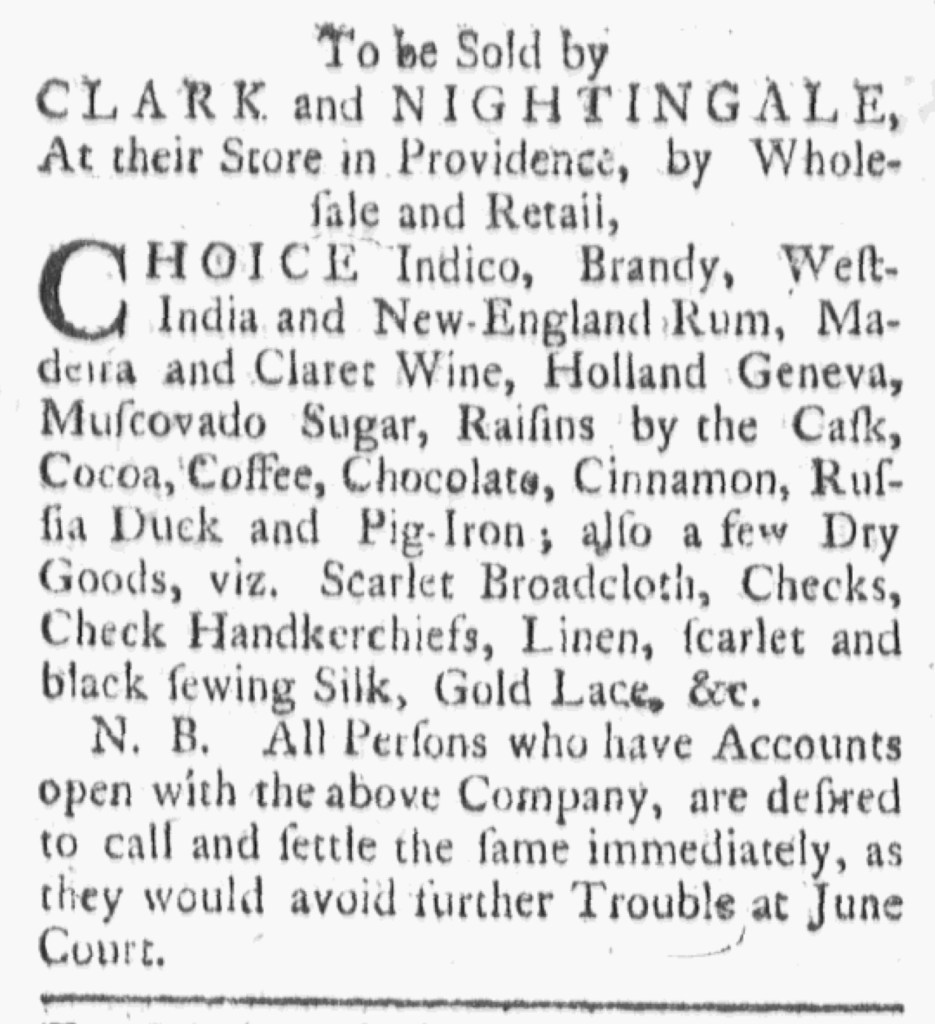
“Rasins by the Cask, Cocoa, Coffee, Chocolate, [and] Cinnamon.”
In the spring of 1776, the partnership of Clark and Nightingale advertised a variety of commodities available “At their Store in Providence, by Wholesale and Retail.” Their inventory included “Muscovado Sugar, Rasins by the Cask, Cocoa, Coffee, Chocolate, [and] Cinnamon.” Among the beverages they listed, tea was conspicuously absent. That popular beverage had been so thoroughly politicized that it disappeared from newspaper advertisements.
Does this explain the rise of coffee as the more popular beverage in America? Historian Michelle Craig McDonald, author of Coffee Nation: How One Commodity Transformed the Early United States, cautions that we should not be too hasty in reaching that conclusion. Yes, the Tea Act angered colonizers to the point that members of the Sons of Liberty disguised as Indigenous Americans dumped tea into Boston Harbor in December 1773 and residents of cities and towns throughout the colonies gathered for the ritual destruction of their own tea in bonfires. That could have been the opening for coffee to eclipse tea in popularity. For a time, coffee did become a substitute for tea. McDonald relays a story of an innkeeper refusing to serve tea to John Adams but instead offering him coffee in July 1774.[1] Yet she also cautions, as she did in a presentation at the American Antiquarian Society, that coffee eventually became a prohibited item enumerated in nonimportation agreements. The first article of the Continental Association, a nonimportation agreement devised by the First Continental Congress that went into effect on December 1, 1774, specified that the colonizers “will not import into British America … any Molosses, Syrups, Paneles, Coffee, or Pimenta, from the British Plantations” in the Caribbean. McDonald asserts that “by 1775, coffee had become a political liability in its own right.”[2]
Yet coffee, unlike tea, did not disappear from newspapers advertisements. It seemingly did not have the same political valence as tea. In addition, as McDonald explains, “privateering stepped into the breach” by the time Clark and Nightingale advertised that they sold coffee.[3] Loopholes allowed colonizers to enjoy the beverage. In general, consumers never completely abstained from consuming tea or coffee. Too much evidence demonstrates that they continued to drink both beverages even though they pretended otherwise. Yet the notoriety associated with tea meant that it stopped appearing alongside coffee in advertisements. Despite the boycott, readers still saw coffee listed alongside other commodities.
**********
[1] Michelle Criag McDonald, Coffee Nation: How One Commodity Transformed the Early United States (Philadelphia: University of Pennsylvania Press, 2025),115.
[2] Coffee Nation, 115.
[3] Coffee Nation, 117.