April 21

What was advertised in a revolutionary American newspaper 250 years ago this week?
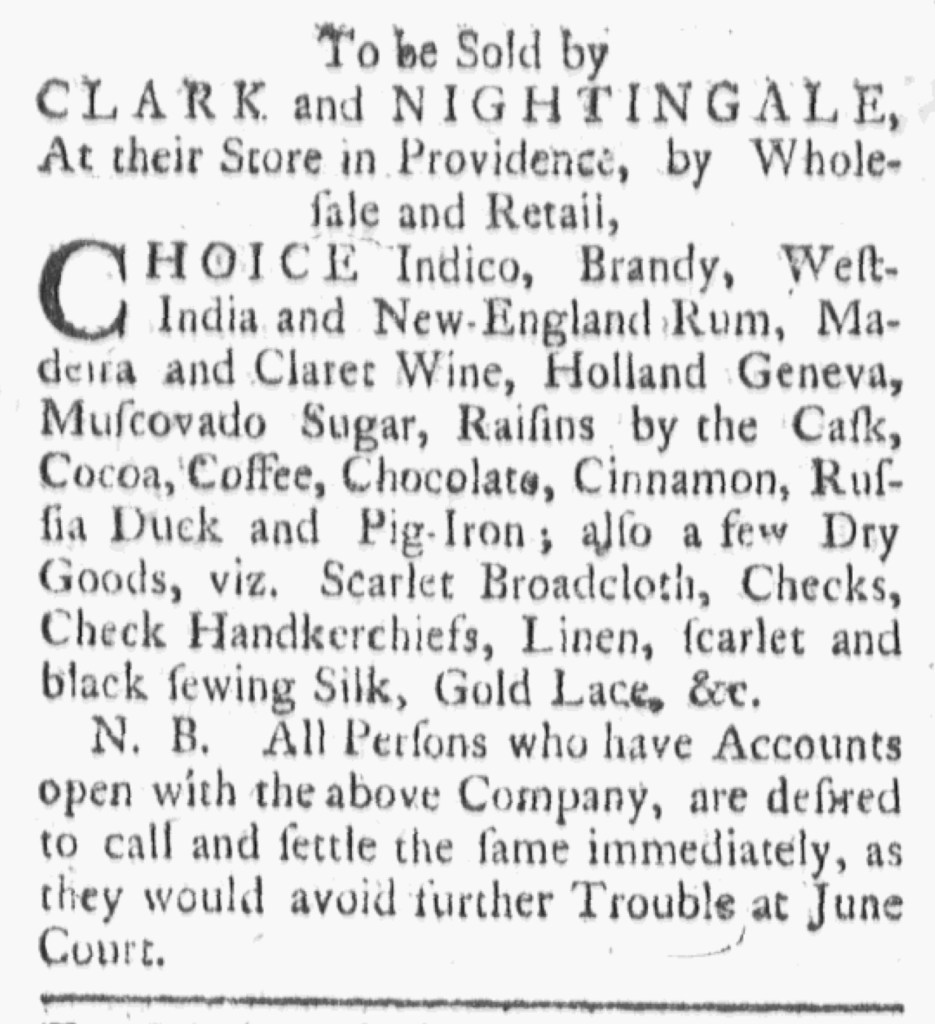
Providence Gazette (April 20, 1776).

“Rasins by the Cask, Cocoa, Coffee, Chocolate, [and] Cinnamon.”

In the spring of 1776, the partnership of Clark and Nightingale advertised a variety of commodities available “At their Store in Providence, by Wholesale and Retail.”  Their inventory included “Muscovado Sugar, Rasins by the Cask, Cocoa, Coffee, Chocolate, [and] Cinnamon.”  Among the beverages they listed, tea was conspicuously absent.  That popular beverage had been so thoroughly politicized that it disappeared from newspaper advertisements.

Does this explain the rise of coffee as the more popular beverage in America?  Historian Michelle Craig McDonald, author of Coffee Nation: How One Commodity Transformed the Early United States, cautions that we should not be too hasty in reaching that conclusion.  Yes, the Tea Act angered colonizers to the point that members of the Sons of Liberty disguised as Indigenous Americans dumped tea into Boston Harbor in December 1773 and residents of cities and towns throughout the colonies gathered for the ritual destruction of their own tea in bonfires.  That could have been the opening for coffee to eclipse tea in popularity.  For a time, coffee did become a substitute for tea.  McDonald relays a story of an innkeeper refusing to serve tea to John Adams but instead offering him coffee in July 1774.[1]  Yet she also cautions, as she did in a presentation at the American Antiquarian Society, that coffee eventually became a prohibited item enumerated in nonimportation agreements.  The first article of the Continental Association, a nonimportation agreement devised by the First Continental Congress that went into effect on December 1, 1774, specified that the colonizers “will not import into British America … any Molosses, Syrups, Paneles, Coffee, or Pimenta, from the British Plantations” in the Caribbean.  McDonald asserts that “by 1775, coffee had become a political liability in its own right.”[2]

Yet coffee, unlike tea, did not disappear from newspapers advertisements.  It seemingly did not have the same political valence as tea.  In addition, as McDonald explains, “privateering stepped into the breach” by the time Clark and Nightingale advertised that they sold coffee.[3]  Loopholes allowed colonizers to enjoy the beverage.  In general, consumers never completely abstained from consuming tea or coffee.  Too much evidence demonstrates that they continued to drink both beverages even though they pretended otherwise.  Yet the notoriety associated with tea meant that it stopped appearing alongside coffee in advertisements.  Despite the boycott, readers still saw coffee listed alongside other commodities.

**********

[1] Michelle Criag McDonald, Coffee Nation: How One Commodity Transformed the Early United States (Philadelphia: University of Pennsylvania Press, 2025),115.

[2] Coffee Nation, 115.

[3] Coffee Nation, 117.

September 10

What was advertised in a colonial American newspaper 250 years ago today?

Sep 10 - 9:10:1768 Providence Gazette
Providence Gazette (September 10, 1768).

“The Sign of the Elephant.”

Richard Jackson and John Updike informed prospective customers that their shop was located at “the Sign of the Elephant, opposite John Angell’s, Esq,” in an advertisement in the September 10, 1768, edition of the Providence Gazette. Elsewhere on the same page, Clark and Nightingale also used the combination of shop sign and landmarks to denote their location: “At the Sign of the Fish and Frying-Pan, opposite Oliver Arnold’s, Esq; near the Court-House.” Sarah Goddard and John Carter, printers of the Providence Gazette, did not list their location in either of the advertisements they inserted in the issue, but the colophon stated that “the Sign of Shakespear’s Head” adorned their printing office. Joseph Russell and William Russell also did not indicate their location in their advertisements in the September 10 issue, but these prominent merchants regularly ran other advertisements that told readers to seek them out at “the Sign of the Golden Eagle, near the Court-House.” Collectively, these advertisers paint a portrait of some of the sights colonists would have seen as they traversed the streets of Providence in the late 1760s.

Jackson and Updike marketed many of the same goods as Clark and Nightingale. Both sets of partners led their advertisements with “English and India Goods” before providing more complete accountings of their various sorts of merchandise. In selecting the visual images to identify and, in effect, brand their shops, however, they opted for different strategies. Jackson and Updike chose an elephant, an exotic beast unlikely to have been glimpsed by the vast majority of residents of Providence. Known only to most colonists through texts and perhaps a limited number of woodcuts and engravings in circulation in the Atlantic world, the elephant conjured images of the faraway origins of the “India Goods,” including textiles, sold at Jackson and Updike’s shop. Associating their wares with the elephant linked the merchant-shopkeepers to extensive networks of exchange that reached to the other side of the globe. Clark and Nightingale, on the other hand, advanced a much more utilitarian and familiar image. Neither the fish nor frying pan required imagination on the part of readers or passersby who saw their sign, but the image did communicate that the partners competently and efficiently outfitted their customers with the necessities. Their choice of logo emphasized the practical aspects of their merchandise.

Unfortunately, very few eighteenth-century shop signs have survived. The descriptions in newspapers advertisements do not indicate whether Jackson and Updike’s elephant or any of the other signs were carved or painted, but they do testify to their presence in colonial towns and cities. They also suggest that merchants, shopkeepers, and artisans not only displayed signs to assist prospective customers navigating the streets but also sometimes adopted images intended to convey messages about their wares.