June 14

What was advertised in a colonial American newspaper 250 years ago today?

Supplement to the South-Carolina Gazette (June 14, 1773).

“A Variety of Cabinet-Work … of the newest Fashion and neatest Construction, such as were never offered for Sale in this Province before.”

Richard Magrath’s upcoming furniture sale was going to be an event, at least according to the advertisement that appeared in the supplement that accompanied the June 14, 1773, edition of the South-Carolina Gazette.  The venue, “Mr. PIKE’s LONG ROOM,” where the dancing master gave lessons and hosted balls, set the tone for the sale of a “Variety of Cabinet-Work” that included “SOPHAS, French Chairs, Conversation Stools, and Easy-Chairs, of the newest Fashion and neatest Construction.”

Magrath aimed to generate excitement and interest by creating a buzz about the sale.  He proclaimed that “the Gentry may be assured, that it will be the greatest Sale of neat Cabinet-Work ever known in this Place,” a spectacle not to be missed because furniture of such elegance and quality had “never [been] offered for Sale in this Province before.”  Magrath included an eighteenth-century version of humblebragging to entice prospective customers to attend the sale.  “The Subscriber omits giving any further Encomiums on the Construction and Neatness of the different Articles,” he proclaimed, “as he doubts not of meeting with general Approbation, from the great Encouragement and repeated Favours he has already received from most of the First Families in the Province.”  In other words, Magrath declared that he had already earned a reputation among “the Gentry” for providing them with furniture of the highest quality and the most current tastes.  He also suggested that prospective customers could enhance their status by acquiring furniture at his sale, thus joining the “First Families” or most genteel and elite colonizers in South Carolina.

Magrath also laid the groundwork for future sales, confiding that he “intends to have a Sale of neat Cabinent-Work annually.”  He demanded that readers to take note, pledging that he “will always be supplied with the newest Fashions in this Branch” as a result of “his Connection in London,” the most cosmopolitan city in the empire.  For the moment, prospective buyers could examine the items offered at the upcoming sale during viewings at Magrath’s house, selecting which they hoped to purchase at the auction in Pike’s Long Room.  Through both advertisements and viewings, Magrath wanted to generate excitement about his elegant furniture, hoping that the excitement would compound itself before and during the sale.
November 27

What was advertised in a colonial American newspaper 250 years ago this week?

New-York Gazette and Weekly Mercury (November 25, 1771).

“Every other article that fashion produces in the millenary business.”

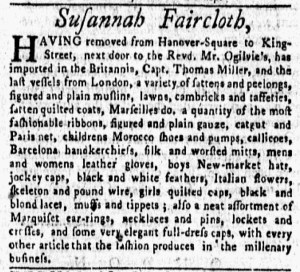
The appropriately named Susannah Faircloth sold a variety of textiles and adornments at her shop in New York in the early 1770s.  In an advertisement in the November 25, 1771, edition of the New-York Gazette and Weekly Mercury, she listed “a variety of sattens and peelongs, figured and plain muslins, lawns, cambricks and taffeties” and “figured and plain gauze,” naming an array of fabrics familiar to discerning eighteenth-century consumers.  She acquired her wares from England, having imported them “in the Britannia, Capt. Thomas Miller, and the last vessels from London.”

Faircloth and other advertisers reported such connections to the cosmopolitan center of the empire as a means of convincing prospective customers that they carried the latest fashions.  Elsewhere in the same issue, for instance, the partnership of Leigh and Price promoted goods “imported by the Britannia, Capt. Miller, and by the late Vessels from London.”  Several artisans who set up shop in New York indicated that they formerly practiced their trades in London, including Bennett and Dixon, “Jewellers, Goldsmiths, and Lapidaries, from LONDON,” James Yeoman, “WATCH and CLOCK-MAKER, from LONDON,” and Thomas Brown, “Marble Cutter, FROM LONDON.”  With so many artisans hailing from London and so many merchants and shopkeepers outfitting customers in garments and goods from London, the advertisements in the New-York Gazette and Weekly Mercury suggested to customers that they had full access to the styles of the fashionable metropolis.

Faircloth also invoked the latest tastes more explicitly.  Among her inventory, she carried “a quantity of the most fashionable ribbons.”  She concluded her advertisement with a proclamation that she also sold “every other article that the fashion produces in the millenary business.”  Prospective customers could depend on her to offer more than just goods shipped from London.  She also provided knowledge of the latest trends, a valuable resource for consumers.

July 6

What was advertised in a colonial American newspaper 250 years ago today?

Jul 6 - 7:6:1768 Georgia Gazette
Georgia Gazette (July 6, 1768).

“EVANS, TAYLOR, HABIT and CLOAK-MAKER, from LONDON.”

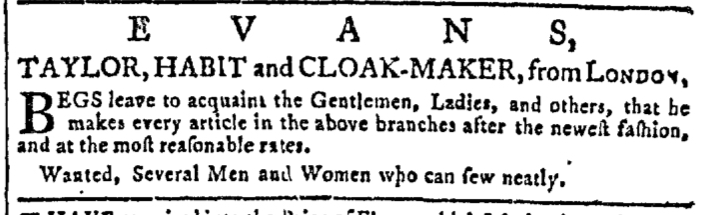
Except for the mononym, this advertisement by Evans in the July 6, 1768, edition of the Georgia Gazette was not flashy. Nor was it particularly lengthy. Yet despite the economy of prose, Evans, a “TAYLOR, HABIT and CLOAK-MAKER,” managed to work several appeals into his short advertisement. In that regard, he met the standards for advertising established by many of his contemporaries throughout the colonies.

Like many other artisans, especially those in the garments trades, he first informed prospective clients of his origins. Evans was “from LONDON,” though he did not indicate how long it had been since he had lived there or how long he had pursued his trade in that city. Still, establishing a connection to the cosmopolitan center of the empire likely afforded him some cachet among the residents of Savannah and its environs.

Asserting that connection also provided a foundation for one of his other appeals. He promised potential customers that “he makes every article in the above branches after the newest fashion.” It went without saying that he meant the newest fashion in London. The tailor played on colonists’ anxieties that they lived in a provincial backwater, one separated from the metropole not only by distance but also by taste and style. Evans assured them that when they wore his clothing that they donned the current trends not only in the largest and most sophisticated urban ports on this side of the Atlantic but also the fashions in London. Yet it was not prohibitively expensive to rival the styles in those places. Evans pledged that he charged “the most reasonable rates” for the garments he made.

The tailor incorporated a brief employment advertisement at the end of his notice: “Wanted, Several Men and Women who can sew neatly.” Doing so communicated to readers that his services were in such demand that he needed more help in his shop, not just a single assistant but instead several to handle the volume of clients he served. Just as prospective clients desired to keep up with “the newest fashion” they also derived status from having their apparel made by a popular tailor.

Evans’s advertisement may seem sparse at first glance, but the savvy tailor inserted several appeals that recommended his services to customers. Without going into great detail, he played on several currents in consumer culture already quite familiar to eighteenth-century readers.