March 21

What was advertised in a colonial American newspaper 250 years ago today?

Pennsylvania Evening Post (March 21, 1775).

“Being resolved to decline his Retail Trade … he will sell his Stock of Goods on Hand at the very lowest Rates.”

George Bartram had been in business “At the Sign of the GOLDEN FLEECE’s HEAD” in Philadelphia for several years by the time he placed an advertisement in the March 21, 1775, edition of the Pennsylvania Evening Post.  He sometimes called his establishment the Woollen-Drapery and Hosiery WAREHOUSE and used visual elements to enhance his advertisements.  For instance, a decorative border enclosed the name of his business in some advertisements while others featured a woodcut that depicted that golden fleece’s head.  Earlier in his career, he kept shop “at the Sign of the Naked Boy.”  An even more elaborate woodcut replicated that sign with a naked boy holding a yard of cloth in a cartouche in the center, flanked by rolls of fabric on either side and the proprietor’s name below them.  Bartram was still using the golden fleece’s head woodcut to adorn his advertisements in Dunlap’s Pennsylvania Packet in March 1775, but he did not have a second one to use in the Pennsylvania Evening Post.

Instead, he relied on advertising copy in making his pitch to prospective customers.  As he had often done in previous newspaper notices, Bartram emphasized the array of choices he made available to consumers, promoting a “large and fresh Assortment of MERCHANDIZE.”  To demonstrate that was the case, he inserted a lengthy list of goods, such as “Broadcloaths, of the neatest and most fashionable Colours, with suitable Trimmings,” “beautiful buff and white Hair Shags,” “rich black Paduasoys and Satins,” and “handsome Silk and Worsted Stuff for Womens Gowns.”  His intended for those evocative descriptions to entice readers.  He played to both taste and imagination by making choice a theme throughout his catalog of merchandise: “Handkerchiefs of all Sorts,” “a Variety of Cambricks suitable for Gentlemen’s Ruffles and Stocks,” “a large Assortment of brown and white Russia Sheetings and Hessians,” “an elegant Assortment of the best Moreens,” “a Quantity of the best Rugs,” and “a large Assortment of Hosiery.”

In a final nota bene, Bartram announced that customers could acquire his wares at bargain prices because he was going out of business.  He “resolved to decline his Retail trade” and “assures his Friends and the Public that he will sell his Stock of Goods on Hand at the very lowest Rates.”  He also offered a discount “to those who purchase a Quantity,” hoping that would offer additional encouragement for prospective customers.  Bartram did not indicate why he was closing his business, though the Continental Association, a nonimportation agreement adopted throughout the colonies, may have presented an opportunity to liquidate his merchandise and get rid of items that had lingered on the shelves in his Woollen Drapery and Hosiery Warehouse.  Bartram was “SELLING OFF” his inventory, offering good deals on absolutely everything.
March 12

What was advertised in a colonial American newspaper 250 years ago today?

Providence Gazette (March 12, 1774).

“As cheap … as can be bought at any Shop in NEW-ENGLAND.”

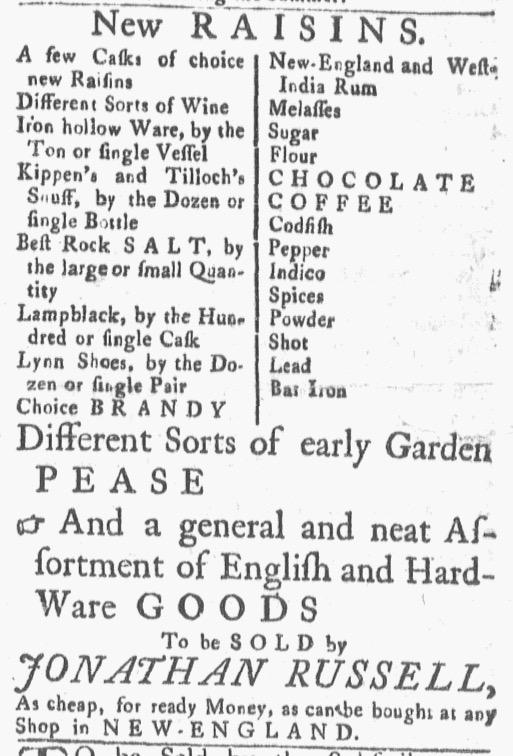
Jonathan Russell offered a variety of goods to prospective customers in his advertisement in the March 12, 1774, edition of the Providence Gazette.  The headline promised “New RAISINS.”  A list of other items appeared below the headline, followed by a note about “Different Sorts of early Garden PEASE” and another about a “general and neat Assortment of English and Hard-Ware GOODS.”  Both ran in the same size font as the headline, suggesting that Russell may have instructed the compositor to place greater emphasis on that portion of his inventory.  Although he did not enumerate the “English and Hard-Ware GOODS,” he underscored the choices available to consumers when he asserted that he stocked a “general and neat Assortment.”

Some of the items in the list of goods also attracted attention because they appeared in capital letters.  “Best Rock SALT,” “Choice BRANDY,” “CHOCOLATE,” and “COFFEE” stood out among the “Kippen’s and Tilloch’s Snuff, by the Dozen or single Bottle,” “Lampblack, by the Hundred or single Cask,” “Lynn Shoes, by the Dozen or single Pair,” flour, codfish, and other commodities.  Notably, Russell peddled “CHOCOLATE” and “COFFEE,” but did not mention tea at all. Capitalizing “CHOCOLATE” and “COFFEE” called attention to the fact that tea was absent from his inventory as colonizers continued to debate the politics of consuming that beverage just a few months after the Boston Tea Party.

Russell concluded his advertisement with an appeal to price, claiming that customers could purchase his wares “As cheap … as can be bought at any Shop in NEW-ENGLAND.”  He did not place himself in competition solely with James Green, “HILL’s ready Money Variety Store,” and other merchants and shopkeepers in Providence.  Instead, he declared that his low prices matched those in Newport, Portsmouth, and Boston.  Prospective customers did not need to visit other shops in Providence or send away to merchants and shopkeepers in other towns to get better deals.  Although not as extensive as other advertisements in the same issue of the Providence Gazette, Russell’s notice incorporated consumer choice and competitive prices and even seemed to offer political commentary for those who read carefully.

October 22

What was advertised in a colonial American newspaper 250 years ago today?

New-Hampshire Gazette (October 22, 1773).

“A neat and elegant Assortment of MERCERY, HABERDASHERY, and WOOLEN GOODS.”

Daniel Fowle, the printer of the New-Hampshire Gazette, apparently experienced some sort of disruption in his paper supply in the fall of 1773.  For several weeks, he issued a broadsheet newspaper with four columns on each side rather than the usual standard edition that consisted of three columns on each of four pages.  That meant that he delivered eight columns of news, advertising, and other contents rather than twelve.  It was not the first time in recent years that Fowle made some sort of substitution when he did not have access to sheets of the usual size.

In this instance, that meant Thomas Achincloss’s lengthy advertisement in the October 22 edition accounted for an even greater proportion of the space on the broadsheet than if it had appeared in a standard issue at some other time.  It filled half a column.  Achincloss advised readers that he recently imported and offered for sale a “neat and elegant Assortment of MERCERY, HABERDASHERY, and WOOLEN GOODS,” though most of the advertisement consisted of an extensive list of his wares.  He stocked “Calicoes, newest Patterns,” a “Genteel Assortment of Chintzes,” and “Laces, Knee Straps, [and] Necklaces, different qualities, newest and most fashionable,” along with a variety of other textiles and accessories enumerated in his notice.  Achincloss supplemented that merchandise with a “neat Assortment of Hardware,” an “assortment of Bibles and Testaments, also of various Books and Stationary Ware,” and “Men’s Saddles” and “Riding Whips.”  He presented a multitude of choices to consumers in Portsmouth and nearby towns.

Achincloss realized that promoting this selection may not have been enough to draw prospective customers to his shop.  To incite demand, he made appeals to price before and after describing his inventory.  He initially stated that he sold his goods “at a very low advance” (or only a small markup), but went into more detail in a nota bene at the end of the advertisement.  “The Public may depend, and be assured,” Achincloss declared, “that the Goods being from first Hands and Manufacturers, will be afforded upon as low terms, as any in the place can.”  In other words, Achincloss claimed that he acquired these goods directly from the producers rather than middlemen merchants.  That kept his costs low, allowing him to pass along the savings to his customers.  In turn, he set competitive prices that matched the best deals available in Portsmouth.

The amount of space that Achincloss’s advertisement occupied may have attracted attention.  Once readers perused it, they encountered an array of choices, especially among the dozens of textiles that the shopkeeper listed, as well as assurances of low prices.  In crafting this notice, Achincloss deployed some of the most common marketing strategies in use throughout the colonies.

October 20

What was advertised in a colonial American newspaper 250 years ago today?

Pennsylvania Gazette (October 20, 1773).

Sprogell is, and will be, constantly supplied with every article upon the very best terms.”

In the fall of 1773, Lodowick Sprogell took to the pages of the Pennsylvania Gazette to advertise a “GENERAL and neat assortment of GOODS, suitable to the present and ensuing season” available at his store on Second Street in Philadelphia.  To give prospective customers a sense of the selection, he listed some of his merchandise, including “mens, womens, boys, girls, and childrens stockings, of various colors,” “black silk mitts,” “worsted caps,” and “scarlet, light and dark blue, copper, London brown, copper and dark mixtures, and pearl coloured superfine, fine and coarse broadcloths.” He stocked many other kinds of textiles as well as accessors, like “buttons, buckles, [and] ribbons,” as well as “a variety of other articles.”  Like many other advertisers, Sprogell presented some of his wares and encouraged readers to use their imaginations to conjure what else they might discover when they visited his store.

The merchant also made appeals to price, noting that he acquired his inventory “upon the very best terms” and would pass along the bargains to his customers.  Before listing any of the goods, Sprogell suggested that readers could indeed afford them by stating the he was “determined to sell … at the most reasonable rates.  In a nota bene at the end of his advertisement, he reiterated this appeal, declaring that he had been “supplied with every article upon the very best terms” and, as a result, “he flatters himself that it is in his power to sell as low as can possibly be purchased elsewhere in the city.”  Among the many merchants and shopkeepers who hawked their wares in the largest city in the colonies, Sprogell vowed to set prices that matched or beat his competitors.

He also attempted to entice prospective customers with promises of future shipments, asserting that he “will be, constantly supplied” with new merchandise.  Most merchants and shopkeepers focused exclusively on goods already in their stores when they advertised, but some occasionally strove to create a sense of anticipation among prospective customers.  This also signaled that shoppers would not encounter leftovers in the coming months because Sprogrell already had a plan in place to regularly update his inventory.  In his advertisement, he looked to the future, not just the present, as an additional means of convincing consumers to take advantage of the large selection and low prices at his store.

October 12

What was advertised in a colonial American newspaper 250 years ago today?

South Carolina Gazette and Country Journal (October 12, 1773).

“A great variety of articles in the highest taste.”

In his efforts to sell his merchandise to prospective customers in Charleston and nearby town in the fall of 1773, James McCall emphasized the array of choices available at his shop.  Like many other purveyors of consumer goods, he listed many of his wares in a newspaper advertisement.  His merchandise included everything from “superfine bright scarlet broad-cloth” and “rich black Genoa velvet” to “elegant china” and “neat portmantua and other trunks” to “handsome tall candlesticks” and chamber and street lamps.”  He stocked “Morocco slippers” in a range of colors, including “red, blue, green, and yellow.”  Similarly, customers could choose “mens velvet caps, with and without tassels,” to suit their tastes.

McCall introduced consumers to his catalog of goods by describing his inventory as a “very large ASSORTMENT” and explaining that he included only certain items in his advertisement.  The list commenced with “AMONG OTHER ARTICLES” and concluded with a promise of “a great variety of articles in the highest taste.”  The word “variety” also appeared elsewhere in the advertisement, “a variety of pewter, copper, tin, and iron ware” and “writing, printing, and [a] variety of paper,” to encourage prospective customers to imagine the items on his shelves and visit his shop to see for themselves.  In addition, “&c.” (an abbreviation for et cetera), deployed more than once in the advertisement, suggested even more choices.  In case that did not lure readers, the shopkeeper expected “Further supplies in the next vessels” to arrive in port.

The competition for customers sometimes manifested itself in competitions for placing the longest newspaper advertisements.  Listing dozens of items and occupying approximately one-third of a column, McCall’s advertisement matched others that ran in the October 11 edition of the South-Carolina Gazette and the October 12 edition of the South-Carolina Gazette and Country Journal.  On other occasions, however, that advertisement would have seemed brief in comparison to those placed by other merchants and shopkeepers.  In listing so many choices, McCall and others may not have merely attempted to meet consumer demand.  Instead, they may have intended for their catalogs of goods to incite greater demand by demonstrating many of the available choices and prompting prospective customers to envision selecting among them.

August 13

What was advertised in a colonial American newspaper 250 years ago today?

New-Hampshire Gazette (August 13, 1773).

“Country Traders … will, perhaps, never again have an Opportunity of purchasing so cheap.”

For nearly two years, Ebenezer Bridgham pursued a regional advertising campaign for his “Staffordshire & Liverpool Warehouse, In King-Street, BOSTON.”  In addition to placing notices in newspapers published in Boston, he also advertised in the Essex Gazette (published in Salem), the Providence Gazette, the New-Hampshire Gazette (published in Portsmouth), the Connecticut Courant (published in Hartford), and the New-London Gazette.  He initially ran the same notice in several newspapers, but later his efforts became more sporadic.  An advertisement often appeared in newspapers in one or two towns, but not in all locations that Bridgham attempted to cultivate a clientele among consumers and, especially, retailers.  Overall, he was one of the few advertisers who attempted to serve a regional market by placing notices in newspapers in several towns in the early 1770s.

As fall approached in 1773, he once again advertised in the New-Hampshire Gazette, alerting prospective customers to the “very large and full ASSORTMENT of CROCKERY WARE” available at his warehouse.  He stocked “almost every Kind of CHINA, GLASS, DELPH, … and many other Kinds of FLINT WARE” in various colors.  To entice customers, he proclaimed that he set prices “little more than the Sterling Cost.”  In other words, when they made purchases at the Staffordshire and Liverpool Warehouse they did not pay a significant markup for imported goods.  Consumers regularly encountered claims about low prices, so Bridgham demonstrated his motivation to offer bargains.  He announced that he was “Intending soon for GREAT-BRITAIN” and wished to settle accounts before his departure.  That also meant reducing his inventory as much as possible, prompting him to offer good deals to his customers.

Bridgham concluded with a note to “Country Traders” in New Hampshire, informing them that they “would find a very great Advantage in immediately supplying themselves from said Store.”  The merchant asserted that retailers “will, perhaps, never again have an Opportunity of purchasing so cheap.”  With such bargains, they could increase their own sales and generate more revenue as they passed along the savings to their own customers.  Bridgham combined appeals to price and consumer choice in his advertisement in hopes of convincing shopkeepers and others to acquire “CROCKERY WARE” and other items from him rather than other merchants.

June 11

What was advertised in a colonial American newspaper 250 years ago today?

New-Hampshire Gazette (June 11, 1773).

“They are determined to sell as low for Cash as can be bought in any Part of the Province.”

George Bell and Company sold a variety of goods at their shop in Newmarket.  In an advertisement in the June 11, 1773, edition of the New-Hampshire Gazette, Bell and Company promoted a “large and general Assortment of English, India and Scotch Goods” recently imported into the colony.  To entice prospective customers, they listed some of those items, including textiles (“Calicoes, Crapes, Taffity’s, Cambricks, and Lawns, flower’d and plain”), “a fine Assortment of Ribbons of the newest Patterns,” and a “fine Assortment of crockery and hard Ware.”  Bell and Company could have published an even more extensive catalog of their inventory, but they instead confided that they stocked “many other Articles, too tedious to mention” … but not too tedious for consumers to browse in their shop.

In addition to emphasizing such an array of choices, Bell and Company made an appeal to price, asserting that they “are determined to sell as low for Cash as can be bought in any Part of the Province.”  Located in Newmarket, a bit to the west of Portsmouth, they sought to assure prospective customers, especially those in the countryside, that they did not need to visit the colony’s primary port to get the best bargains.  Although Bell and Company may have assumed some additional expenses in transporting the imported goods to Newmarket compared to their competitors in Portsmouth, they aimed to convince consumers that they absorbed those costs rather than passing them along to their customers.  Their proclamation also served as an invitation to haggle over the prices to give Bell and Company opportunities to match the deals offered at shops in Portsmouth and elsewhere in the colony.  They did not explicitly state that they matched prices, but declaring that they “are determined to sell as low … as can be bought in any Part of Province” suggested that they would at least consider adjusting their prices if customers alerted them to better deals.

As was often the case in newspaper advertisements placed by colonial merchants and shopkeepers, appeals to low prices and consumer choice appeared in combination in Bell and Company’s advertisement.  They gave prospective customers multiple reasons to visit their shop as part of their shopping experience.

May 14

What was advertised in a colonial American newspaper 250 years ago today?

New-Hampshire Gazette (May 14, 1773).

“Will be sold … as low as at any Store or Shop in America.”

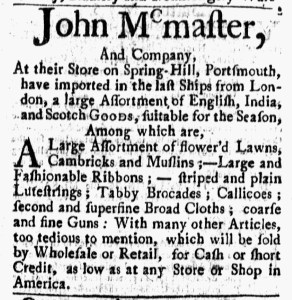
Among the advertisements and notices in the May 14, 1773, edition of the New-Hampshire Gazette, John McMaster and Company promoted a “large Assortment of English, India, and Scotch GOODS” recently received via “the last Ships from London.”  They invited prospective customers to visit their store in Portsmouth to examine their “Large Assortment of flower’d Lawns, Cambricks and Muslins,” “striped and plain Lutestrings,” and “Tabby Brocades.”  In addition to textiles, McMaster and Company stocked “Large and Fashionable Ribbons,” “coarse and fine Guns,” and “may other Articles, too tedious to mention.”  Advertisers often used that phrase to entice curious readers to browse their merchandise.

Beyond providing an array of choices to consumers, McMaster and Company called attention to their prices, proclaiming that their customers could acquire these goods “as low as at any Store or Shop in America.”  They did not merely compare their prices to those set by local competitors in and near Portsmouth.  Instead, they boldly declared that neither consumers who purchased on their own behalf nor retailers who bought to sell again would not find better deals anywhere else, not even in the much larger ports of Boston, Charleston, New York, and Philadelphia.  McMaster and Company were not alone in making that claim.  In another advertisement, an entrepreneur who identified himself as McIntyre but did not give a first name hawked “CHINA and EARTHEN WARE” available at “his Store near the Market.”  He asserted that he charged prices “as cheap as sold in America.”

Both McMaster and Company and McIntyre attempted to leverage promises of good deals, indeed the best deals possible, to induce prospective customers to imagine themselves purchasing their wares.  They whet readers’ appetites with allusions to a “large Assortment” or “Good Assortment” of merchandise and then presented their low prices, the lowest anywhere, as the means of satisfying those appetites.

April 19

What was advertised in a colonial American newspaper 250 years ago today?

Boston Evening-Post (April 19, 1773).

Those who are acquainted with his Prices, will not need to be told that he sells at low Rates.”

Samuel Eliot made consumer choice and low prices the centerpieces of the advertisement he inserted in the April 19, 1773, edition of the Boston Evening-Post.  He first established that he stocked a “very fine Assortment of English and India Piece GOODS.”  He also stated that his inventory included a “Variety of Genteel Looking-Glasses” as well as “Stationary, Cutlery, and Hard Ware.”  He did not provide as extensive a list of individual items as Caleb Blanchard did for his “large and general Assortment of English and India GOODS” or Daniel Waldo did for his “compleat Assortment of London, Bristol, Birmingham, and Sheffield Hard Ware Goods,” but he did conclude with “&c. &c.” (an abbreviation for et cetera) to indicate that he sold goods beyond those that appeared in his advertisement.

Rather than listing dozens of items like some of his competitors, Eliot devoted more attention to promoting his prices.  In a paragraph that appeared in italics, he declared, “Those who are acquainted with his Prices, will not need to be told that he sells at low Rates.”  Even though they did not need to be told, Eliot offered a reminder that simultaneously presented an opening for elaborating on his prices for “those who are not” already aware of the bargains he offered.  He invited them “to call on him,” confidently asserting that once they visited his shop near Dock Square or his store on Wilson’s Lane they “shall be satisfied he makes no idle Profession, when he engages to sell his Goods on the most reasonable Terms.”  Eliot suggested that he set such low prices that many consumers already associated good deals with his merchandise.  For those not already aware, he issued a challenge to confirm his “low Rates” for themselves.  Getting prospective customers into one of his locations, Eliot likely surmised, increased the chances of making sales, especially if his prices were indeed as low as he suggested.  Other merchants and shopkeepers, like Ebenezer Storer, made passing references to “the lowest Rates” for their goods.  Eliot, in contrast, encouraged engagement with readers of the Boston Evening-Post by creating a narrative around his prices.

February 18

What was advertised in a colonial American newspaper 250 years ago today?

New-York Journal (February 18, 1773).

“With many other articles too numerous for an advertisement.”

Samuel Deall sold a variety of merchandise at his shop on Broad Street in New York in 1773.  In an advertisement in the February 18 edition of the New-York Journal, he listed only some of his wares, informing prospective customers that he carried “a large assortment of haberdashery and hosiery of all sort,” “Gentlemen and Ladies gloves of all sorts,” “gilt, bordered and plain message cards,” “Bayley’s boxes of improved soap with brushes for shaving,” “fine tooth brushes,” and “the fine new invented Cakes for shining liquid blacking for shoes and boots.”  The merchant listed a variety of other items and concluded by noting that he stocked “many other articles too numerous for an advertisement.”

In adopting that means of suggesting that he offered a wide array of choices to consumers, Deall deployed a strategy popular among merchants and shopkeepers.  Elsewhere in that issue of the New-York Journal, several other advertisers published short catalogs of their merchandise and added that space did not permit them to go into even greater detail.  For instance, Robert G. Livingston, Jr., stated that he sold “Sundry other goods in the store way, too tedious to mention.”  Similarly, Wigglesworth, Kent, and Company concluded their litany of goods with a promise that they had “many other Articles too tedious to enumerate.”  William Wikoff once again placed his advertisement that enticed consumers with “many more articles, too tedious to insert” in the newspaper.  Gerardus Duycknick ended his advertisement for his Universal Store, so named because he supposedly stocked everything, with a note about “a Variety of other Articles … too tedious to mention.”

Each of these advertisers used lists of goods to demonstrate some of the choices they made available to customers.  To enhance those lists, each also suggested that going into greater detail in a newspaper advertisement was neither practical nor entertaining.  Instead, they implied that prospective would have more satisfying and enjoyable experiences by visiting their stores, browsing their merchandise, and seeing for themselves the many choices that might suit their tastes and budgets.  As colonizers participated in a transatlantic consumer revolution in the eighteenth century, offering choices became one of the most popular marketing strategies deployed by merchants and shopkeepers.