April 5

GUEST CURATOR: Megan Watts

What was advertised in a colonial American newspaper 250 years ago this week?

Apr 5 - 4:4:1767 Providence Gazette
Providence Gazette (April 5, 1767).

“A FRESH and NEW Assortment of English and India Goods.”

I chose this advertisement because it specifically mentioned English products. One thing that has surprised me over the course of my research into consumer culture is how much Americans tried to emulate British society in the middle decades of the eighteenth century. This is interesting because in the 1760s and 1770s colonists had continent-wide movements to reject both British importations and government.

To understand the original interest in British goods, even so close to the American Revolution, what the products represented has to be understood. In 1767 many colonists viewed England, especially London, as very genteel and sophisticated. This idea generated a sizable demand for imported goods. The motivation for owning these goods, however useful they might have been, was not purely functional. Many colonists had a mindset like this: the more English items owned, the more refined (and wealthy) a person was. This assumption went both ways. If a colonist owned an English item, it not only boosted that person’s understanding of their personal socioeconomic status, but also affected their peers’ judgment. In addition to the material possessions, even the use of such these products came under scrutiny of fellow colonists. As the public historians at Colonial Williamsburg explain, “Those who owned the ‘right stuff’ without knowing how to use it properly gave themselves away as imposters.” The social rituals and protocols associated with many goods were complicated, and no one wanted to seem like an uncouth pretender. Overall, if colonists possessed a fashionable product, especially if it was an object associated with genteel society, they could express their real (or perceived) higher status, for just a small fee to a seller like Thompson and Arnold.

**********

ADDITIONAL COMMENTARY: Carl Robert Keyes

Price. Choice. Fashion. These were some of the most common appeals to consumers that appeared in eighteenth-century newspaper advertisements. As Megan notes, Thompson and Arnold implicitly advanced an appeal to fashion when they announced that they sold imported English goods. In addition, they made more explicit and extensive appeals to price and choice in their advertisement published in the Providence Gazette on April 4, 1767. Many advertisers merely made passing or brief mentions of the prices they charged for vast assortments of imported goods, but Thompson and Arnold made variations on these standard appeals in order to attract potential customers’ attention.

For instance, the shopkeepers did not resort to stating that they stocked an “assortment of goods.” Instead, they informed readers that their inventory included “Goods suitable for Town and Country, Winter and Summer.” In fact, they had such a broad array of merchandise that “to enumerate the Articles would take up too much Room for a News-Paper.” (Despite that protest, Thompson and Arnold previously published list-style advertisements that named dozens of imported goods they sold, and in recent months the Providence Gazette had repeatedly printed full-page advertisements for a variety of local shopkeepers, including Thompson and Arnold.) The partners boldly declared that they carried “as great a Variety of Article as can be found in any one Store in New-England.” Most advertisers promoted an assortment of goods as a means of allowing consumers to make choices that corresponded to their own tastes, choices that allowed them to make statements, as Megan notes, about their character, status, and familiarity with the rituals of gentility. Thompson and Arnold offered a different explanation for why it was significant that they carried such a vast variety of goods: “their Assortment is so large they hope to save their Customers the Trouble of going through the Town to supply themselves with the Necessaries they may want.” In presenting customers with so many goods that they “would take up too much Room” to list them in their advertisement, Thompson and Arnold underscored that they sold convenience in addition to choice, an innovative variation on one of the most common appeals in eighteenth-century advertisements.


October 27

GUEST CURATOR: Megan Watts

What was advertised in a colonial American newspaper 250 years ago today?

oct-27-10271766-boston-gazette
Boston-Gazette (October 27, 1766).

“DRUGS and Medicines of the very best Kinds.”

This advertisement caught my attention because it is unique. In reading colonial newspapers I have not seen many advertisements for medical supplies. This one includes “Syringes of all kinds” and “Bateman’s Drops,” among other things.

The advertisement made me wonder about the realities of health in the 1700s. Colonists tried to do what we still strive for now, to live a healthy life. However, that was much more difficult to do in the 1700s. Fewer medical discoveries, poor hygiene practices, and contamination of water sources contributed to an unfavorable health environment. In eighteenth-century America a mild illness could turn into a fatal ailment. Diseases, like yellow fever, were always a threat and could cause epidemics.

One example of a disease causing havoc happened in Philadelphia in the late 1700s. As Simon Finger notes, “At the end of the eighteenth century, Philadelphia found itself in the grip of an implacable horror, wracked by ‘the hurricane of the human frame.’ Yellow fever loomed like the storm.”[1] The spread of illnesses wreaked havoc on the population. Not only were residents dying from illnesses, but the economy was also affected. Finger further states that: “yellow fever returned to terrorize Philadelphia six more times, taking thousands of lives, paralyzing the port economy, and sowing the seeds of a panic.”[2]

Americans now have access to properly educated doctors, hygiene education, and clean water sources. In 2016, not many people are worried about a lethal cough or a yellow fever epidemic occurring. However, it is important to recognize the unhealthy environment colonists lived in and the health threats they faced, as it was one of the characteristics of the 1700s.

**********

ADDITIONAL COMMENTARY: Carl Robert Keyes

Peter Roberts offered a variety of conveniences for customers who purchased his “DRUGS and Medicines of the very best Kinds.” Like many other druggists (as well as some shopkeepers), he provided mail order service for those who were unable to visit his shop “opposite the West Door of the Court-House Boston.” In a nota bene he announced that “Orders by Letters from Practitioners and others, in Town or Country, will be as faithfully complied with as if they were present.”

Roberts offered another convenience less commonly promoted in eighteenth-century advertisements. Before listing the various remedies and medical equipment he stocked, the druggist stated that he “carefully prepares and puts up in the best Manner, DOCTOR’s BOXES of all sizes, with proper Directions, for Ships or private Families.” In other words, Roberts produced and sold the early modern equivalent of the first aid kit. Given that customers could choose boxes of “all sizes,” Roberts most likely allowed them to choose specific items they wished included. On the other hand, some customers probably preferred readymade boxes that included the most popular and commonly used items, leaving it to the druggist to make the selections based on his experience and expertise.

While these “DOCTOR’s BOXES” represented a convenience for his customers, they presented an opportunity for Roberts, an opportunity to increase sales and move inventory more quickly. Customers purchased individual items from Roberts and other druggists as they needed them or in anticipation of need. When Roberts assembled one these boxes, however, he could include various products that customers were less likely to select on their own or that they were less likely to imagine that they might need at some point. He could include items that customers were much less likely to purchase separately but that they would accept as part of a larger package. He bundled his products in order to distribute them in greater numbers.

Note that Roberts also sold “DOCTOR’s BOXES” for vessels going to sea as well as to “private Families.” He recognized that the local market was comprised of more than the “Practitioners” who lived in Boston and its hinterland. The city was a busy port. Potential customers were arriving and departing by ship all the time. When they were in port, they needed a variety of supplies, including the “DRUGS and Medicines” that Roberts sold.

**********

[1] Simon Finger, The Contagious City: The Politics of Public Health in Early Philadelphia (Ithaca, NY: Cornell University Press, 2012), 120.

[2] Finger, Contagious City, 120.

October 18

GUEST CURATOR: Lindsay Hajjar

What was advertised in a colonial American newspaper 250 years ago today?

oct-18-10181766-providence-gazette
Providence Gazette (October 18, 1766).

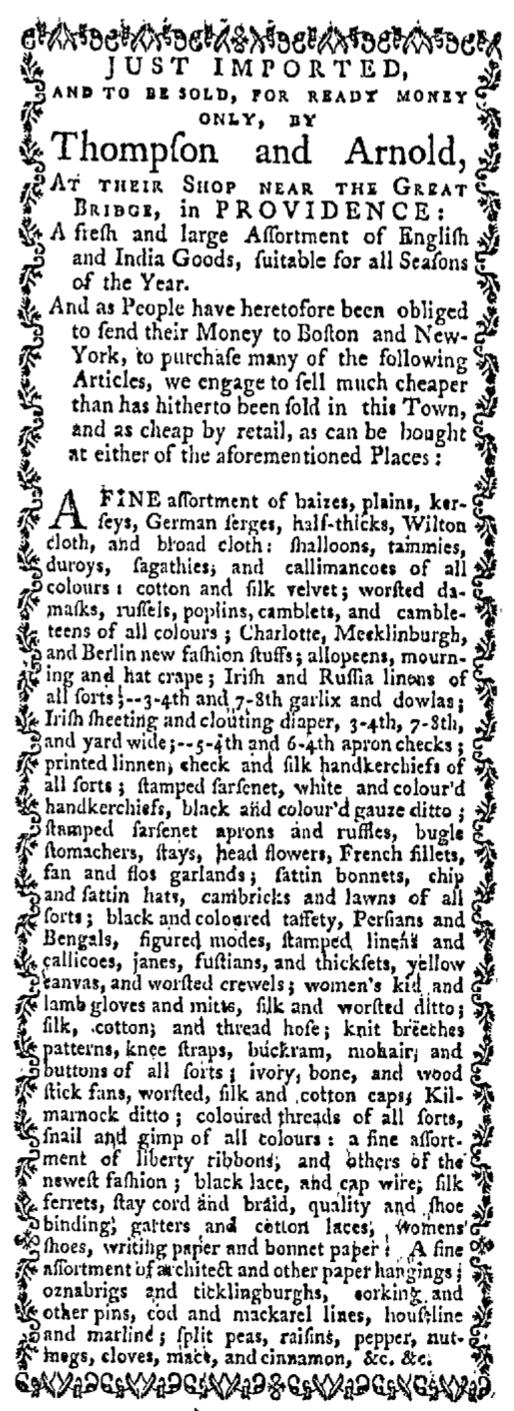
“As people have heretofore been obliged to send their Money to Boston and New-York …”

This advertisement gave a long list of much of the merchandise sold by Thompson and Arnold at their shop in Providence. The shopkeepers were looking for customers who were in a financial position that they did not need to barter or buy on credit; their imported goods were “TO BE SOLD, FOR READY MONEY ONLY.” They stated that previously the residents of Providence would have had to travel to Boston and New York to acquire many of the goods in the advertisement, but now they could come to their shop and buy them in town and for a fair price, one that was cheaper than found in Boston or New York.

They tried to entice consumers in Providence with their abundance of goods that they sold and with two other advertising techniques that are very familiar today. First, they emphasized the fact that potential customers did not have to travel far to get them. They also promised low prices. Today consumers often expect prices to be more expensive in urban place. The same was true for the colonists; being able to get these goods close to home for a reasonable price was enticing.

As a second strategy, they compared their prices to other stores in Providence with the same goods. Today, consumers love comparing pricing and trying to get the best deals. Thompson and Arnold knew that this would be an effective tactic because it would draw people in and they could end up buying more than they originally intended.

American consumers have a long history of expecting to find what they need when they need it. T.H Breen confirms this: “after the 1740s American shoppers came to expect a much larger selection, and merchants had to maintain ever larger inventories.”[1] In colonial America consumers sometimes needed to make the compromise of either getting what they wanted close to home but at an escalated price or traveling and getting a better price. Thompson and Arnold made it possible for the consumers in Providence to get both convenience and low prices.

**********

ADDITIONAL COMMENTARY: Carl Robert Keyes

For my commentary on today’s advertisement, I must once again address the project’s methodology as well as my pedagogical goals. Once again one of the guest curators has selected an advertisement that should look very familiar to regular readers. At a glance, it appears that Lindsay has selected the same advertisement that guest curator Nicholas Commesso analyzed a few weeks ago. The same shopkeepers previously published the same list of goods with the same introductory remarks (the same copy from start to finish) and the same decorative border in the same publication. On closer inspection, I uncovered only one difference between the two advertisements: a colon substituted for a period at the end of the sentence immediately before the advertisement listed the goods available at Thompson and Arnold’s shop. (I have no ready explanation for why the printer would have made this change.) Technically, that single change qualifies this as a new advertisement.

That hardly seems like a satisfactory explanation or rationale for repeating an advertisement, deviating from the usual methodology and commitment to examining a new advertisement every day. Other factors played a more significant role in my decision. First of all, Thompson and Arnold published a very robust advertisement that made multiple implicit and explicit appeals to potential customers. Nick examined some of them when he selected this advertisement, but Lindsay picked up on others. Both students learned about aspects of colonial commerce and marketing; both contributed, in different ways, to the ongoing conversation at the Adverts 250 Project. One short entry about Thompson and Arnold’s advertisement was not sufficient to do it justice. In addition, featuring this advertisement a second time also underscores the frequency that some entrepreneurs resorted to advertising. Some shopkeepers ran an advertisement just once or for just a few weeks, but others, like Thompson and Arnold, ran their advertisements so many times that readers would have recognized them on sight. Repetition likely helped to cement Thompson and Arnold’s shop in the popular imagination around Providence.

The rhythm of newspaper publishing in colonial America also influenced my decision to allow Lindsay to feature this advertisement a second time. Nineteen newspapers (that have survived and have been digitized) were published during the week that Lindsay is serving as guest curator. Monday was the most popular day for publishing newspapers, with nine of the nineteen published on Monday. Saturday was one of the least popular days. The Providence Gazette was the only newspaper regularly published on Saturdays in 1766. That means that once a week the featured advertisement for the Adverts 250 Project should come from the Providence Gazette, the only newspaper published on that day 250 years ago. No newspapers were published on Sundays. The methodology for the project requires going back to the most recently published newspaper, which means that the featured advertisement should be drawn from the Providence Gazette twice a week. This places disproportionate emphasis on the Providence Gazette, a problem compounded by the fact that it included less advertising than some other newspapers (but more than others). Other newspapers, especially those printed in Philadelphia, New York, Boston, and Charleston, could better bear that burden, but between the relative scarcity of advertisements and the tendency to run them for weeks or months, the Adverts 250 Project has pretty much exhausted the advertisements for consumer goods and services printed in the Providence Gazette in the fall of 1766. I could have insisted that Lindsay go back one day earlier to select an advertisement from the New-London Gazette (which usually had even fewer advertisements), the New-Hampshire Gazette (which also had relatively few advertisements), or the Virginia Gazette (which typically ran many advertisements that have not yet been featured here). Future guest curators will have to do so, but I determined that even though today’s advertisement repeated an earlier one (except for that colon that replaced a period!) Thompson and Arnold still had something to tell us about colonial marketing and life in early America more generally.

**********

[1] T.H. Breen, “An Empire of Goods: The Anglicization of Colonial America, 1690-1776,” Journal of British Studies 25, no. 4 (October 1986): 489.

June 4

What was advertised in a colonial newspaper 250 years ago today?

Jun 4 - 6:4:1766 Georgia Gazette
Georgia Gazette (June 4, 1766).

“He will also bake every day … any thing for dinner that may be sent to him.”

Joseph Williams promoted the bread and biscuits he baked “at his house opposite to the Dutch church,” a landmark so familiar that no other directions were necessary in Savannah in 1766. In addition to the bread and other baked goods he made each day, Williams announced that he provided an additional service: “He will also bake every day between 11 and 1 o’clock any thing for dinner that may be sent to him.” What exactly did Williams mean “any thing for dinner that may be sent to him”? Did he anticipate that patrons would send him orders that he would fulfill? Or did he envision that customers would drop off items that they had prepared but wished for him to bake in his ovens? Whatever the answer, Williams peddled more than bread and biscuits. He sold convenience to readers in Savannah, aiding them in preparing that day’s dinner, and provided a service that would have been attractive to a variety of customers, from single laborers to wives burdened with a myriad other domestic chores. Williams offered an eighteenth-century version of take-out food. In so doing, he commodified convenience.